
Qwen 3.8 Max: Alibaba’s 2.4-Trillion-Parameter Flagship Explained (Specs, Benchmarks, Price & Access)
Qwen 3.8 Max is Alibaba’s newest flagship large language model, previewed on July 19, 2026 at the World AI Conference (WAIC) in Shanghai under the model ID qwen3.8-max-preview, and its defining spec is a 2.4-trillion-parameter sparse Mixture-of-Experts design. It launched with almost no published benchmarks, so this guide separates the few confirmed facts — parameters, pricing, and access channels — from Alibaba’s marketing claim that the model is “second only to Claude Fable 5,” which remains unverified without an official benchmark table or model card.
What Is Qwen 3.8 Max?
A new flagship in the Qwen family
Qwen3.8-Max is the top “Max” tier of Alibaba’s Qwen AI model family, unveiled at WAIC Shanghai on July 19, 2026 as a preview build. It succeeds Qwen 3.7 Max (May 2026) and is Alibaba’s first Max-class model above one trillion parameters to accept multimodal input, according to developer Shuai Bai. The model sits at the peak of a lineup that also includes a smaller sibling, Qwen3.8-27B, announced at the same event.
The name comes from Alibaba’s tiered naming convention: “Max” signals the highest-capability variant in each Qwen generation, not a raw parameter count. As context, the Qwen line has been tracked on Wikipedia’s Qwen article as one of the most actively developed Chinese open-model families.
Not the same as Qwen3-8B
A common naming trap: “Qwen 3.8 Max” (a roughly 2.4-trillion-parameter flagship) is completely different from the older dense “Qwen3-8B,” which has about 8 billion parameters. Readers searching for a version number often confuse the two. The “3.8” in Qwen 3.8 Max refers to the generation version, not a parameter count, while “Qwen3-8B” literally has 8 billion weights.
Qwen 3.8 Max Specs: Parameters, Architecture, Context & Modalities
The confirmed numbers
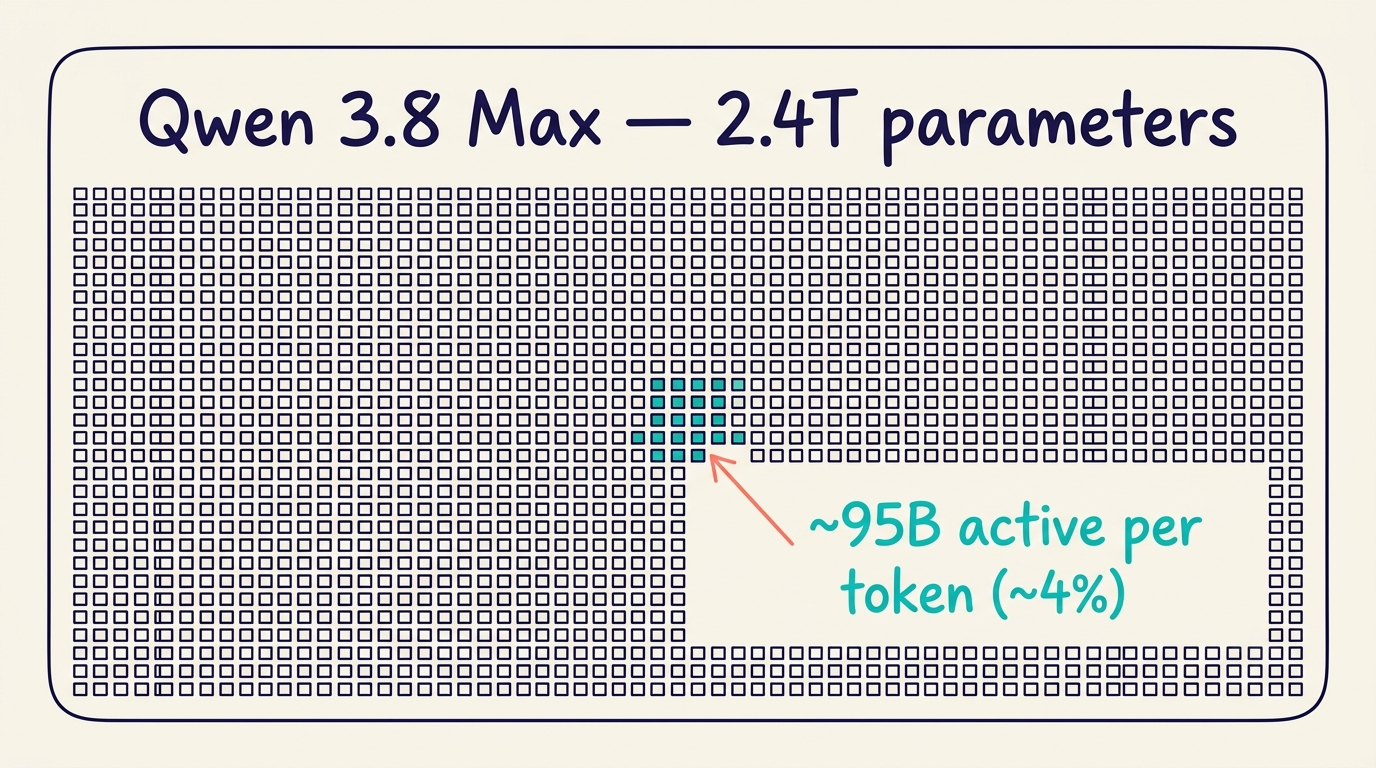
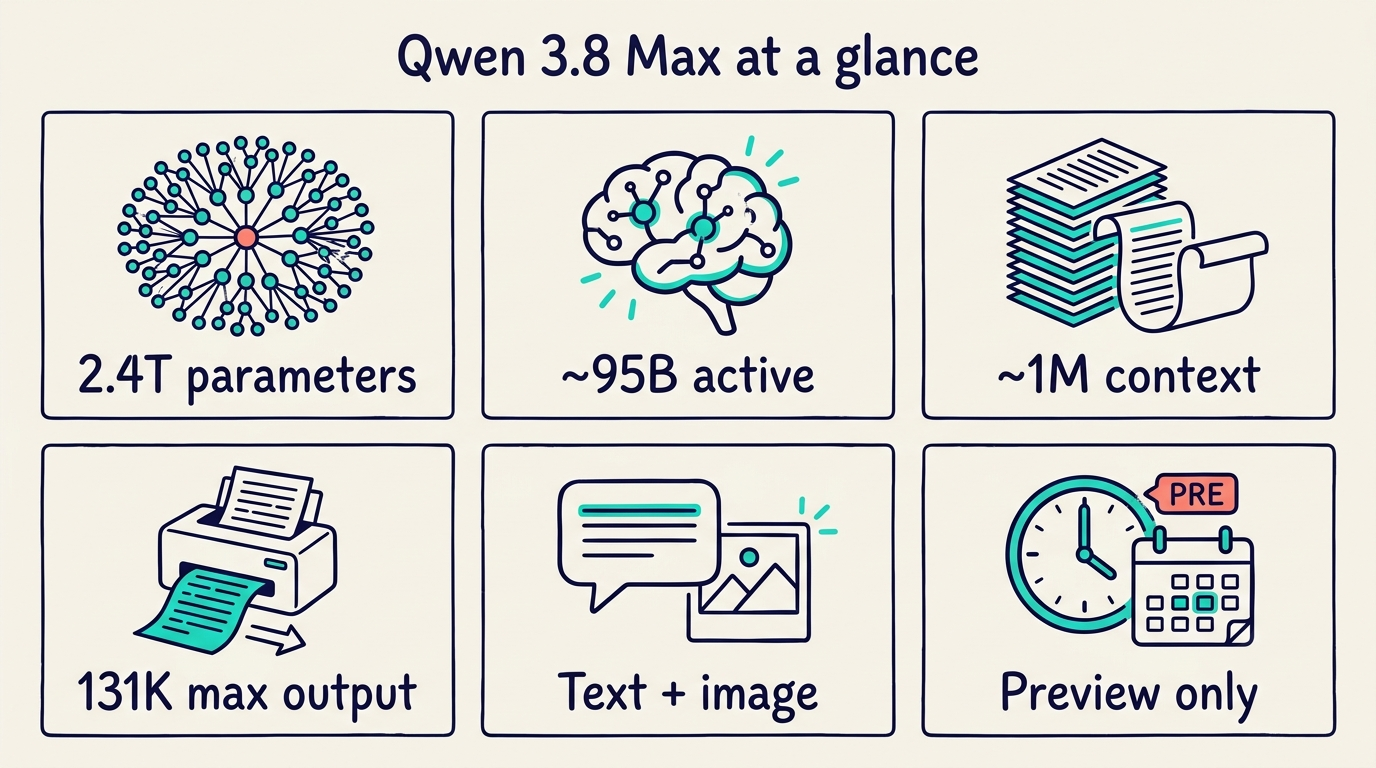
2.4 trillion total parameters is the one firmly confirmed specification, using a sparse Mixture-of-Experts (MoE) architecture that activates only about 95 billion parameters — roughly 4% — per token. This activation efficiency is central to how the model can function at inference scale without requiring every parameter to fire on every request.
| Spec | Value | Source confidence |
|---|---|---|
| Total parameters | 2.4 trillion | Confirmed |
| Active per token | ~95 billion (~4%) | Confirmed |
| Context window | 983,616 tokens (Qwen Cloud metadata); “up to 1M” (rounded in press coverage) | Reported |
| Max output | 131,072 tokens | Reported |
| Modalities | Text + image (video/doc/speech reported) | Partially confirmed |
| Reasoning effort | Low / high / xhigh (default xhigh) | Reported |
| Temperature | 0.6 | Reported |
| Parallel tool calls | Not supported (preview) | Confirmed |
The context window figure is worth flagging: Qwen Cloud’s own metadata lists 983,616 tokens, but Alibaba and several reporters round this to “up to 1M.” Both figures point to the same architecture; the precise cap depends on how the model is accessed.
What “multimodal” means here
Text and image input are confirmed in practice. Alibaba and early coverage also mention video understanding, document parsing, speech handling, and image generation — but there is no formal spec sheet confirming the complete modality list. Demonstrated uses during preview included turning screenshots into working web apps and converting 2D architectural floor plans into 3D visualizations, both of which rely on image-plus-text reasoning.
Reasoning and tool use
Reasoning in Alibaba’s 2.4T flagship is always on — you cannot turn it off, only adjust the effort level between low, high, and xhigh, with xhigh set as default. This is a design choice that trades speed for reliability on complex tasks. The model exposes both OpenAI-compatible and Anthropic-compatible API endpoints, which means existing SDKs can call it by switching the base URL. The significant preview limitation is that parallel tool calls are not yet supported, ruling out certain multi-step agentic pipelines.
According to Qwen team lead Shuai Bai, Qwen 3.8 Max is the family’s first Max-class model to cross one trillion parameters while accepting native multimodal input — a notable architectural step, though independent confirmation of the full modality list is still pending.
Qwen 3.8 Max Benchmarks: Marketing Claim vs Independent Reality
The vendor claim
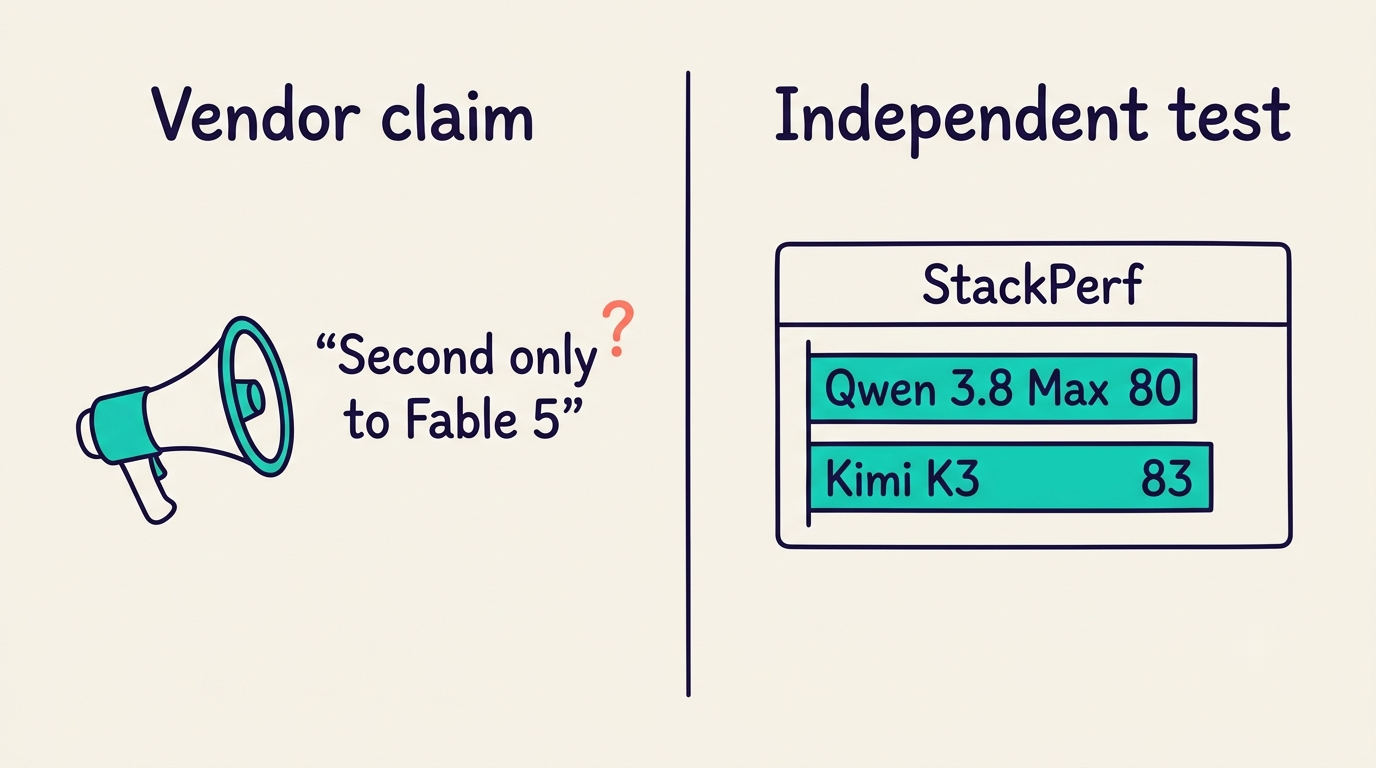
Alibaba positioned Qwen3.8-Max as “second only to Claude Fable 5” at launch — but released no accompanying benchmark table, model card, or license document. That framing should be read as an unverified marketing position. Early arena signals place it 5th on LMSYS Text Arena and 2nd on Vision Arena — these rankings are self-reported and may shift as more votes accumulate, but suggest strong image-understanding relative to text-only leaderboard position.
Head-to-head numbers that do exist
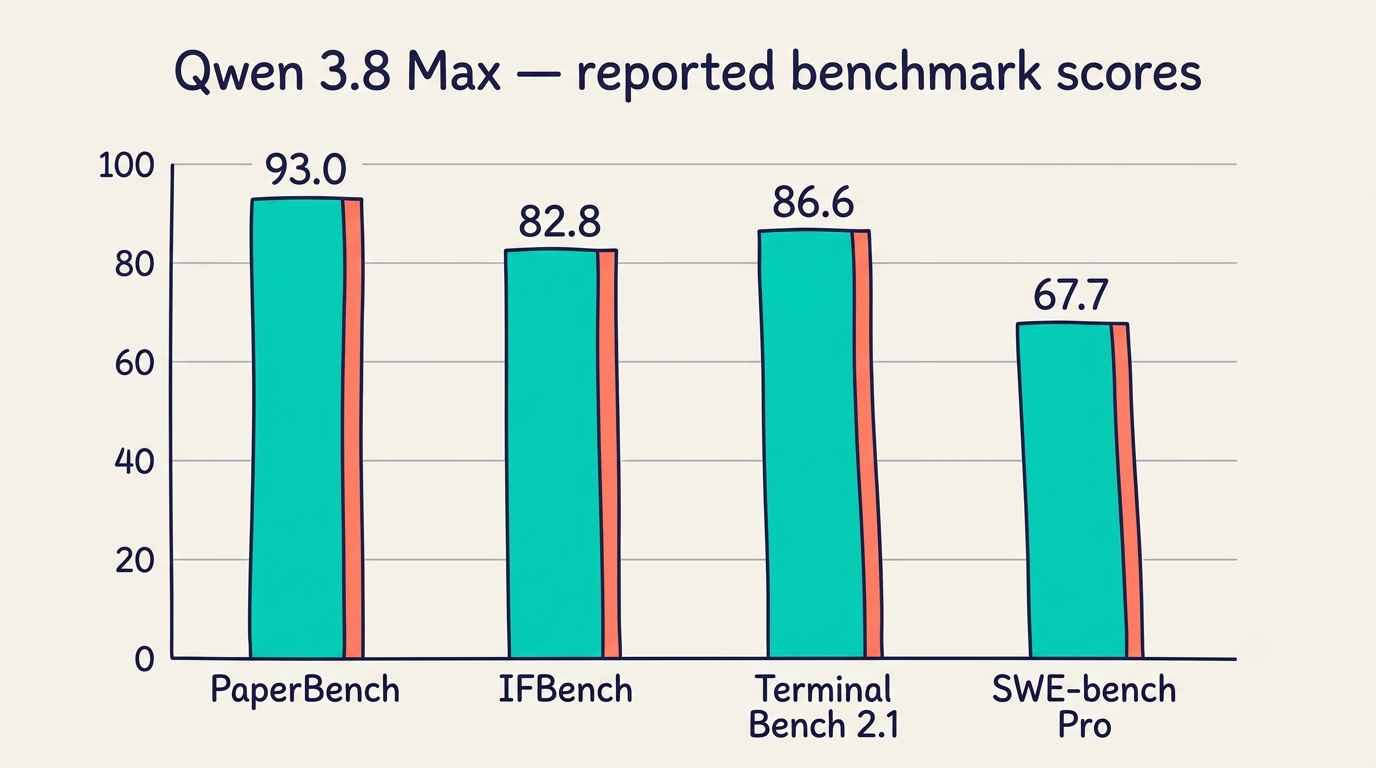
Early reported head-to-head comparisons are worth examining, with the caveat that they come from third-party coverage rather than official Alibaba documentation:
| Benchmark | Qwen 3.8 Max | GPT-5.6 Sol | Claude Fable 5 | Winner |
|---|---|---|---|---|
| PaperBench | 93.0 | 90.5 | — | Qwen |
| IFBench | 82.8 | 72.7 | — | Qwen |
| Terminal Bench 2.1 | 86.6 | 88.8 | — | GPT-5.6 Sol |
| MRCR v2 | 92.9 | 93.8 | — | GPT-5.6 Sol |
| SWE-bench Pro | 67.7 | — | 80.0 | Fable 5 |
| Humanity’s Last Exam | 43.6 | — | 53.3 | Fable 5 |
The pattern is clear: Alibaba’s 2.4T flagship is genuinely competitive on instruction-following and research tasks, but Claude Fable 5 holds a substantial lead on software engineering and hard reasoning. “Second only to Fable 5” is directionally plausible for some categories and demonstrably false for others.
The one independent test
The clearest neutral data point available is the StackPerf 269-file coding-agent test. Qwen 3.8 Max scored 80/100 versus Kimi K3’s 83/100 — three points apart. Qwen made 44 tool calls during the test with zero failures and achieved 9/10 tool-use reliability. That result places qwen3.8-max-preview as competitive, not dominant, in the coding-agent category where Alibaba’s marketing is strongest.
Qwen 3.8 Max Pricing
Preview pricing (Token Plan)
During the preview period, access is credit-based through Alibaba’s Token Plan at approximately 10% of standard rates. The plan tiers are:
- Lite — approximately $6
- Standard — approximately $18
- Pro — approximately $68
An additional discount applies during off-peak hours (22:00–08:00 UTC+8), which Alibaba appears to be using as a capacity management tool during high-demand preview windows. No official standalone per-token API price has been published as of August 2026.
Reported API rate and how it compares
One reported QwenCloud API rate is $2.00 per million input tokens, $6.00 per million output tokens, and $0.25 per million cached tokens. These figures should be treated as reported rather than officially confirmed until Alibaba publishes a formal pricing page.
| Model | Input ($/M) | Output ($/M) | Cache ($/M) | Status |
|---|---|---|---|---|
| Qwen 3.8 Max | $2.00 | $6.00 | $0.25 | Reported |
| Kimi K3 | $3.00 | $15.00 | — | Published |
| Qwen 3.7 Max | $1.25 | $3.75 | — | Published |
If the reported rates are accurate, Alibaba’s new flagship undercuts Kimi K3 substantially on output tokens — which is where costs accumulate in long-context and agentic workloads. The predecessor Qwen 3.7 Max is cheaper on input but the gap on output is notably wide.
How to Access Qwen 3.8 Max
The channels available today
There are four main routes to the model during preview:
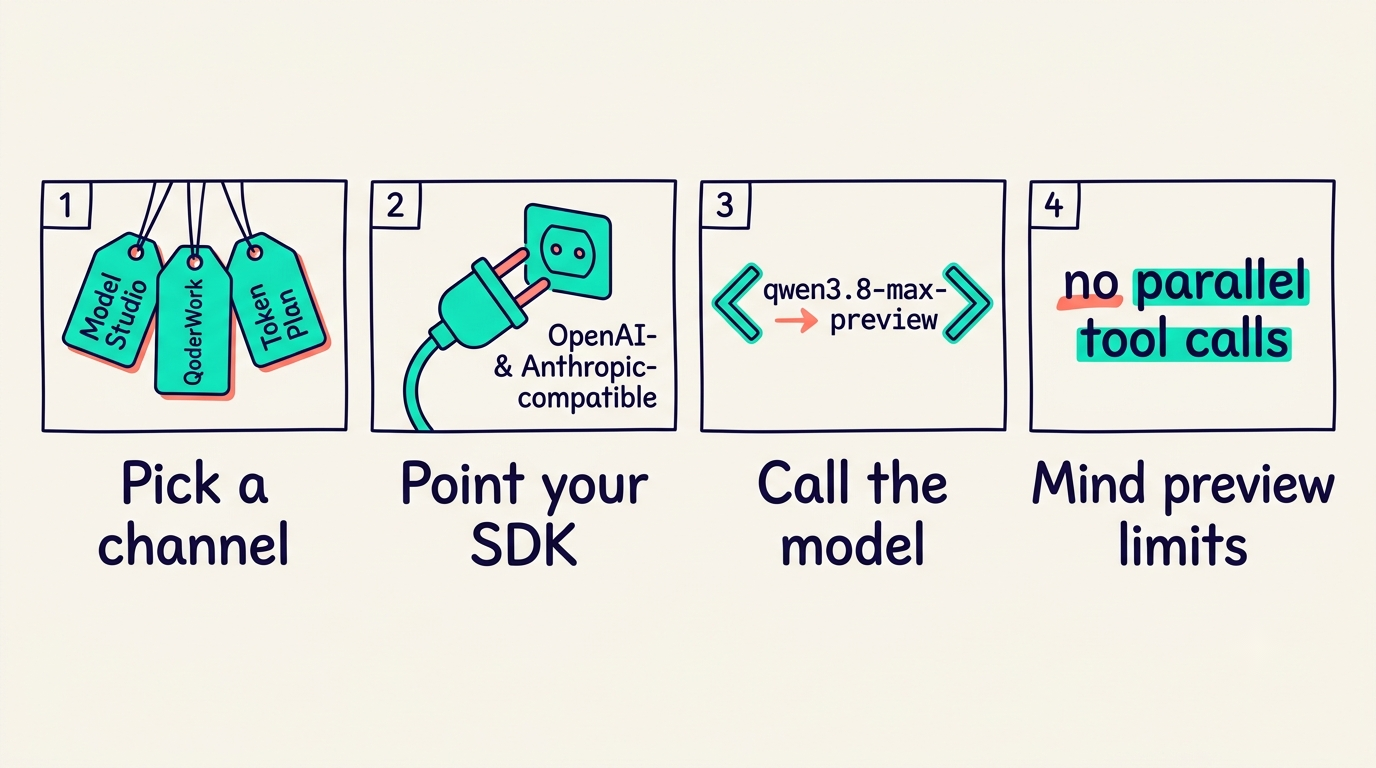
- Alibaba Cloud Model Studio — the primary API endpoint; create an account at Model Studio, generate an API key, and point your SDK at the
qwen3.8-max-previewmodel ID. - QwenWork — a public beta workspace that opened the same day as the preview launch, designed for interactive use without SDK setup.
- Qoder and QoderWork — coding-focused platforms in the Qwen ecosystem that expose the model with a code-completion and agent interface.
- Token Plan — the credit-based system that gates preview access; individual accounts enroll here before using any of the above channels.
Because the endpoints are both OpenAI-compatible and Anthropic-compatible, tools like Cursor, Cline, or any SDK pointing at a custom base URL can switch to the model by updating one configuration line. The model ID to use is qwen3.8-max-preview.
A note on preview limits
The individual Token Plan explicitly prohibits backend and batch API usage during preview — so the model is built for interactive coding sessions and research queries, not production pipelines. Parallel tool calls are not yet supported, which also limits complex multi-step agentic workflows. If you want to test Qwen 3.8 Max alongside rivals like Claude Fable 5 and GPT-5.6 Sol without wiring up each API separately, multi-model chat interfaces like bota.chat provide a practical way to compare outputs side by side.
Is Qwen 3.8 Max Open Source? Open-Weights Status
Promised, not delivered (yet)
As of the August 3, 2026 announcement, Alibaba says open weights are coming “next week” — with no attached date or license. Today, qwen3.8-max-preview is API-only, not open source in any practical sense. If weights do ship, it would mark the first time Alibaba has released open weights for a Max-class model. Earlier Qwen family releases — including Qwen3 and Qwen3-Coder — used the Apache 2.0 license, which allows commercial use and modification, so that license is the likely precedent, though nothing has been confirmed.
What running it would take
At 2.4 trillion parameters, the weights would be roughly 1.2 TB at 4-bit quantization and approximately 4.8 TB at 16-bit. For context, a single H100 GPU holds 80 GB of VRAM — so full 16-bit inference would require a cluster of roughly 60 H100s. Even 4-bit quantization demands around 15 H100s. Self-hosting is out of reach for almost every developer and organization, which means cloud API access will remain the practical path even after any open-weights release.
The following steps outline how to check for weights once they drop:
- Watch the official Qwen organization on Hugging Face — that’s where Alibaba posts all public model artifacts.
- Check the Qwen GitHub repository for license details and quantization guides.
- Once available, use
transformersorvllmwith the appropriate quantization flag; 4-bit viabitsandbytesor GGUF format viallama.cppare the most accessible paths. - Verify your hardware budget: plan for at least 1.2 TB disk space for the 4-bit checkpoint plus significant RAM during loading.
- Monitor community quantizations on Hugging Face — third-party INT4/GGUF versions typically appear within days of an official weights drop and run on smaller hardware.
Qwen 3.8 Max vs Kimi K3, GPT-5.6 Sol & GLM-5.2
The competitive field
The 2026 frontier now has several models competing in the same weight class. Here is where Qwen 3.8 Max sits relative to its nearest rivals:
| Model | Developer | Params | Context | Open weights | Reported price (input/output) |
|---|---|---|---|---|---|
| Qwen 3.8 Max | Alibaba | 2.4T MoE | ~1M | Promised | $2 / $6 (reported) |
| Kimi K3 | Moonshot AI | 2.8T MoE | 1M | Yes (July 27) | $3 / $15 |
| GLM-5.2 | Z.ai | ~753B / ~40B active | 1M | Yes (MIT) | — |
| GPT-5.6 Sol | OpenAI | Undisclosed | — | No | — |
| Claude Fable 5 | Anthropic | Undisclosed | — | No | — |
Kimi K3 from Moonshot AI is the most structurally similar rival: both are MoE architectures with roughly 1M-token context windows aimed at coding and agentic tasks. Kimi K3 already has published weights and independently verified scores, while Qwen 3.8 Max is still in the “trust us” phase. GLM-5.2 from Z.ai is smaller but ships with an MIT license, making it more permissive for commercial self-hosting than either of the larger MoE models.
Where Qwen 3.8 Max fits
Qwen 3.8 Max slots in as a strong-but-unproven Chinese flagship. The marketing claims are bigger than the published evidence; the coding and tool-use behavior is competitive; the preview pricing is aggressive; and the open-weights promise remains vague. Against Kimi K3’s already-published weights and verified StackPerf score of 83/100, Qwen’s concrete advantages are lower reported output cost and tighter integration with the Alibaba Cloud ecosystem for teams already using that infrastructure.
For developers choosing between the two large Chinese MoE models right now, Kimi K3 offers more certainty — you can download and evaluate the weights today. Qwen 3.8 Max offers potentially lower API cost and the Alibaba support stack, but requires waiting for both the open-weights drop and independent benchmark confirmation before making a production commitment.