
Zhipu AI’s Company History: From Tsinghua Startup to Z.ai
Anyone comparing z ai chat tools eventually runs into the same name confusion: is Zhipu AI the same company? Yes — Zhipu AI is the original name of the firm that rebranded internationally as Z.ai in July 2025, and its founding story stretches back to a university research lab rather than a Silicon Valley garage.
Founded in 2019 as a spinoff of Tsinghua University, the company spent six years building the GLM model family before completing an initial public offering on the Hong Kong Stock Exchange in January 2026. The full timeline, including every model release and ownership detail, is tracked on Wikipedia’s Z.ai entry, while the current product lineup lives on the official Z.ai site.
From Tsinghua University lab to independent company
Long before it competed with international chatbots, the company was a research group inside one of China’s top universities, focused on a very different problem than conversational AI.
The founders and the knowledge-graph roots
The company began life focused on knowledge graphs, not language models — its original legal identity, Beijing Zhipu Huazhang Technology Co., Ltd., was incorporated in 2019 and reflects that origin (the entity was only renamed Knowledge Atlas Technology Joint Stock Company Limited years later, as part of the pre-IPO restructuring described below). Co-founders Tang Jie and Li Juanzi were both professors in Tsinghua’s Knowledge Engineering Group (KEG), and the early venture struggled to attract outside investors, operating for three months out of rent-free office space provided by Zhongguancun Science Park before its first meaningful capital arrived — roughly $15 million in September 2021.
GLM: the research that became the product
Tsinghua KEG’s General Language Model (GLM) architecture, introduced in a paper presented at ACL 2022, laid the groundwork that the team scaled a year later into GLM-130B, a bilingual 130-billion-parameter model presented at ICLR 2023. As the original research describes it,
We introduce GLM-130B, a bilingual (English and Chinese) pre-trained language model with 130 billion parameters.
Zeng et al., “GLM-130B: An Open Bilingual Pre-Trained Model,” ICLR 2023
That research base became the foundation for ChatGLM, launched as a conversational product in March 2023 — the company’s first real answer to the wave of chatbots that followed ChatGPT’s late-2022 debut.
Funding rounds that built a unicorn
Two financing rounds, seven months apart, turned the Tsinghua spinoff into one of China’s best-capitalized AI labs and pulled in its first backers from outside the country.
In October 2023, the company raised roughly 2.5 billion yuan (about $340 million) from a group that included Alibaba, Tencent, Meituan, Ant Group, Xiaomi and HongShan — a signal that China’s biggest tech players saw it as a serious domestic answer to OpenAI. Seven months later, in May 2024, Saudi Arabia’s Prosperity7 Ventures joined a $400 million round that valued the company at approximately $3 billion, its first major round backed by international, non-Chinese capital.
| Round | Date | Amount | Lead / notable backers |
|---|---|---|---|
| Series round | October 2023 | ~2.5B yuan (~$340M) | Alibaba, Tencent, Meituan, Ant Group, Xiaomi, HongShan |
| Growth round | May 2024 | $400M | Prosperity7 Ventures (Saudi Arabia), valuation ~$3B |
Both rounds landed before the July 2025 rebrand, so every early backer signed on under the Zhipu AI name rather than Z.ai. That timing matters for anyone tracing ownership through public filings or press coverage from 2023-2024, since none of it will mention the Z.ai brand at all.
The mix of backers also shifted meaningfully between the two rounds, and the investor list itself tells a story about how the company was perceived at each stage:
- 2023 backers were almost entirely Chinese internet giants betting on a domestic large-model champion.
- 2024 backers added Gulf sovereign capital, the first sign of ambitions beyond China.
- Valuation roughly doubled in the seven months between the two rounds as GLM adoption grew.
- Both rounds predate the July 2025 rebrand, meaning early investors backed the company under the Zhipu AI name.
Why the company rebranded as Z.ai
One brand for a global audience. The rebrand to Z.ai in July 2025 was timed to the release of GLM-4.5 and GLM-4.5 Air — the company’s move to compete directly for international developers rather than staying framed as a China-only lab. Today the z.ai chat product and API sit under the Z.ai name everywhere except mainland China, where “Zhipu AI” (智谱) is still the name used.
A brand built for the open-source developer market. The timing wasn’t accidental. GLM-4.5 and later releases such as GLM-5.2 shipped under the permissive MIT license, and a name developers outside China could search for, pronounce, and trust mattered more once the company started courting a global open-source audience rather than only domestic enterprise customers.
Expansion followed the name change. The rebrand coincided with new offices opening in several markets at once, turning what had been a Beijing-based research lab into a company with a genuinely international footprint within about a year.
| New office | Region covered |
|---|---|
| Middle East | Gulf enterprise and government customers |
| United Kingdom | European developer and enterprise outreach |
| Singapore | Southeast Asian markets |
| Malaysia | Additional Southeast Asian coverage |
The list below highlights how each round of investors and each office fits into the same growth pattern:
- Middle East, UK, Singapore, Malaysia — all opened within roughly a year of the July 2025 rebrand.
- International capital first appeared in the 2024 funding round, a year before the office expansion.
- The MIT-licensed model releases and the office expansion moved together, not in sequence.
- None of these offices operated under the Zhipu AI name — all opened after the Z.ai rebrand.
US sanctions and the Entity List
Being added to the US Commerce Department’s Entity List on January 16, 2025, over allegations that its AI research was advancing China’s military modernization, limited the company’s access to certain US-origin technology and components. In practice, an Entity List designation typically restricts a few overlapping categories at once:
- Advanced semiconductors and related manufacturing equipment.
- Software tooling tied to restricted hardware ecosystems.
- Ongoing licensing relationships with US suppliers, which require case-by-case export approval afterward.
For a company that had relied on American chips and software tooling, that combination was a serious constraint rather than a symbolic one.
The practical response was to double down on domestic chip compatibility rather than contest the listing. GLM models were adapted to run on Huawei’s Ascend processors by August 2025, and GLM-4.6, released later that year, added support for China’s Cambricon chips as well. Here’s roughly how that response played out, in sequence:
- January 16, 2025 — added to the US Entity List; access to some US-origin technology restricted.
- First half of 2025 — engineering effort redirected toward domestic chip support instead of contesting the listing.
- August 2025 — GLM models confirmed running on Huawei Ascend hardware.
- Later 2025 — GLM-4.6 adds support for Cambricon chips, broadening the domestic hardware base.
- Parallel to all of this — international expansion (Middle East, UK, Singapore, Malaysia offices) continued rather than pausing.
Legal rename and the Hong Kong IPO
Ahead of going public, the underlying entity completed one more identity change — this time a legal one rather than a marketing one.
From private startup to public company
The company formally changed its registered name to Knowledge Atlas Technology JSC Ltd. before listing. On 8 January 2026, it completed its initial public offering on the Hong Kong Stock Exchange under ticker 2513.HK, with the stock closing its first trading day up more than 12%, taking market capitalization to roughly HK$57.5 billion — making it the first major large language model developer anywhere to go public.
What came after the IPO
The listing didn’t slow model development — if anything, releases sped up in the months right after:
- February 2026 — GLM-5 released, the first major model family after the IPO.
- April 2026 — GLM-5.1 follows, an incremental upgrade.
- June 2026 — GLM-5.2 ships open source under the zai-org organization on GitHub, with a one-million-token context window.
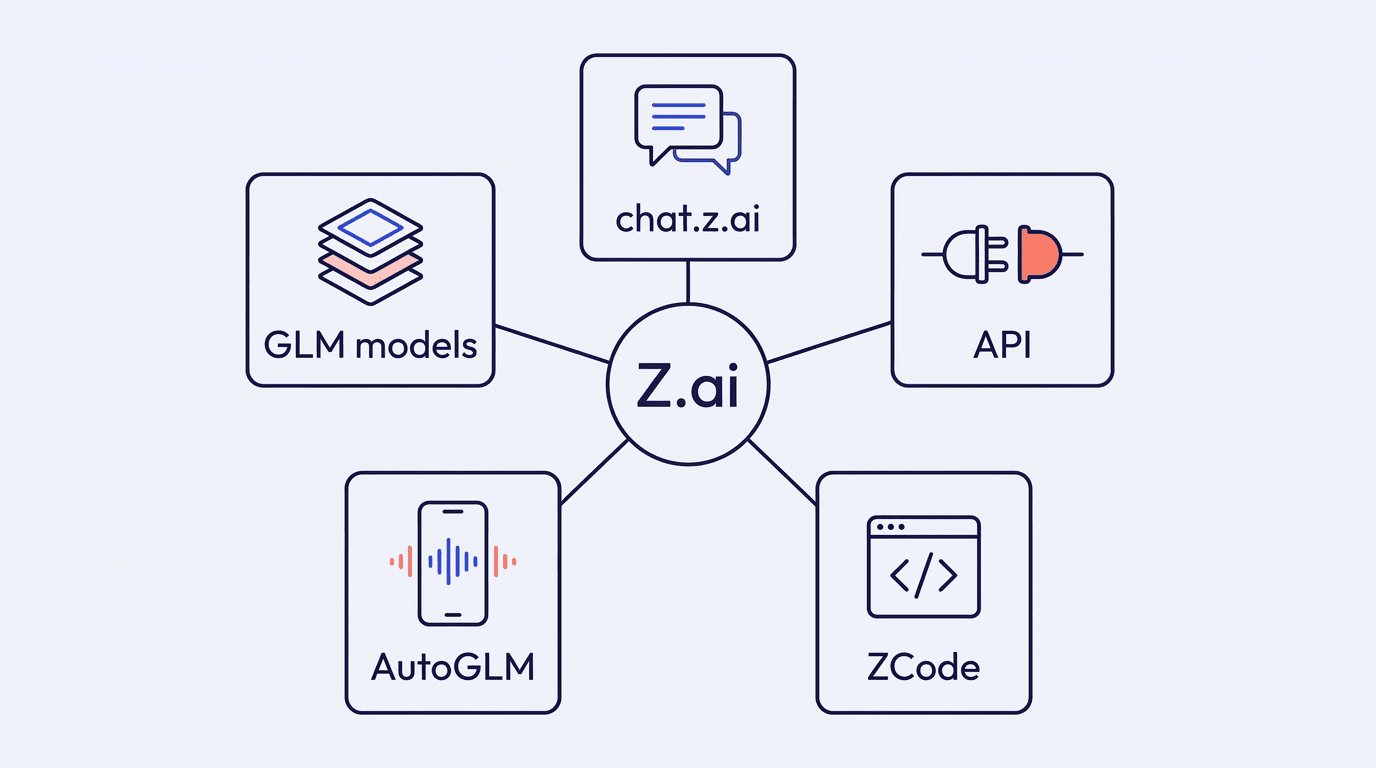
That same open release pattern is what powers downstream tools such as ZCode, which build directly on the openly licensed GLM weights rather than a closed API.