
ZCode: Inside the Free Agentic Development Environment for GLM-5.2
ZCode is a free desktop Agentic Development Environment (ADE) that Z.ai launched the week of July 1, 2026 to give the z ai model family a proper home for coding — a file manager, terminal, Git panel, and live browser preview built around an agent conversation instead of a text editor. It bundles all of that inside one Electron app rather than scattering it across editor panes.
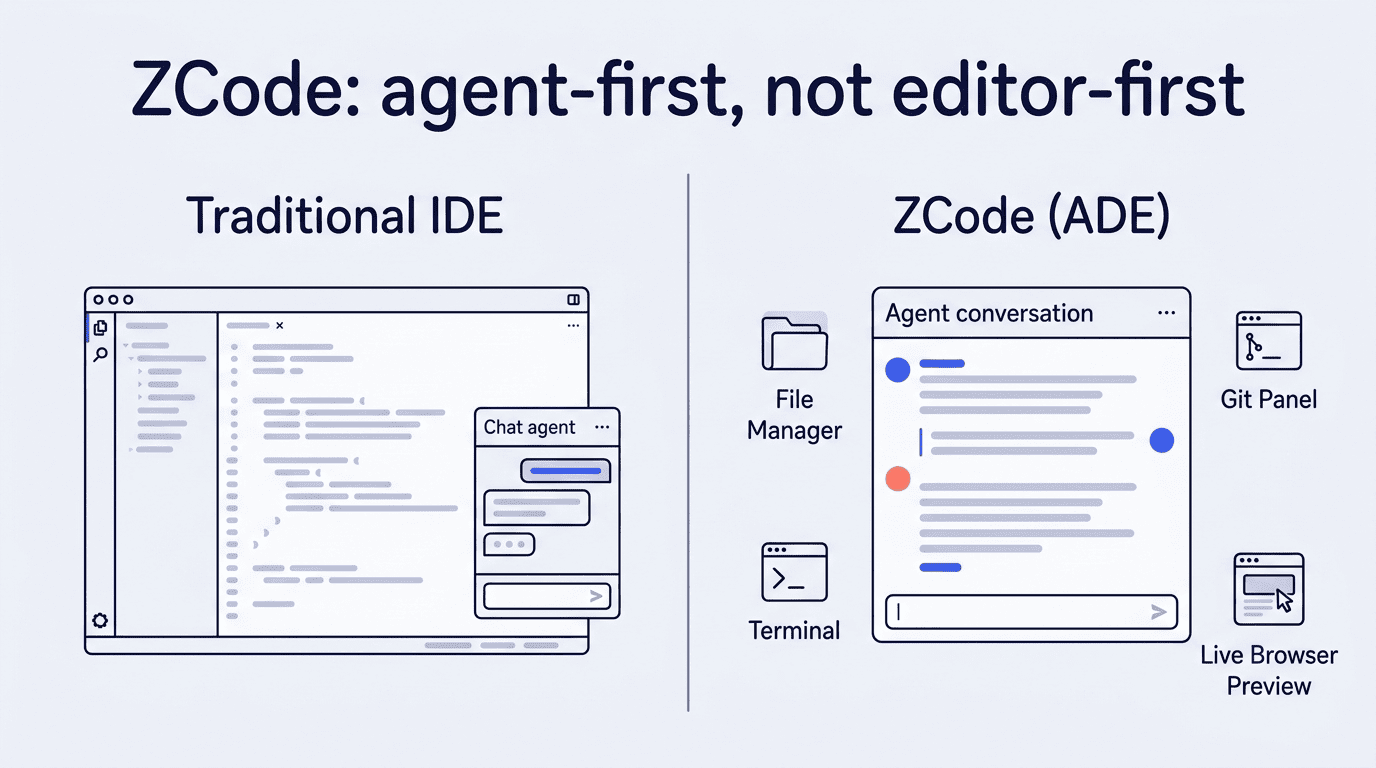
Where Cursor or a VS Code fork starts from the editor and bolts on a chat panel, ZCode starts from the agent and arranges the rest of the workspace around it. This piece breaks down what ZCode actually does, how it differs from Cursor, Claude Code, and GitHub Copilot, and what the GLM Coding Plan quota bonus means in practice.
What ZCode Is: Agent-First, Not Editor-First
An editor-first IDE puts code files at the center of the screen and treats the agent as a sidebar add-on. ZCode inverts that: the agent conversation sits at the center, and everything else is arranged around it, all inside one free Electron app. The docs.z.ai documentation describes ZCode explicitly as an ADE rather than an IDE — a distinction the product leans on throughout its own onboarding material.
A single ZCode window bundles:
- A file manager for browsing and editing the project tree
- An integrated terminal for running shell commands
- A Git panel for staging, committing, and reviewing diffs
- A live browser preview for checking rendered changes instantly
- The agent chat itself, which stays the focal point of the layout
ZCode is Z.ai’s official agentic development environment, built to give GLM-5.2 a native home for real development work rather than treating it as a plug-in.
Z.ai documentation
Launch timeline
ZCode launched publicly the week of July 1, 2026, positioned as the official harness for GLM-5.2 — Z.ai’s own coding model. It shipped as a free download for macOS, Windows, and Linux from day one, and Z.ai has kept shipping near-daily point releases in the weeks before and after launch, a pace that suggests the product is still being actively hardened rather than treated as finished.
That launch pace matters for anyone deciding whether to adopt ZCode now or wait. A tool iterating this fast tends to fix rough edges quickly, but it also means workflows built around today’s exact menu layout or keyboard shortcuts may shift within a few release cycles.
Core Features: Goal Mode, Execution Modes, and Subagents
ZCode’s headline feature is Goal Mode, but the execution-mode system and subagent architecture underneath it are what make that mode usable on real repositories instead of toy scripts.
The /goal loop
Typing /goal followed by an objective — such as “refactor the authentication module to use JWT” — sets a verifiable session objective inside ZCode. The agent plans the work, implements it, runs tests, and iterates automatically after each round, checking whether the stated goal is verified complete. It only stops to summarize once the goal is met, or once it hits a blocker it cannot resolve on its own.
That auto-verification loop is the core difference between Goal Mode and a plain chat prompt: instead of a developer manually re-checking each round, ZCode keeps looping against its own test results until the objective actually holds.
Execution modes and subagents
ZCode cycles through five execution modes with Shift+Tab, trading autonomy for confirmation friction depending on how much a developer wants to supervise:
- Default — balances autonomy with periodic check-ins on riskier edits.
- Confirm Before Changes — asks before every file write.
- Auto Edit — applies file edits automatically but still confirms shell commands.
- Plan Mode — produces a plan without touching files, for review before execution.
- Full Access — runs end-to-end without confirmation prompts.
On top of those modes, ZCode ships subagents that split work by role:
- General-purpose — full read/write access, used for implementation tasks
- Explore — strictly read-only, scoped to research and codebase discovery
- Custom subagents — defined by the developer with their own model choice and permission set, useful for splitting a “planner” role from an “executor” role inside the same session
This split matters most on larger repositories, where letting a read-only agent map out the codebase before a full-access agent starts editing cuts down on wasted or conflicting changes.
Platforms, BYOK, and the GLM Coding Plan Bonus
ZCode is free to install, but the cost of actually running it comes from whichever model sits behind it — GLM-5.2 through Z.ai directly, or a third-party model through BYOK.
Installing ZCode
ZCode is available as a free download on macOS, Windows, and Linux, with BYOK support so developers can connect their own API keys for third-party models instead of relying solely on Z.ai’s own endpoint. Some of the underlying tooling and connectors are open-sourced under the zai-org GitHub organization, for readers who want to inspect or extend the plumbing themselves.
BYOK setup covers several third-party providers directly, including:
- Anthropic
- OpenRouter
- Moonshot
- DeepSeek
- OpenAI
- MiniMax
Each provider slots in alongside the default Z.ai connection, so a team already paying for one of those APIs doesn’t need a separate subscription just to try ZCode’s interface.
| Platform | Availability | Notes |
|---|---|---|
| macOS | Free download | Runs from launch week |
| Windows | Free download | Runs from launch week |
| Linux | Free download (beta) | Newest of the three, still stabilizing |
GLM Coding Plan quota bonus
Subscribers to a GLM Coding Plan get roughly 1.5x the effective usable quota when running GLM-5.2 through ZCode compared with metering the same subscription elsewhere — a bonus tied specifically to using Z.ai’s own harness rather than a third-party client. As of this writing, that bonus is a promotional discount running through July 31, 2026 (Z.ai says peak-hour consumption drops from a 3x to a 2x coefficient), not a permanent feature of the plan, so check the current terms before assuming it carries past that date. The full pricing breakdown, including tier comparisons, lives in the separate GLM Coding Plan guide, since plan pricing is its own topic distinct from the ZCode app itself. Developers who want to weigh GLM-5.2 pricing directly against other frontier coding models can check the OpenRouter GLM listing as a third-party reference point.
ZCode vs. Cursor, Claude Code, and GitHub Copilot
Each of the four tools optimizes for a different point in the workflow, and none of them is a strict upgrade over the others.
Where each tool wins
Cursor’s advantage is its VS Code heritage. Because it forked from an established editor, Cursor inherits a mature extension ecosystem, familiar keybindings, and years of editor polish that a brand-new agent-first app cannot match on day one.
A CLI-first agent tool’s advantage is operating at repository scale from the terminal. Developers who live in the shell can pipe a coding agent into existing scripts and CI steps without ever opening a GUI, which suits infrastructure-heavy or headless workflows.
GitHub Copilot’s advantage is line-level suggestions and native pull-request integration. It stays closest to the code a developer is already looking at and slots directly into the GitHub review flow most teams already use.
ZCode’s angle is being the only one of the four built as a full desktop GUI specifically for its own underlying model, with Goal Mode and a built-in subagent system as first-class features rather than bolted-on extras.
| Tool | Interface | Built around | Standout feature |
|---|---|---|---|
| ZCode | Desktop GUI (agent-first) | GLM-5.2 | Goal Mode, custom subagents |
| Cursor | Desktop GUI (editor-first) | Model-agnostic | VS Code extension ecosystem |
| Claude Code | Terminal CLI | Claude models | Repository-scale automation |
| GitHub Copilot | Editor plugin | Model-agnostic | Line-level suggestions, PR integration |
Who should try ZCode first
ZCode fits two kinds of developers most clearly:
- Those already curious about the Z.ai model family who want a free, agent-first desktop workspace rather than an extension bolted onto an existing editor
- Those coming from a chat-first habit who mostly talk to the model instead of writing code directly, and want a natural next step into an actual coding workspace
For that second group, chat.z.ai is worth reading first, since it covers the conversational side of the model before jumping into the coding workspace.