
GLM-5.2: Z.ai’s Open-Weight Coding Model with 1M-Token Context Explained
GLM-5.2 is the flagship open-weight large language model from z.ai chatbot platform (formerly Zhipu AI), released June 2026 with a 1-million-token context window and MIT license — making it the most powerful freely available text-only LLM at the time of its debut. It is built on a 753-billion-parameter Mixture-of-Experts architecture, scores 62.1% on SWE-bench Pro, and undercuts GPT-5.5 by roughly one-sixth the API cost. Z.ai, a Beijing-based research company spun out of Tsinghua University in 2019, positions GLM-5.2 as a frontier-class coding model ready for agentic workflows and long-horizon reasoning tasks.
What Is GLM-5.2?
From Zhipu AI to Z.ai: The Company Behind the Model
Zhipu AI rebranded to Z.ai in 2025 as part of its global product push. Founded in 2019 as a Tsinghua University spinout, the company has published the General Language Model (GLM) series continuously since GLM-1. GLM-5.2 is the fifth generation and their current frontier release. The THUDM GitHub organization maintains all official repositories and academic reference code for the model family.
GLM-5.2 at a Glance
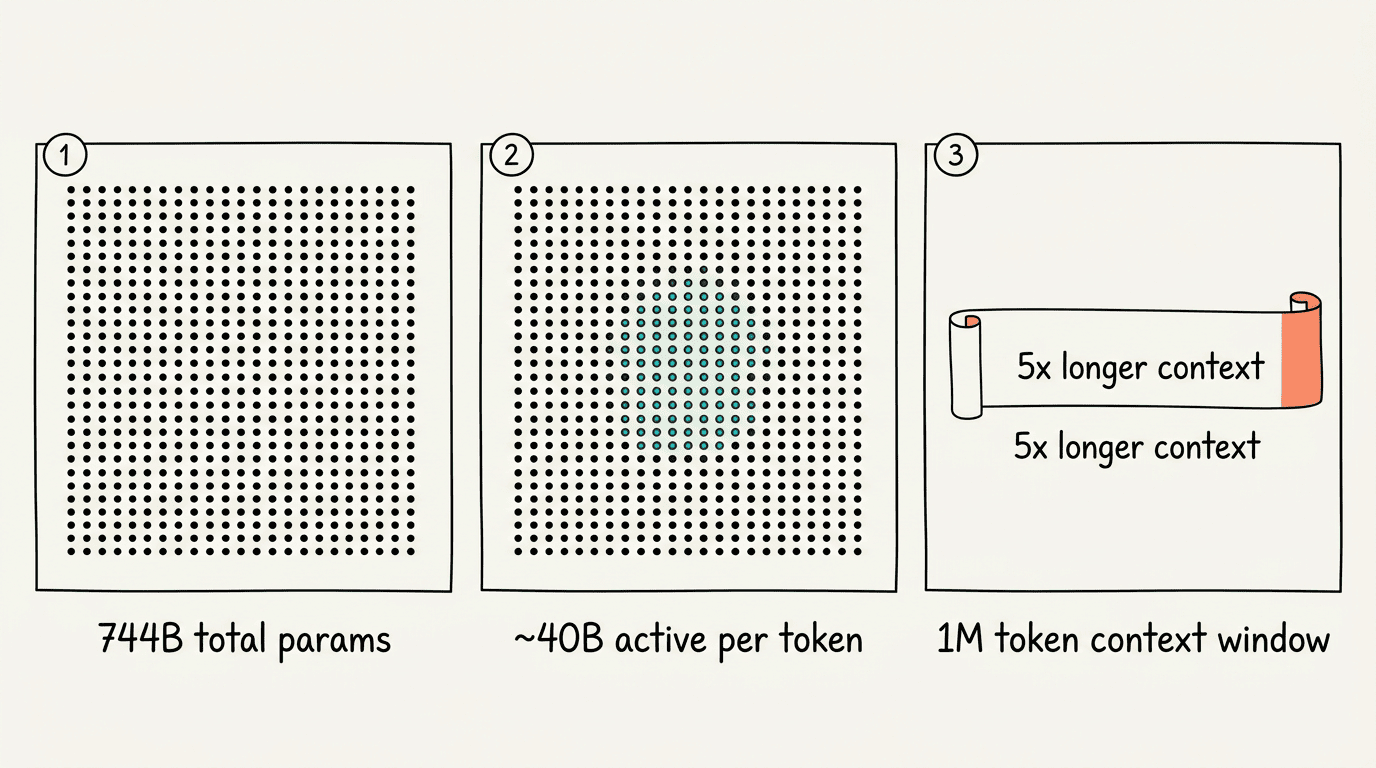
GLM-5.2 is a sparse Mixture-of-Experts model with 753B total parameters and ~40B active per token. It was released under the MIT license with no regional restrictions. The model weighs 1.51 TB and became available to GLM Coding Plan subscribers on June 13, 2026, with open weights going public on June 16, 2026.
Key facts at a glance:
- 753B total parameters, ~40B active per inference token
- 1-million-token context window (opt-in via
glm-5.2[1m]) - MIT License — commercially usable, no regional exclusions
- Scores 62.1% on SWE-bench Pro, 74.4% on FrontierSWE
- API pricing: $1.40/1M input tokens via Z.ai
Architecture: What Makes GLM-5.2 Different
MoE Design: 753B Parameters, 40B Active
GLM-5.2 uses a sparse Mixture-of-Experts (MoE) design: the full model carries 753 billion parameters, but any single inference token only activates roughly 40 billion. This gives the 753-billion-parameter open-weight model the knowledge density of a very large system at the inference cost of a much smaller one. In practice, that tradeoff is what makes $1.40/1M input token pricing viable for a model competing at frontier level.
IndexShare: Solving the 1M-Context Problem
The key architectural innovation is IndexShare, a sparse-attention mechanism that reuses the same sparse indexer across every four transformer layers. At the 1M-token scale, IndexShare delivers a 2.9× reduction in per-token FLOPs compared to standard full attention. Z.ai credits this as the primary reason 1M-context inference is economically feasible at current pricing — without it, the memory and compute requirements would make the context window commercially impractical.
Multi-Token Prediction and Supporting Techniques
GLM-5.2 ships with improved Multi-Token Prediction (MTP) layers paired with KVShare, yielding up to a 20% boost in speculative decoding acceptance rates. LayerSplit handles memory management across the MoE experts, and Critic-based PPO was used for reinforcement learning fine-tuning. Together these make the agentic coding model significantly faster at generation than its predecessor GLM-5.1 — average task output grew from ~26K tokens to ~43K tokens.
The four primary architectural techniques in GLM-5.2:
- IndexShare — sparse indexer shared across every 4 transformer layers (2.9× FLOP reduction at 1M context)
- KVShare + MTP — combined KV-cache sharing with Multi-Token Prediction for 20% faster speculative decoding
- LayerSplit — distributed memory management across MoE expert layers
- Critic-based PPO — reinforcement learning fine-tuning for improved reasoning alignment
The IndexShare mechanism enables us to run 1M-token inference at a cost that’s actually competitive with 128K-context proprietary models — that’s the architectural bet GLM-5.2 is built around.THUDM / Z.ai Engineering Team, GitHub
Context Window: 1 Million Tokens in Practice
GLM-5.2’s 1-million-token context window is 5× larger than GLM-5.1’s ~200K limit. In practice, this means the long-context language model can ingest roughly 750,000 words simultaneously — an entire codebase, a large legal contract, or a year’s worth of application logs in a single prompt.
Access to the full context is opt-in via the glm-5.2[1m] model ID. The model outputs up to 131,072 tokens per response, and at Max effort level it can generate up to 85K output tokens per task. Average output across typical coding tasks has grown to ~43K tokens, up from ~26K for GLM-5.1.
The massive context is what enables the autonomous coding use cases Z.ai describes as “long-horizon” tasks — see the GLM Coding Plan overview for how these multi-step workflows are structured in practice.
Benchmarks: How GLM-5.2 Compares
Coding Benchmarks
On the key coding benchmarks at launch:
| Benchmark | GLM-5.2 | GPT-5.5 | Claude Opus 4.8 | Gemini 3.1 Pro |
|---|---|---|---|---|
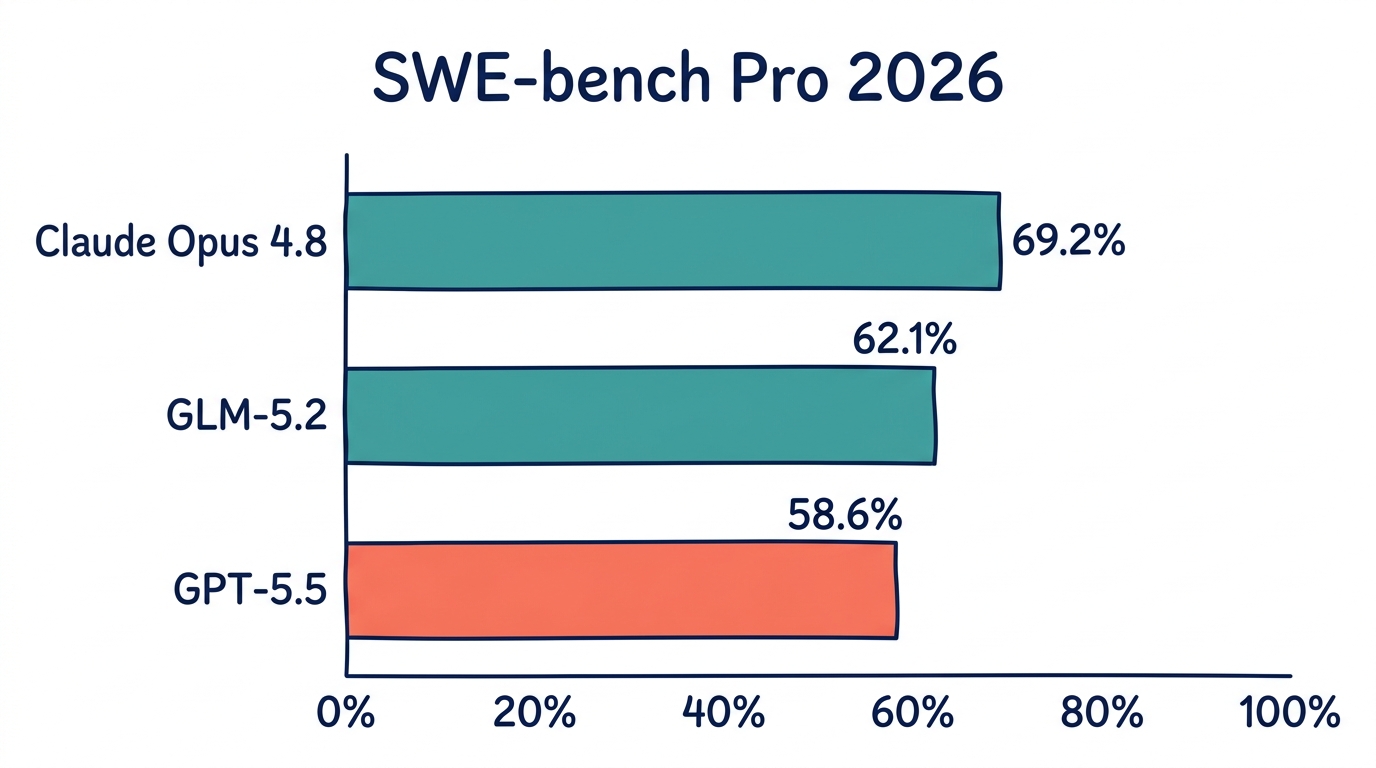
| SWE-bench Pro | 62.1% | 58.6% | — | 54.2% |
| FrontierSWE | 74.4% | 72.6% | 75.1% | — |
| Terminal-Bench 2.1 | 81.0 | — | 85.0 | — |
GLM-5.2 leads GPT-5.5 on SWE-bench Pro by 3.5 percentage points and trails Claude Opus 4.8 by less than 1% on FrontierSWE. It also places 2nd on the Code Arena: Frontend leaderboard. On the Artificial Analysis Intelligence Index v4.1, Z.ai’s latest flagship LLM scores 51 — ahead of MiniMax-M3 (44), DeepSeek V4 Pro (44), and Kimi K2.6 (43).
Math and Reasoning
On AIME 2026 (advanced math competition), GLM-5.2 scores 99.2% — among the highest recorded for any open-weight model and competitive with the best proprietary systems. This positions it as a serious option for quantitative reasoning workflows beyond pure coding.
Cybersecurity Real-World Test
Semgrep’s engineering team ran GLM-5.2 on IDOR vulnerability detection tasks, measuring both accuracy and cost. The frontier-class coding model achieved an F1 score of 39% — beating Claude Code (Opus 4.6 at 37%, with Opus 4.8/4.7 at 28%) at roughly $0.17 per vulnerability found. That is approximately one-sixth the cost of comparable frontier proprietary systems, reinforcing the value proposition Z.ai markets around pricing efficiency.
Key benchmark results at a glance:
- SWE-bench Pro: 62.1% (vs GPT-5.5’s 58.6%)
- FrontierSWE: 74.4% (vs Claude Opus 4.8’s 75.1%)
- Terminal-Bench 2.1: 81.0
- AIME 2026 math: 99.2%
- Artificial Analysis Intelligence Index v4.1: 51 (top open-weight score)
Reasoning Modes: High vs Max Effort
GLM-5.2 ships with two configurable reasoning effort levels. The distinction matters in practice for both cost and output quality:
High effort produces faster responses with moderate chain-of-thought depth. It suits standard coding tasks, most agentic loops, and latency-sensitive applications.
Max effort activates extended thinking with up to 85K output tokens per task. Z.ai explicitly recommends Max for complex multi-file coding, long-horizon agent workflows, and tasks requiring deep reasoning chains. The model was primarily trained and evaluated at the Max effort level, which is reflected in the benchmark numbers above.
For most users running the agent-oriented system as a coding backend, Max effort is the default starting point. High effort is a cost-reduction lever once a workflow is proven to be reliable.
Pricing and Availability
API Pricing
The official Z.ai API charges $1.40 per million input tokens, $4.40 per million output tokens, and $0.26 for cached input. On OpenRouter, third-party hosts typically offer slightly lower rates at around $0.95 input / $3.00 output.
For context, GPT-5.5 runs at roughly 6× the cost on equivalent tasks. The practical implication: GLM-5.2’s cybersecurity cost of $0.17 per vulnerability found, versus approximately $1.00 for comparable frontier models, illustrates how the pricing gap compounds across high-volume automated workflows.
| Tier | Monthly | Annual (per month) | Quota |
|---|---|---|---|
| Lite | $18 | $12.60 | ~80 prompts / ~400 off-peak |
| Pro | $72 | $50.40 | ~400 / ~2,000 |
| Max | $160 | $112.00 | ~1,600 / ~8,000 |
Peak hours (14:00–18:00 UTC+8) cost 3× quota; off-peak 2×. A promotional 1× rate runs through September 2026.
Open Weights and HuggingFace
GLM-5.2 weights are published on Hugging Face under the THUDM organization and via zai-org/GLM-5.2. A quantized variant (THUDM/GLM-Z1-9B-0414) is available for lower-resource environments. The MIT license permits self-hosting, fine-tuning, and commercial deployment with no regional restrictions. The model is SOC 2 and GDPR compliant when used via Z.ai’s API.
How to Use GLM-5.2: Integration Guide
Z.ai exposes GLM-5.2 via an Anthropic-compatible endpoint, meaning it drops into any tool already configured for Claude with minimal changes. Here is a step-by-step setup guide for the most common environments:
- Create a Z.ai account at api.z.ai and generate an API key from the dashboard.
- Set environment variables:
ANTHROPIC_BASE_URL=https://api.z.ai/v1andANTHROPIC_API_KEY=<your-z.ai-key>. - Select the model ID: use
glm-5.2for standard context orglm-5.2[1m]for 1M-token context. - Set reasoning effort: pass
--effort maxfor complex coding tasks;--effort highfor faster, cheaper runs. - Verify the connection: run a simple test prompt to confirm the endpoint is resolving correctly before committing to a production workflow.
- Adjust quota awareness: if using a Coding Plan subscription, note that peak hours (14:00–18:00 UTC+8) cost 3× your prompt quota.
- Enable MCP if needed: GLM-5.2 supports the Model Context Protocol for tool calls natively — add MCP server config the same way you would for a standard Claude integration.
For Claude Code specifically: set ANTHROPIC_BASE_URL and pass --model glm-5.2 (or glm-5.2[1m]) per session. No other configuration changes are required.
For Cline and OpenAI-compatible tools (Roo Code, OpenClaw), point the base URL to https://api.z.ai/v1, set your API key, and select glm-5.2 from the model list. For automation workflows, the AutoGLM agent framework is built around GLM-5.2’s native tool calling and MCP integration.
GLM-5.2 vs GLM-5.1: What Changed
The jump from GLM-5.1 to GLM-5.2 is more than an incremental update — it involves a full architecture shift from dense to sparse MoE, a 5× context expansion, and significant gains across every major coding benchmark.
| Metric | GLM-5.1 | GLM-5.2 |
|---|---|---|
| Context window | 200K tokens | 1M tokens |
| SWE-bench Pro | 58.4% | 62.1% |
| Terminal-Bench 2.1 | 62.0 | 81.0 |
| Avg. output per task | ~26K tokens | ~43K tokens |
| Architecture | Dense | Sparse MoE |
The 1M context is the headline upgrade, but the Terminal-Bench 2.1 improvement (+19 points) signals the biggest real-world gain for terminal-based agentic workflows. The architecture change to MoE also means inference cost per token dropped even as model capacity increased.
Open-Weight Position: MIT License and Self-Hosting
GLM-5.2 is released under the MIT license with no commercial restrictions and no regional exclusions — a deliberate contrast to some Chinese-origin models that have included geographic limitations in their licensing terms. The weights are publicly downloadable at 1.51 TB. For the academic foundations of the GLM model family, see the GLM-4 technical report on arXiv.
Self-hosting the full 753B model (1.51 TB) requires significant GPU infrastructure — estimated at 8–16× H100-class cards for full inference. For teams that want open-weight guarantees without on-premises hardware, several managed options exist:
- OpenRouter — third-party hosting at ~$0.95/$3.00 input/output, full 1M context available
- Cloudflare Workers AI — lower-latency edge inference, capped at 262K context
- Z.ai managed API — official endpoint with SOC 2 and GDPR compliance, $1.40/$4.40 rates
- Hugging Face Inference API — quantized variants for reduced hardware requirements
SOC 2 and GDPR compliance apply when using the model through Z.ai’s managed API. Self-hosted deployments carry the same open-weight permissiveness but shift compliance responsibility to the operator.
FAQ
What is GLM-5.2?
GLM-5.2 is Z.ai’s (formerly Zhipu AI) flagship open-weight large language model, released June 2026 with 753B total parameters (40B active per token), a 1-million-token context window, and an MIT license. It is optimized for coding, agentic workflows, and long-horizon reasoning tasks.
How does GLM-5.2 compare to GPT-5.5?
On SWE-bench Pro, GLM-5.2 scores 62.1% vs GPT-5.5’s 58.6%. On FrontierSWE, GLM-5.2 scores 74.4% vs GPT-5.5’s 72.6%. API pricing is roughly one-sixth of GPT-5.5, making GLM-5.2 the more cost-efficient option for coding tasks.
What is the context window of GLM-5.2?
GLM-5.2 supports a 1-million-token context window, accessible via the glm-5.2[1m] model ID. This is 5× larger than GLM-5.1’s ~200K limit. Maximum output is 131,072 tokens; at Max effort, the model can generate up to 85K output tokens per task.
Is GLM-5.2 open source?
GLM-5.2 is open-weight under the MIT license — the model weights are publicly downloadable and freely usable commercially with no regional restrictions. The training code is not fully open, but the weights are available on Hugging Face.
How much does GLM-5.2 cost?
Via Z.ai API: $1.40/1M input tokens, $4.40/1M output tokens, $0.26 for cached input. Subscription plans (GLM Coding Plan): Lite $18/month, Pro $72/month, Max $160/month. OpenRouter hosts offer approximately $0.95/$3.00 input/output.
What benchmarks does GLM-5.2 score on?
SWE-bench Pro (62.1%), FrontierSWE (74.4%), Terminal-Bench 2.1 (81.0), AIME 2026 math (99.2%), Artificial Analysis Intelligence Index v4.1 (score 51), Code Arena WebDev (2nd place), and cybersecurity IDOR detection (F1 39%, beating Claude Code).
Can I run GLM-5.2 locally?
Yes — the full model (753B parameters, 1.51 TB) requires approximately 8–16× H100-class GPUs. A quantized variant is available on Hugging Face (THUDM/GLM-Z1-9B-0414) for lower-resource environments. The MIT license permits self-hosting and fine-tuning without restriction.
How do I use GLM-5.2 with Claude Code?
Set ANTHROPIC_BASE_URL=https://api.z.ai/v1 and your Z.ai API key as ANTHROPIC_API_KEY. Pass –model glm-5.2 (or glm-5.2[1m] for 1M context) to Claude Code. Z.ai exposes an Anthropic-compatible endpoint, so no other configuration changes are needed.