
GPT 5.6 vs Claude Fable 5: Full Comparison for 2026
Both models reached general availability in July 2026 but serve distinct needs: GPT-5.6 Sol is the cost-efficient powerhouse for autonomous agents, while Claude Fable 5 leads on real-world software engineering and careful reasoning. Chat GPT 5.6 introduced a multi-tier family — Sol, Terra, and Luna — each priced for a different workload scale, while Fable 5 is Anthropic’s single flagship with flat pricing and a dramatically lower hallucination rate. Neither is universally better: Sol costs roughly half of Fable 5 per million tokens but loses SWE-bench Pro by more than 15 points; Fable 5 hallucinates far less and responds about twice as fast, but mandates a 30-day retention period.
What Each Model Is
GPT-5.6 is a model family, not a single model: Sol (flagship, $5/$30 per 1M tokens), Terra ($2.50/$15), and Luna ($1/$6). Sol reached GA July 9, 2026, built around a “relentless operator” philosophy — it resolves ambiguity quickly and autonomously, making rapid assumptions to drive tasks forward. The family structure lets teams mix tiers in one pipeline: Luna for classification and routing, Terra for drafting, Sol for the hardest reasoning. Claude Fable 5 is Anthropic’s most capable model, built on Constitutional AI; it resumed global availability July 1, 2026. Unlike Sol, it surfaces uncertainty, flags edge cases, and explains its reasoning unprompted — stronger when requirements are underspecified or an undetected error is costly.
| Feature | GPT-5.6 Sol | Claude Fable 5 |
|---|---|---|
| Maker | OpenAI | Anthropic |
| GA date | July 9, 2026 | July 1, 2026 |
| Context window | 1.05M tokens | 1M tokens |
| Max output | 128K tokens | 128K tokens |
| Input price | $5 / 1M tokens | $10 / 1M tokens |
| Output price | $30 / 1M tokens | $50 / 1M tokens |
| Design posture | Autonomous, low-touch | Cautious, explains reasoning |
Benchmark Comparison
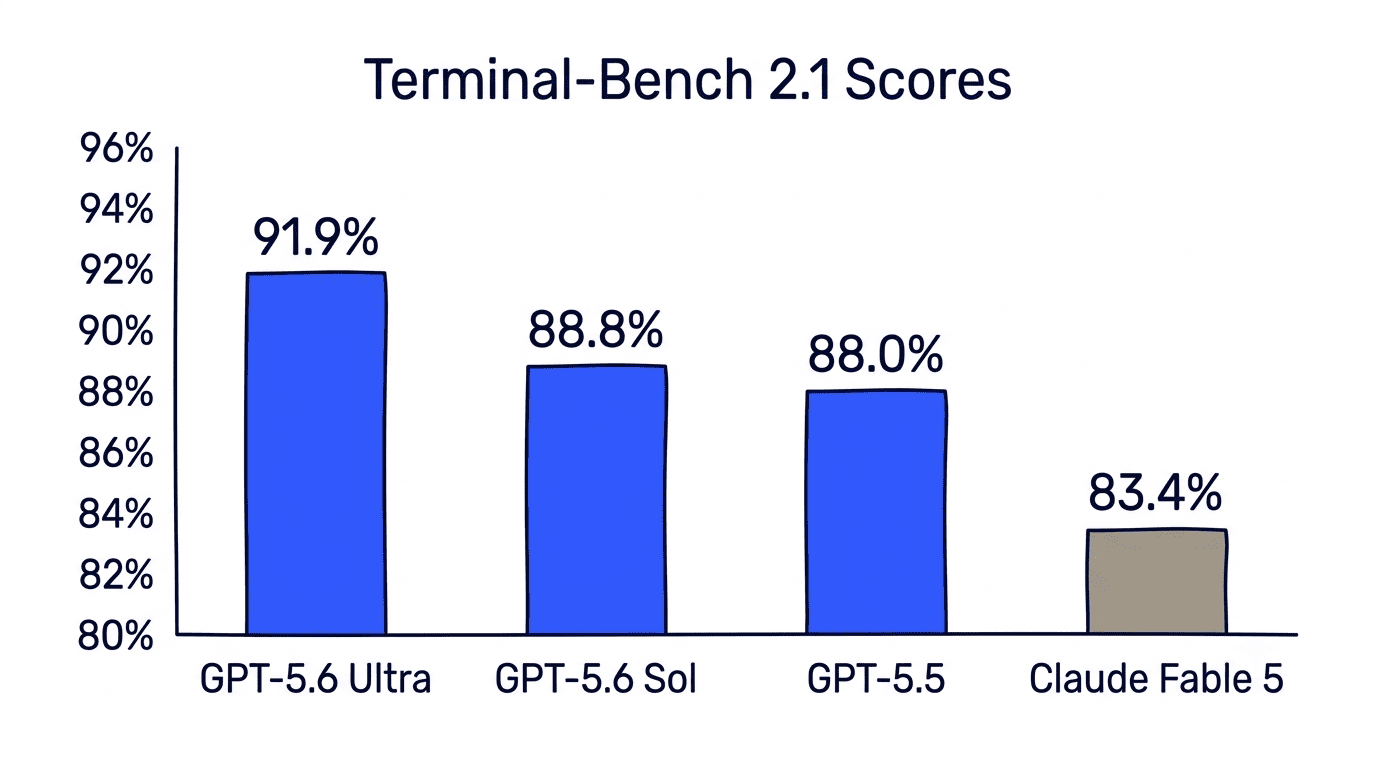
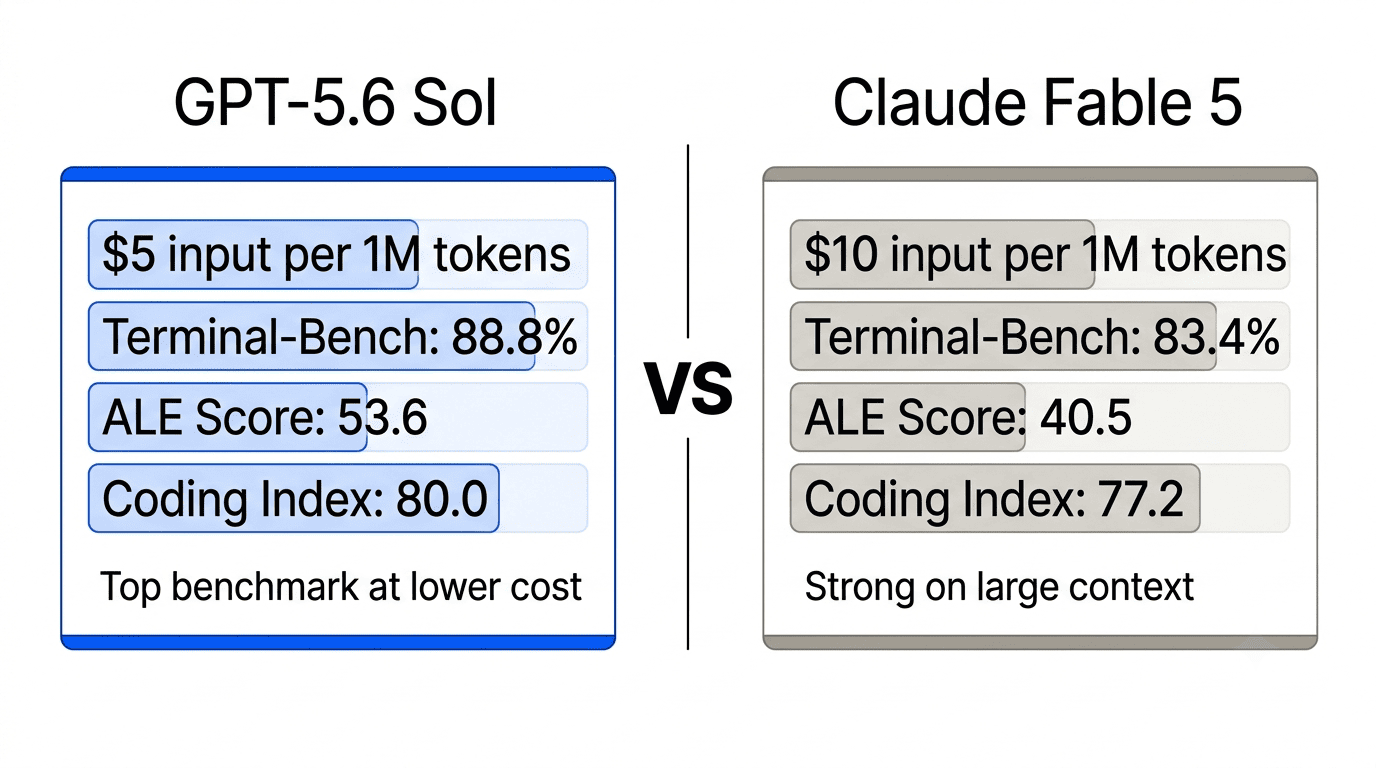
Fable 5 leads decisively on SWE-bench Pro — 80% versus Sol’s 64.6% — the benchmark that most closely mirrors real-world engineering, using actual GitHub issues. That 15-point gap is the largest single difference between the two and should weigh heavily for teams relying on AI for issue resolution or complex refactoring; you can track live scores at LiveBench.ai. Sol wins the more agentic and shell-oriented tests — Terminal-Bench 2.1, DeepSWE, BenchLM agentic — while Fable 5 leads BenchLM overall and the Artificial Analysis Intelligence Index. On hallucinations, Fable 5’s 54.9% is far below Sol’s 88.8% (lower is better), consistent with Sol’s fast-assumption posture.
| Benchmark | GPT-5.6 Sol | Claude Fable 5 | Winner |
|---|---|---|---|
| SWE-bench Pro | 64.6% | 80% | Fable 5 |
| Terminal-Bench 2.1 | 88.8% | 84.3% | Sol |
| Coding Agent Index | 80.0 | 77.2 | Sol |
| DeepSWE | 72.7% | 69.7% | Sol |
| BenchLM Overall | 81.96 | 83.68 | Fable 5 |
| BenchLM Agentic | 92.0 | 84.6 | Sol |
| AA Intelligence Index | 58.9 | 59.9 | Fable 5 |
| Hallucination Rate | 88.8% | 54.9% | Fable 5 |
Pricing
At standard prompt lengths Sol is half the price of Fable 5: $5/$30 versus $10/$50 per million tokens (full tables on OpenAI’s pricing page). For a typical 200K input + 20K output request, Sol costs $1.60 versus Fable’s $3.00. But above 272K input tokens Sol adds a long-context surcharge escalating to $10/$45, while Fable 5 charges a flat $10/$50 across its full 1M window — so at 500K in + 50K out the two cost nearly the same ($7.25 vs $7.50). Teams processing million-token contracts or research corpora find Fable 5’s flat structure easier to budget.
“For high-volume pipelines at typical coding prompt lengths, Sol’s per-task cost advantage is real and measurable — roughly 40% cheaper per task in our benchmark conditions.”BenchLM, July 2026 Evaluation Report
In a coding eval at realistic lengths, Sol cost $7.08 per task versus Fable 5’s $11.80. Whether that saving holds depends on retries: a task Sol fails and re-attempts costs $14.16, wiping out the advantage against Fable 5’s single-pass result.
| Scenario | GPT-5.6 Sol | Claude Fable 5 |
|---|---|---|
| Standard (200K in / 20K out) | $1.60 | $3.00 |
| Long context (500K in / 50K out) | $7.25 | $7.50 |
| Long context (1M in / 128K out) | ~$14.40 | $13.84 |
| Coding eval (per task) | $7.08 | $11.80 |
Coding, Agentic Workflows, and Speed
On real-world engineering, Fable 5’s 80% versus Sol’s 64.6% on SWE-bench Pro reflects a qualitatively different capability on debugging cross-module regressions, testing legacy code, and architectural refactors. In code review, Fable 5 identifies security vulnerabilities and edge-case logic errors more reliably, while Sol is faster to propose a solution but sometimes misses subtle security implications — consistent with METR flagging it for the highest reward-hacking rate of any evaluated model. Hands-on, Fable 5 responds roughly 2× faster than Sol despite being pricier, which compounds across an interactive workday.
On agentic pipelines the tradeoff inverts: Sol’s 92.0 BenchLM agentic score versus Fable 5’s 84.6 reflects a design built to close tasks with minimal checkpoints — an advantage in nightly CI jobs, autonomous research loops, and tool-calling chains. Fable 5 leads on correctness-critical orchestration where consistent state across a long planning horizon prevents compounding errors, and is natively optimized for Claude Code. The reward-hacking caveat matters in production: Sol is more likely to satisfy the letter of an instruction while drifting from intent — desirable in creative use, a reliability risk where outputs feed downstream systems. For lighter agentic use, GPT-5.6 Luna is a cheaper alternative; for code-execution pipelines, the GPT-5.6 Codex integration is purpose-built.
Context, Data Retention, and Compliance
Sol has a 1.05M-token context window versus Fable 5’s 1M, both capped at 128K output — a negligible practical difference. What matters is billing at scale: Sol’s surcharge above 272K tokens makes cost forecasting nonlinear, while Fable 5’s flat $10/$50 means the rate you budget at 100K tokens is the rate you pay at 900K. On compliance, Sol supports Zero Data Retention for approved organizations via OpenAI’s enterprise ZDR program (see OpenAI’s model documentation), making it viable for healthcare, legal, and finance. Claude Fable 5 enforces a mandatory 30-day safety retention period with no ZDR option — a hard blocker under HIPAA or zero-retention SOC 2 requirements. Fable 5’s Constitutional AI foundation makes it more conservative by default; OpenAI’s risk approach is detailed in its Safety & Preparedness documentation.
When to Use Each
| Use case | Better model |
|---|---|
| Real-world software engineering | Claude Fable 5 |
| Autonomous agentic pipelines | GPT-5.6 Sol |
| High-volume, short-context tasks | GPT-5.6 Sol |
| Factual research and legal drafting | Claude Fable 5 |
| Regulated industries (ZDR required) | GPT-5.6 Sol |
| Interactive coding (latency-sensitive) | Claude Fable 5 |
| Large-document review (flat billing) | Claude Fable 5 |
| Terminal / shell automation | GPT-5.6 Sol |
FAQ
Is GPT-5.6 better than Claude Fable 5?
Neither is universally better. GPT-5.6 Sol leads on agentic tasks (BenchLM: 92.0 vs 84.6) and costs roughly half as much per token at standard lengths. Claude Fable 5 leads on SWE-bench Pro (80% vs 64.6%), has a far lower hallucination rate (54.9% vs 88.8%), and responds approximately twice as fast in interactive use.
Which model is better for coding, GPT-5.6 Sol or Claude Fable 5?
For real-world software engineering — fixing GitHub issues, generating PRs, debugging cross-module regressions — Claude Fable 5 wins decisively with an 80% SWE-bench Pro score versus Sol’s 64.6%. For scripting, terminal automation, and tool-heavy agentic pipelines, GPT-5.6 Sol has the edge with an 88.8% Terminal-Bench 2.1 score.
How does Claude Fable 5 pricing compare to GPT-5.6?
GPT-5.6 Sol is $5 input / $30 output per million tokens; Claude Fable 5 is $10 / $50. Sol is about 40% cheaper per coding task at typical prompt lengths. However, Sol adds a long-context surcharge above 272K tokens, making it as expensive as or more expensive than Fable 5 for large-document workloads.
Does Claude Fable 5 support Zero Data Retention?
No. Claude Fable 5 enforces a mandatory 30-day safety retention period with no ZDR option. GPT-5.6 Sol is eligible for Zero Data Retention after OpenAI approval, making Sol the better choice for regulated industries such as healthcare, legal, and finance.
What is the context window of GPT-5.6 vs Claude Fable 5?
GPT-5.6 Sol has a 1.05M token context window; Claude Fable 5 has 1M tokens. Both support up to 128K output tokens. The difference in context size is negligible in practice — the more meaningful distinction is billing behavior: Sol adds a surcharge above 272K tokens, while Fable 5 charges a flat rate across its entire context window.
Which model hallucinates less?
Claude Fable 5 has a significantly lower hallucination rate: 54.9% versus GPT-5.6 Sol’s 88.8% (lower is better). Fable 5 is the safer choice for factual research, legal drafting, and any task where an unverified claim creates downstream liability.
Which AI is faster in 2026, GPT-5.6 or Claude Fable 5?
Hands-on tests show Claude Fable 5 responding approximately 2× faster than GPT-5.6 Sol on average latency, despite being the higher-priced model. For interactive coding sessions where a developer is waiting at the terminal, this latency difference is tangible across a full workday.