
OpenAI Terra Model: GPT-5.6 Terra Explained — Specs, Pricing, and When to Use It
Chat GPT 5.6 launched on July 9, 2026 with three tiers — Luna, Terra, and Sol — covering three price-performance points. Terra is the one most developers will reach for first: more capable than the budget Luna, meaningfully cheaper than the frontier Sol, and strong enough to outperform the previous-generation GPT-5.5 on most benchmarks. Here is everything you need on pricing, benchmarks, API specs, and when Terra is the right call.
What Is the OpenAI Terra Model?
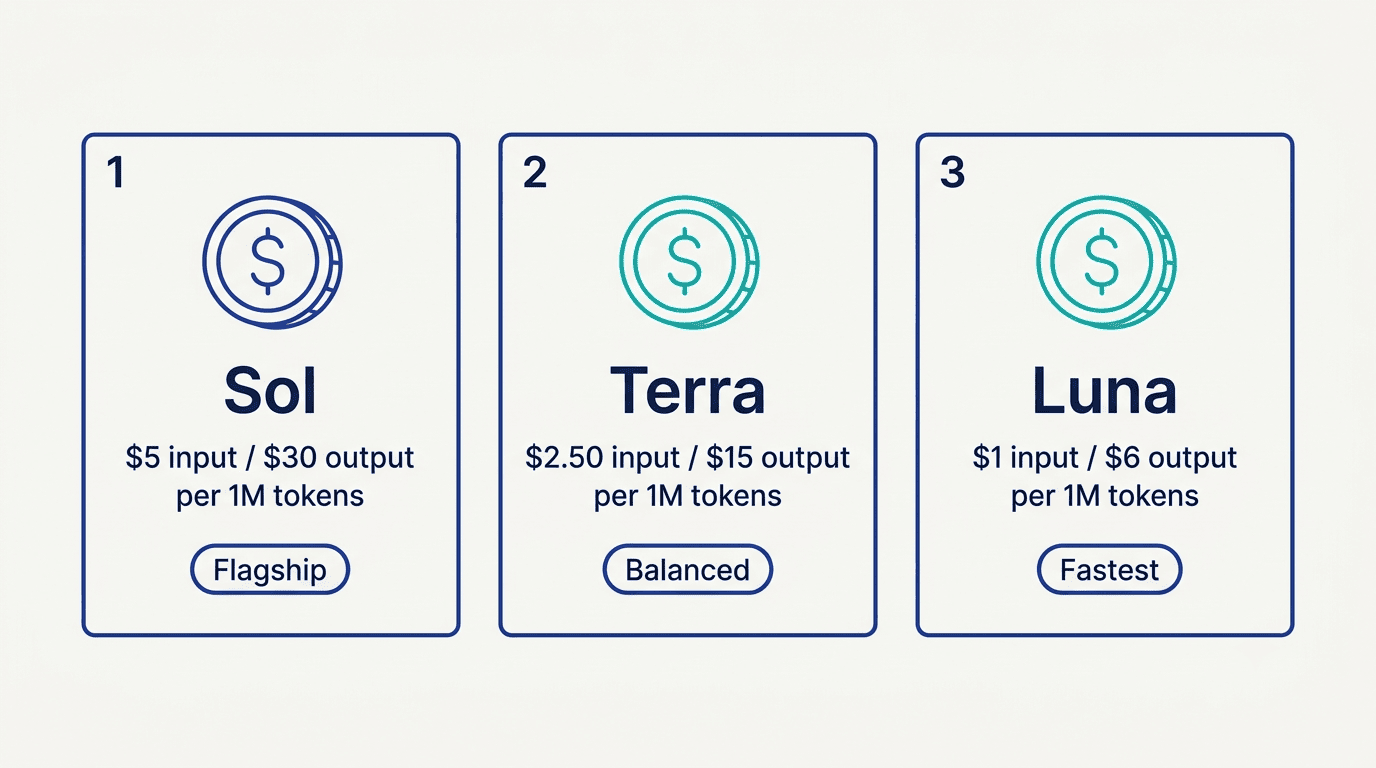
OpenAI released the GPT-5.6 family on July 9, 2026 as a three-tier system: Luna (fast and cheap), Terra (balanced), and Sol (flagship). Each is a separate model selected by passing gpt-5.6-luna, gpt-5.6-terra, or gpt-5.6-sol as the model parameter — the same large language model tiering pattern OpenAI introduced with the o-series. Terra sits in the middle: less raw frontier capability than Sol on the hardest tasks, but significantly more capable than Luna on complex reasoning and long-horizon coding. For the majority of production API workloads — content pipelines, structured extraction, agentic workflows, and general code generation — Terra is OpenAI’s default recommended choice. It also outperforms GPT-5.5 on most public benchmarks while costing less than GPT-5.5 was priced, making it a compelling migration target.
“GPT-5.6 is frontier intelligence that scales with your ambition — from fast and affordable to the most powerful reasoning we’ve ever shipped.”OpenAI, GPT-5.6 Launch Announcement, July 2026
GPT-5.6 Terra Pricing
Terra is priced at $2.50 per million input tokens and $15.00 per million output tokens — per the GPT-5.6 launch announcement — exactly half the cost of Sol on both, and 2.5× more than Luna.
| Model | Input ($/1M) | Output ($/1M) |
|---|---|---|
| GPT-5.6 Luna | $1.00 | $6.00 |
| GPT-5.6 Terra | $2.50 | $15.00 |
| GPT-5.6 Sol | $5.00 | $30.00 |
| Claude Opus 4.8 | $5.00 | $25.00 |
| Claude Fable 5 | $10.00 | $50.00 |
Against Claude Fable 5 at $10/$50, Terra costs roughly 1/4 on inputs and under 1/3 on outputs while delivering competitive everyday results. Terra supports prompt caching: cache reads deliver a 90% discount (effectively $0.25 per million cached tokens), cache writes cost 1.25× the standard input rate, and the minimum cache lifetime is 30 minutes. For RAG pipelines, agentic loops, and multi-turn conversations where the same system prompt repeats, caching typically cuts effective input costs by 60–80%. For prompts exceeding 272K tokens, a higher rate applies (2× input, 1.5× output).
Terra vs Sol vs Luna: Which Should You Use?
Terra is the default for most production workflows — code generation, content pipelines, structured extraction, or agentic tasks without a specific reason to pay for Sol’s frontier capability. Sol earns its cost on precision-critical tasks: it scored 52.7% on Agents’ Last Exam versus Terra’s 50.4%, and 80 on the Coding Agent Index versus Terra’s 77.4 — narrow gaps that matter when a failed first attempt means expensive rework in security research or one-shot code generation. Luna wins when speed and throughput dominate: at $1/$6 it costs 2.5× less than Terra, ideal for high-volume classification, routing, and latency-critical extraction. Terra is also the tier available to ChatGPT Work users — including Free and Go subscribers accessing Work and Codex — so evaluating Terra through the ChatGPT interface already tests the right model.
| Use Case | Best Tier | Reason |
|---|---|---|
| High-volume classification / routing | Luna | Cost and latency priority |
| Code generation, content, agentic tasks | Terra | Best cost-capability ratio |
| Security research, complex orchestration | Sol | Precision matters more than cost |
| RAG pipelines with repeated context | Terra + caching | 60–80% cost reduction via cache |
| Low-latency simple extraction | Luna | Speed priority |
GPT-5.6 Terra Benchmarks
| Benchmark | GPT-5.6 Terra | GPT-5.6 Sol | GPT-5.5 | Claude Fable 5 |
|---|---|---|---|---|
| Agents’ Last Exam | 50.4% | 52.7% | 46.9% | 40.5% |
| Coding Agent Index | 77.4 | 80.0 | — | 77.2 |
| BrowseComp | 87.5% | — | — | — |
On Agents’ Last Exam — stress-testing long-horizon, multi-step agentic reasoning — Terra scores 50.4%, above GPT-5.5’s 46.9% and well above Claude Fable 5’s 40.5%. On the Coding Agent Index, Terra (77.4) and Fable 5 (77.2) are essentially tied, with Sol leading at 80. In an independent CodeRabbit benchmark on identical tasks, Sol achieved a 63.7% pass rate (~20,968 output tokens/task) versus Terra’s 40.7% (~55,594 tokens/task); for code review, Sol passed 69.7% of cases versus Terra’s 52.5%. The 23-point first-pass gap on the hardest tasks is real, but for the majority of code generation, review, and debugging work that doesn’t demand that last mile, Terra’s lower cost and competitive Coding Agent Index score make it the practical choice — reserve Sol for when first-pass accuracy directly reduces downstream engineering time.
Technical Specifications and API Access
| Parameter | Value |
|---|---|
| Model ID | gpt-5.6-terra |
| Context window | 1,050,000 tokens |
| Max output tokens | 128,000 |
| Knowledge cutoff | February 16, 2026 |
| Input modalities | Text + images |
| Output modalities | Text |
| Fine-tuning | Not supported |
| Free tier | Not supported |
The 1,050,000-token context window is shared across all three GPT-5.6 tiers — moving between them changes reasoning capability and cost, not how much context you can pass. Terra is available through both the Responses API (OpenAI’s recommended path, at platform.openai.com) and the legacy Chat Completions API; set model to gpt-5.6-terra, and prompt caching activates automatically for repeated prefixes after the first call. Terra supports the full Responses API tool suite — web search, file search, code interpreter, computer use, MCP, and function calling. The Programmatic Tool Calling feature is particularly relevant for agentic pipelines on Terra, letting it plan, call tools, interpret results, and continue reasoning within a single API call context. At API Tier 5, Terra supports 15,000 RPM and 40,000,000 TPM with a 15 billion token batch queue; OpenRouter also routes to Terra across multiple providers for redundancy.
FAQ
What is the OpenAI Terra model?
GPT-5.6 Terra is the mid-tier model in OpenAI’s GPT-5.6 family, released July 9, 2026. It balances intelligence and cost, sitting between the cheaper Luna and the premium Sol. OpenAI recommends Terra as the default choice for most API production workloads, including code generation, content pipelines, and agentic tasks.
How much does GPT-5.6 Terra cost?
Terra is priced at $2.50 per million input tokens and $15.00 per million output tokens. With prompt caching enabled, effective input costs can drop by up to 90% on cached content — making the practical cost significantly lower for workloads with repeated system prompts.
What is the difference between GPT-5.6 Sol, Terra, and Luna?
Sol is the flagship tier (highest capability, $5 input / $30 output per 1M tokens). Terra is the balanced tier ($2.50 / $15). Luna is the fast and affordable option ($1 / $6). All three share the same 1,050,000-token context window and February 2026 knowledge cutoff. Use Terra for most production tasks, Sol when accuracy on frontier tasks is critical, and Luna when cost and speed dominate.
Is GPT-5.6 Terra available via API?
Yes. Terra is accessible via OpenAI’s Responses API and Chat Completions API using the model identifier gpt-5.6-terra. It is also available through OpenRouter, AWS Bedrock, and other third-party providers for multi-provider redundancy.
What are GPT-5.6 Terra’s benchmark scores?
Terra scores 50.4% on Agents’ Last Exam (above GPT-5.5’s 46.9% and Claude Fable 5’s 40.5%), 77.4 on the Coding Agent Index (essentially tied with Claude Fable 5 at 77.2), and 87.5% on BrowseComp. It outperforms GPT-5.5 on most published benchmarks while costing less.
Is Terra better than GPT-5.5?
Yes — on most benchmarks, GPT-5.6 Terra outperforms GPT-5.5 and does so at a lower API cost. It scores 50.4% on Agents’ Last Exam versus GPT-5.5’s 46.9%, making it the recommended upgrade path for teams currently running on GPT-5.5.
Can I use GPT-5.6 Terra for free?
Terra is not available on OpenAI’s free API tier. However, ChatGPT Work users — including Free and Go plan subscribers accessing the Work and Codex products — get access to Terra through those interfaces without a direct API subscription.