
Muse Code: Meta’s New Terminal Coding Agent, Explained
Muse Code is Meta’s first dedicated coding agent — a terminal-based tool, launched in beta on August 5, 2026, that plans, writes, and validates code across large repositories on its own. It runs on Muse Spark 1.2, Meta’s latest coding model, and competes directly with Anthropic’s Claude Code and OpenAI’s Codex. This guide covers what it is, how the agent works, what it costs, and how to get started.
What Is Muse Code?
A terminal agent for whole-repo work
Muse Code is a command-line coding agent released in beta on August 5, 2026, by Meta Superintelligence Labs. Unlike an autocomplete assistant that responds to a single-line prompt, it takes a complete software-engineering task — planning the change, writing the code, and validating the result — and carries it out across large codebases without requiring step-by-step guidance.
Meta Chief AI Officer Alexandr Wang announced it alongside CEO Mark Zuckerberg, calling it Meta’s first coding agent. Wang framed the launch as a direct challenge to Anthropic and OpenAI, emphasizing price as the key differentiator rather than raw capability.
Where Muse Code fits in Meta’s lineup
Muse Code is the agent layer; Muse Spark 1.2 is the model that drives it. The two were co-trained together, which means the model’s strengths — long-horizon code generation, complex debugging, whole-repo understanding — are shaped specifically for the agent’s working style. It sits alongside Meta’s Model API offerings and is designed to handle the same category of large-codebase workflows that Claude Code and OpenAI Codex target.
The Model Behind It: Muse Spark 1.2
What changed in 1.2
Muse Spark 1.2 is a coding-focused update that Meta says was co-trained with the Muse Code agent itself. The gains Meta reports span code generation accuracy, complex debugging, codebase understanding, and end-to-end developer workflows. The training methodology leans on long-horizon tasks — whole-repository generation and automated research — with a self-improvement loop that grades candidate solutions and feeds the results back into training.
Muse Spark 1.2 was co-trained alongside the Muse Code agent — meaning the model has been shaped from the ground up to do what the agent actually needs, not just to score well on narrow benchmarks.
Meta AI Research — Introducing Muse Code and Muse Spark 1.2
The earlier Muse Spark 1.1 is still available through the Meta Model API, and its token prices carry over to the 1.2-powered Muse Code billing. Meta has not yet published an independent third-party evaluation of Muse Spark 1.2, so the benchmark claims remain Meta’s own figures.
How Muse Code Works
Muse Code’s architecture is built around three ideas that together let it take on projects that would overwhelm a single-threaded coding assistant:
- A structured plan-write-validate loop that gates execution on a drafted plan
- Parallelism across isolated git worktree copies of the repository
- A persistent local event log that records every action for replay and restart
Each pillar addresses a different failure mode of earlier coding assistants: unclear intent, merge conflicts, and lost progress on crashes.
Plan, write, validate
The agent follows a strict three-stage loop: plan, write, then validate. Before touching any file, Muse Code drafts a plan — a structured list of changes with rationale. The plan can be gated on human approval (via the /plan skill). Once approved, the agent writes the changes and then validates its own work, running tests or checks to confirm the result meets the goal. This loop is what separates it from a chat-based assistant that generates code and hands it back to you to verify.
Parallel sub-agents in isolated worktrees
For big jobs, Muse Code fans out to separate sub-agents that work simultaneously in isolated git worktrees, so your working copy is never touched and parallel edits never collide. In Meta’s public demo, it built six features for a game simultaneously without any merge conflicts — a scenario that would be tedious to manage manually.
The isolated-worktree design means every sub-agent operates on its own checked-out copy of the repository. Conflicts are surfaced as standard git merge issues, handled by the same tooling developers already use, rather than as opaque agent errors.
A local event log that makes it restart-safe
Every model call, tool run, human approval, and file edit is appended to a local event log. That log makes the runtime replay-exact: if Muse Code crashes mid-task or you close the terminal, it can pick up exactly where it left off instead of starting over. This is what makes Muse Code practical for jobs that run for hours, such as optimizing a GPU kernel library or refactoring a large service boundary.
Bundled Skills and Background Agents
/plan, /grill, and /goal
Muse Code ships with three bundled skills that cover the full development workflow:
/plan— produces an approval-gated plan before any edits, giving you a review gate before the agent touches any file/grill— stress-tests the plan by probing for weak spots, missing edge cases, or risky assumptions/goal— drives the agent to completion from a high-level objective, handling the planning and execution loop autonomously
Async background agents add another dimension: they persist across the whole session rather than per task, which Meta says lowers latency between steps and reduces how much steering you have to do.
A 24-hour case study
Meta’s most striking showcase is a GPU kernel optimization task on NVIDIA Hopper hardware. Muse Code ran for up to 24 hours, making more than 1,000 tool calls, iteratively improving kernel performance without human intervention at each step. The local event log and background agents are the infrastructure that makes this kind of long-horizon work possible — without them, a single crash or context-length limit would reset all progress.
How to Install and Access Muse Code
Getting Muse Code running is a straightforward process. Here is how to set it up from scratch:
- Open a terminal on macOS or Linux (Windows is not supported in the beta).
- Run the single-line install command provided on Meta’s developer site (
dev.meta.ai). - Authenticate with your Meta account or create one if you do not have one.
- Set up your Meta Model API key — you’ll find it in your developer dashboard after authenticating.
- Export the API key as an environment variable or drop it into the Muse Code config file as prompted.
- Run
muse-code --versionto confirm the install succeeded. - Start your first task with
muse-code "describe your goal here"from your project root.
The underlying Muse Spark 1.2 model is also expected to be available via OpenRouter, which would let developers integrate it into existing toolchains that already use that aggregator. Beta access is subject to Meta’s standard developer terms.
| Platform | Status | Install method |
|---|---|---|
| macOS | Supported | Single-command install |
| Linux | Supported | Single-command install |
| Windows | Not supported (beta) | Not available yet |
| Via OpenRouter | Expected | API key integration |
Muse Code Pricing
Pay-as-you-go vs the contributor tier
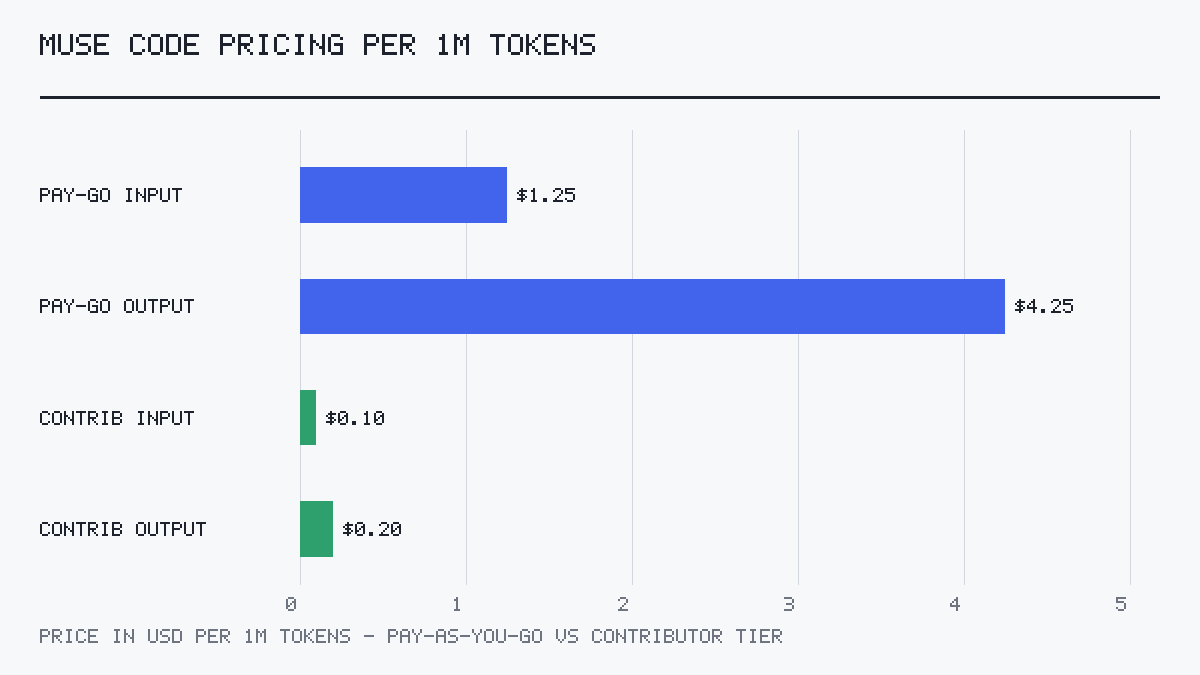
Muse Code uses pay-as-you-go token pricing at the same rates as Muse Spark 1.1: $1.25 per million input tokens and $4.25 per million output tokens. For context, a moderately complex coding session that involves planning, several file reads, and a few rounds of edits might use a few hundred thousand tokens — so typical single-session costs land well under a dollar for standard work.
| Tier | Input (per 1M tokens) | Output (per 1M tokens) | Trade-off |
|---|---|---|---|
| Pay-as-you-go | $1.25 | $4.25 | No data sharing required |
| Contributor | 10x+ cheaper | 10x+ cheaper | Opt in to model-improvement data sharing |
| Enterprise (zero-DR) | Custom | Custom | No data retention, available on request |
The contributor tier cuts costs by more than 10x in exchange for opting in to sharing your usage data to improve Meta’s models. For individual developers and startups with tight budgets, this is a meaningful option — provided the codebase does not contain proprietary or regulated data. Enterprises that need guaranteed data isolation can request a zero-data-retention arrangement from Meta directly.
Muse Code vs Claude Code and OpenAI Codex
Muse Code enters a market that Anthropic’s Claude Code has shaped and OpenAI’s Codex helped establish. The comparison is not simply about benchmarks — it comes down to architecture, pricing, and ecosystem fit.
Where it stands
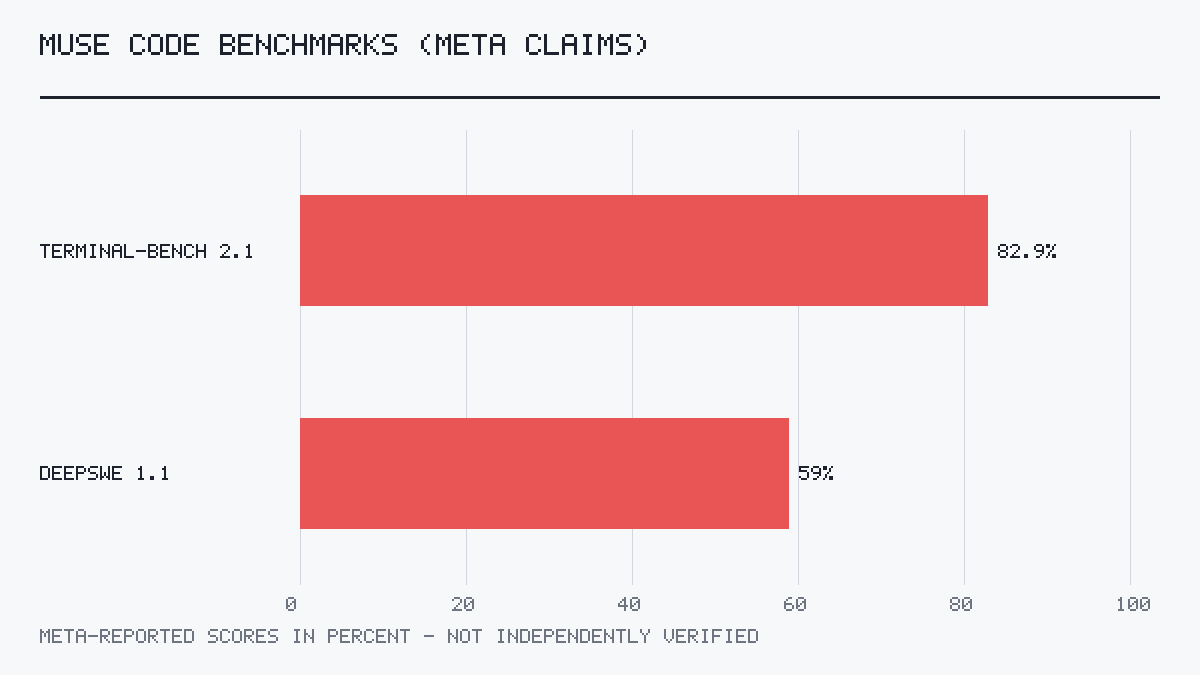
Meta claims strong benchmark scores: approximately 82.9% on Terminal-Bench 2.1 and around 59% on DeepSWE 1.1. These are Meta’s own figures and have not been independently verified; independent results on Terminal-Bench 2.1 are not yet available as of the beta launch. Wang’s own pitch is that Muse Code differentiates on price, not capability — a signal that Meta expects the benchmark gap between the leading agents to narrow quickly.
| Agent | Developer | Key model | Terminal-Bench 2.1 | Pricing (input/output per 1M) |
|---|---|---|---|---|
| Muse Code | Meta | Muse Spark 1.2 | ~82.9% (Meta claim) | $1.25 / $4.25 |
| Claude Code | Anthropic | Claude (latest) | Not directly reported | Usage-based |
| OpenAI Codex | OpenAI | GPT-4o / o-series | Not directly reported | Usage-based |
The key architectural and strategic differences between the three agents at launch:
- Parallelism: Muse Code fans out to isolated worktrees; Claude Code and Codex run single-threaded by default
- Restart-safety: Muse Code’s local event log is a first-class feature; the others rely on session context
- Price: Muse Code’s contributor tier is more than 10x cheaper than pay-as-you-go rates from either rival
- Ecosystem: Claude Code has the most mature integration ecosystem; Codex has the longest lineage
Claude Code is well established and has a large ecosystem of integrations; OpenAI Codex has a longer history but the current Codex CLI targets a similar developer workflow. Muse Code’s contributor tier, if the data-sharing trade-off is acceptable, makes it significantly cheaper than either competitor at launch.