
SynthID Watermark on AI Images: Invisible Proof of Origin
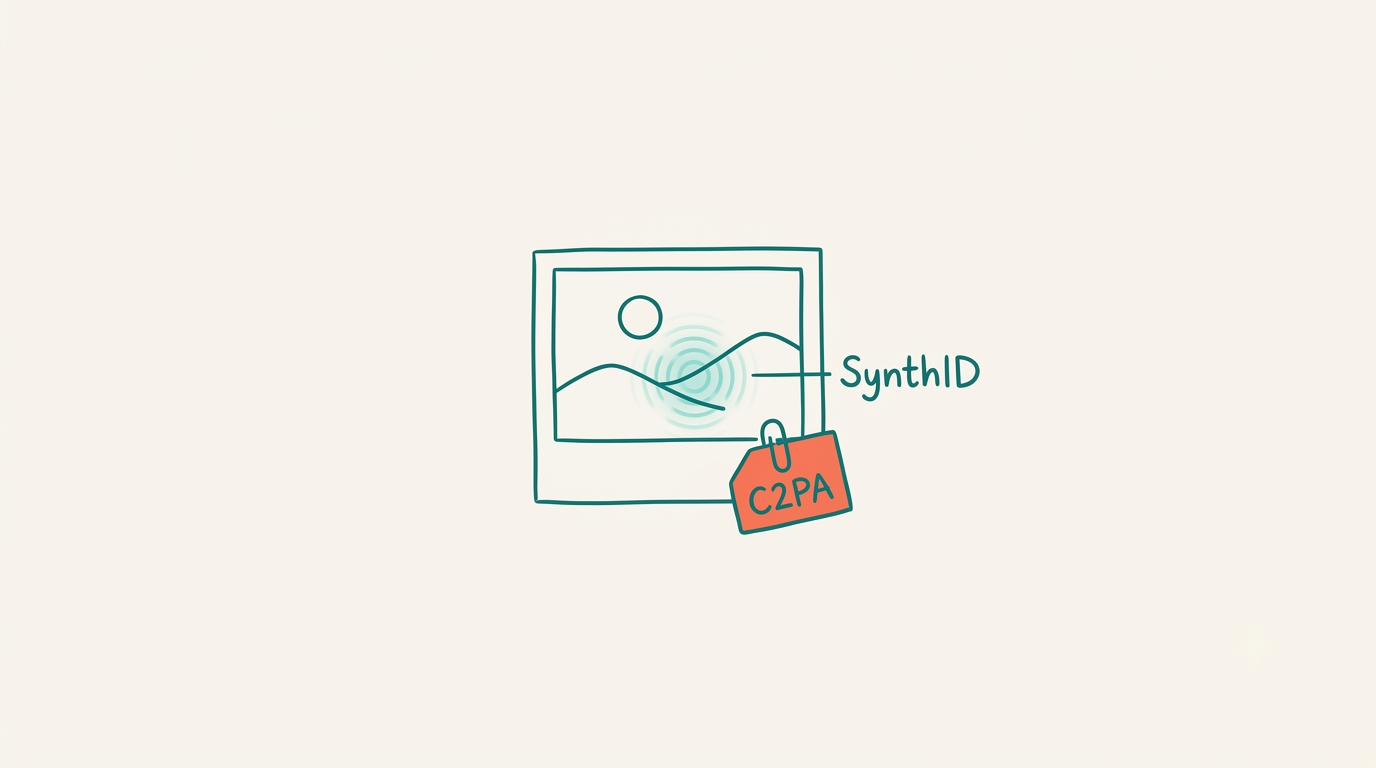
Every image generated through ChatGPT, Codex, or the OpenAI API carries two invisible markers: Google DeepMind’s SynthID watermark and C2PA provenance metadata. These technologies ship with ChatGPT Images 2.5 and make it possible to verify that a picture was AI-created — even after resizing or compression. The system card published September 8, 2026 details the full provenance approach.
What Is SynthID?
SynthID is an imperceptible watermarking technology developed by Google DeepMind. It encodes a signal directly into pixel values — statistically detectable by SynthID’s classifier but invisible to the human eye.
SynthID is designed to be robust to common image manipulations — including cropping, colour adjustments and lossy compression — while remaining imperceptible to people.Google DeepMind, SynthID technical overview
OpenAI applies SynthID across three surfaces:
- ChatGPT — consumer interface, all tiers including free
- Codex — developer automation workflows
- OpenAI API — GPT-Image-2.5 Flare and Sunburst models
Provenance tracking is not opt-in — it ships with every generated image automatically.
C2PA: The Metadata Layer
Each image also carries C2PA metadata — an open standard embedding a signed manifest that records the creator, tool, and timestamp. OpenAI participates in the C2PA Conformance Program, meaning its implementation is independently audited.
| Layer | Technology | Survives screenshot? |
|---|---|---|
| Pixel-level | SynthID (Google DeepMind) | Yes |
| File metadata | C2PA manifest | No |
The two layers are complementary: C2PA can be stripped by re-saving, but SynthID survives because it lives in the image pixels. Together they provide redundancy.
How to Verify Provenance
- Open the image in a C2PA-compatible viewer (e.g. Content Credentials Verify).
- Check the signed manifest — it lists the generating app, model, and timestamp.
- If metadata was stripped, submit the image to a SynthID-capable detector.
- A positive SynthID signal confirms AI generation even without file metadata.
Use cases include editorial fact-checking, platform moderation, and legal evidence.
Connection to Safety
The SynthID Wikipedia entry notes the technology first launched for Imagen in August 2023 and has since expanded to audio, video, and text. OpenAI’s adoption brings it to one of the highest-volume platforms — over 3 billion images per week across ChatGPT Images and the GPT-Image API.
Watermarking sits at the output end of OpenAI’s safety pipeline. Adversarial evaluations measured 1.09% unsafe generations for Sunburst and 1.41% for Flare, versus a 1.64% baseline for Images 2.0. Both provenance layers are applied after all moderation checks pass.
For builders using GPT-Image-2.5 Flare or GPT-Image-2.5 Sunburst, SynthID and C2PA metadata are applied automatically — no extra API parameters required.
FAQ
What is SynthID watermark on AI images?
SynthID is an imperceptible watermark by Google DeepMind embedded in pixel values. It allows AI-origin detection even after cropping, compression, or screenshotting.
Does ChatGPT watermark generated images?
Yes. Every image from ChatGPT, Codex, or the OpenAI API carries a SynthID invisible watermark plus C2PA provenance metadata.
Can SynthID watermark be removed?
SynthID is encoded in pixel values, not file metadata, making it significantly harder to strip than C2PA. It is designed to survive common manipulations like resizing and lossy compression.
What is C2PA metadata?
C2PA is an open standard embedding a signed manifest into an image file — recording creator, tool, and timestamp. OpenAI participates in the C2PA Conformance Program.
Which OpenAI products apply SynthID?
ChatGPT, Codex, and the OpenAI API — including GPT-Image-2.5 Flare and Sunburst. All tiers, all surfaces.
How do I verify if an image was AI-generated?
Use a C2PA viewer like Content Credentials Verify for the metadata layer, or a SynthID detector if metadata was stripped.