
Creator Micro 2: The Compact Macropad Powering OpenAI’s Codex Micro
The Creator Micro 2 is a compact programmable macropad made by Work Louder — and the direct hardware foundation of the Codex Micro, OpenAI’s $230 AI-focused developer keyboard that launched in July 2026. It packs 13 low-profile mechanical switches, a clickable rotary encoder, a 2D analog joystick, and six programmable layers into a frame not much larger than a smartphone. Work Louder sells it from $144 (wired Base) and $174 (Bluetooth Pro), making it a legitimate alternative to Stream Deck for any developer or creative professional who prefers real keypresses over membrane LCD buttons.
What Is the Creator Micro 2?
Hardware Overview
The Work Louder Creator Micro 2 is a boutique compact macro pad with a PMMA (polycarbonate) shell — the Base model uses a polycarbonate frame while the Pro upgrades to a CNC metal frame with PC core. The input surface includes 13 low-profile mechanical MX-style switches, a clickable rotary encoder for scroll and dial inputs, a capacitive touch sensor on the surface for layer cycling, and a 2D analog joystick. RGB backlight and underglow ship standard on every unit.
The footprint is roughly that of a large smartphone — small enough to live to the left of a TKL keyboard without dominating the desk. Its weight is light enough to toss in a laptop bag alongside a travel keyboard, and the Pro’s CNC metal frame gives it significantly more rigidity than the polycarbonate housing on the Base model or competing budget pads.
Work Louder specs the CM2 for Mac, iOS, Windows, Android, and Linux compatibility out of the box. On the Base model that means plug-in USB-C and go; on the Pro, you pair via Bluetooth Low Energy the same way you’d pair a wireless keyboard.
Work Louder Company Background
Work Louder is a boutique keyboard and input device maker whose entire product line targets creative professionals. Before the Creator Micro 2, they built the Creator Board XL modular macropad and the Nomad keyboard with an integrated display strip. Their co-branded device history is instructive: the Figma Creator Micro (announced December 2023) and the Framer Creator Micro 2 followed a clear pattern — the Creator Micro 2 chassis, customized keycap art, and pre-configured shortcuts for a specific software partner.
The OpenAI partnership for the Codex Micro in 2026 is the third iteration of that playbook. Work Louder supplies the hardware; the software partner brings the branding, keycap iconography, and firmware defaults.
Creator Micro 2 Specs and Pricing
Base vs Pro — Which Model to Choose
The Creator Micro 2 ships in two configurations. The Base model starts at $144 and connects via USB-C with a braided cable. The Pro model starts at $174 and adds Bluetooth Low Energy with a built-in 2,100 mAh battery for fully cable-free desk use. Both variants include Work Louder’s custom low-profile switches in 55g or 50g linear (silent or clicky options), and both support both the Input configurator and VIA remapping without any firmware differences.
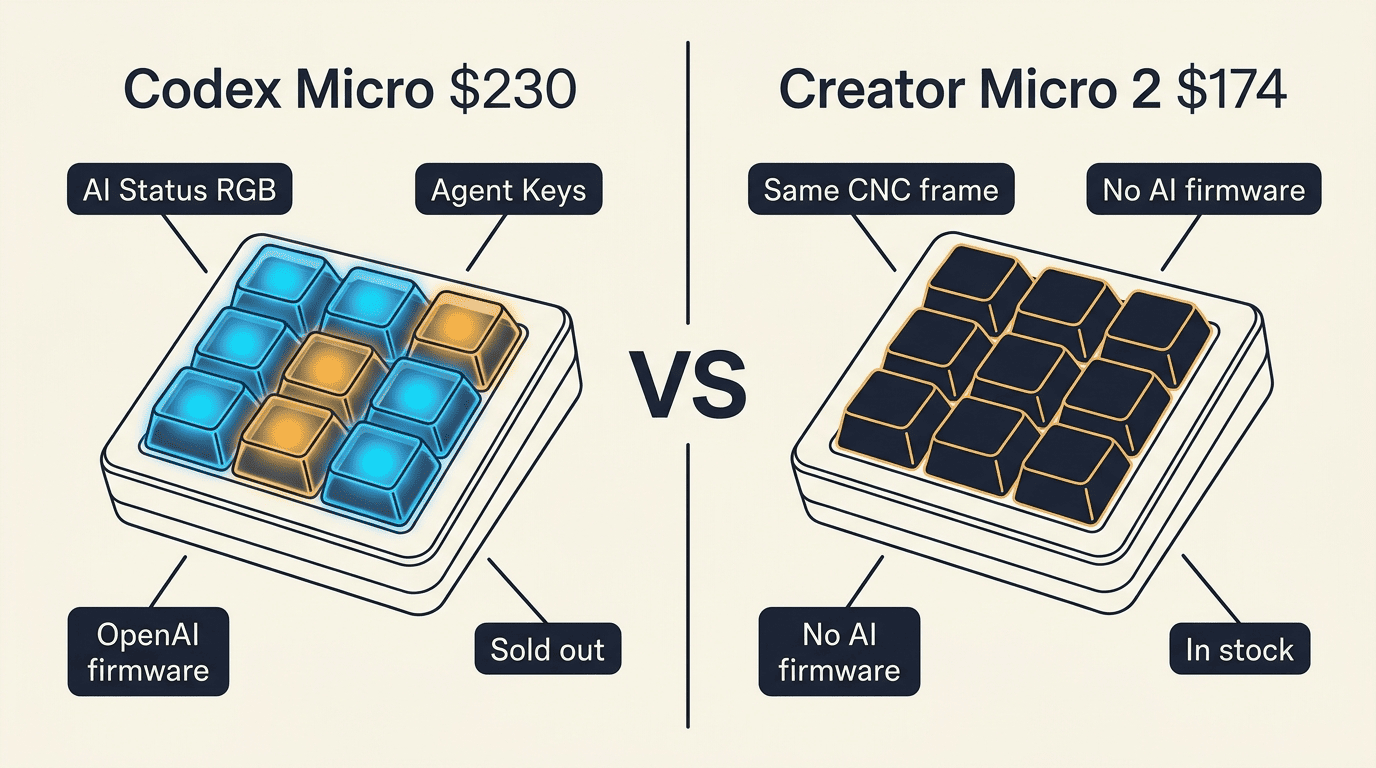
For context on the value proposition: the Codex Micro — the OpenAI-branded version built on this exact chassis — launched at $230. That’s a $56 premium over the Creator Micro 2 Pro for co-branding, Codex-specific keycap iconography, and Codex-targeted firmware defaults. The underlying switches, joystick, and encoder are identical.
Full Technical Specifications
| Specification | Creator Micro 2 Base | Creator Micro 2 Pro |
|---|---|---|
| Price | From $144 | From $174 |
| Switches | Work Louder low-profile 55g / 50g | Work Louder low-profile 55g / 50g |
| Switch type | Silent linear or clicky | Silent linear or clicky |
| Switch housing | POK stem / POM housing | POK stem / POM housing |
| Keycaps | Single-shot PBT, low profile | Single-shot PBT, low profile |
| Frame | Polycarbonate (PC) | CNC metal + PC core |
| Shell | PMMA (polycarbonate) | PMMA (polycarbonate) |
| Connectivity | USB-C wired | USB-C + Bluetooth Low Energy |
| Battery | None | 2,100 mAh |
| Layers | 6 programmable | 6 programmable |
| Compatibility | Mac, iOS, Windows, Android, Linux | Mac, iOS, Windows, Android, Linux |
| Shipping | 1–3 business days | 1–3 business days |
The single-shot PBT keycaps on the Creator Micro 2 are a different low-profile standard from the original Creator Micro v1. If you’re upgrading, note that v2 keycaps are not backward-compatible with v1 switch housings.
How to Program the Creator Micro 2
VIA Configurator — Open-Source Remapping
The Creator Micro 2 supports VIA, the most widely-used open-source GUI for QMK firmware-based keyboards. Open usevia.app, plug in the device over USB-C, and remap any key in real time — no firmware reflashing required. VIA exposes the full QMK layer stack and lets you assign keyboard shortcuts, macros, media controls, mouse buttons, or modifier combos to each of the 13 keys and the rotary encoder, across all six layers simultaneously.
Because macros compile down to standard HID keycode sequences stored in the device’s flash memory, they travel with the hardware. Take the Creator Micro 2 to a different machine, a friend’s desk, or a conference room and every layer loads exactly as configured — no cloud sync, no software install required on the host.
Setting up your first layer takes under five minutes:
- Plug the Creator Micro 2 into your computer via USB-C
- Open usevia.app in Chrome or Edge (Firefox is not supported)
- Click “Authorize device” and select Creator Micro 2 from the popup
- Choose Layer 0 in the layer selector — this is your default active layer
- Click any key in the visual layout and assign a shortcut, macro, or media command
- Repeat the process across layers 1–5 for your other apps or contexts
- Unplug at any point — all assignments save instantly to on-device flash memory
Work Louder Input Configurator — App-Aware Layers
Work Louder’s proprietary Input configurator adds a layer of intelligence that open-source VIA cannot match: active-application detection. When you switch from Figma to VS Code to Final Cut Pro, the Input tool detects the foreground application and automatically transitions the CM2 to the designated layer for that app. No manual layer cycling, no fumbling with the capacitive sensor mid-task.
The Input configurator is how we made the Creator Micro 2 feel less like a keyboard accessory and more like a per-app control surface. The key thing is zero friction on context switch.
Work Louder, Creator Micro 2 product page
The Input tool also supports multi-step macro sequences — chains of actions triggered by a single keypress — and a community preset library where other Creator Micro 2 users share their layer configurations for popular apps. For a developer or designer who works across five or six applications daily, the automatic switching alone justifies the software over raw VIA.
Six Layers, Seven-Slot Radial Menu, and Joystick
The Creator Micro 2 has 6 discrete programmable layers. Each layer holds 13 key assignments, a 7-slot radial menu triggered by the 2D joystick, and one dial assignment for the rotary encoder. Doing the math: 13 × 6 = 78 key slots, plus 7 × 6 = 42 radial menu slots, plus 6 dial actions — over 120 programmable actions in a device that fits in one hand.
The joystick’s radial menu works by tilting the stick in any of the seven directions (plus center), displaying an on-screen overlay with the assigned action labels. This brings seven additional actions per layer to fingertip reach without consuming a key slot. The capacitive touch sensor on the surface cycles through layers manually, while three quick taps on it switch between BLE Bluetooth channels 1, 2, and 3 on the Pro model — useful for pairing to a desktop, a laptop, and a tablet simultaneously.
See also: how the rotary encoder dial behaves across layers and which dial assignments work best for developers.
Creator Micro 2 vs Stream Deck
The Creator Micro 2 and the Elgato Stream Deck target overlapping but distinct users. Both are programmable shortcut pads. The design philosophy behind each could hardly be more different.
| Feature | Creator Micro 2 | Stream Deck MK.2 |
|---|---|---|
| Keys | 13 mechanical switches | 15 LCD membrane keys |
| Key feel | Tactile / clicky mechanical | Silicone membrane |
| Macro storage | On-device (QMK flash) | Requires host software |
| Software dependency | Optional (VIA/Input) | Required (Elgato service) |
| OS support | Mac, Windows, Linux, iOS, Android | Mac, Windows only (full features) |
| Price | From $144 | From $119.99 (MSRP $149.99) |
| Wireless | Pro model (BLE) | No |
| Customizable display | No (printed keycaps) | Yes (per-key LCD) |
| Community presets | Input configurator library | Elgato Marketplace |
Where Stream Deck Wins
The Stream Deck excels in live streaming and multi-app production workflows that benefit from visual per-key feedback. LCD icons that change dynamically — showing live viewer counts, recording status, or scene labels — are genuinely useful for streamers and video producers monitoring multiple outputs. The Elgato Marketplace spans OBS, Twitch, Adobe Creative Cloud, Spotify, and hundreds of third-party plugin integrations. For content creators who want visual key labels that update based on state, Stream Deck remains the category benchmark.
Where Creator Micro 2 Wins
The Work Louder macropad inverts every Stream Deck trade-off with intent. Real mechanical switches — tactile, fast, and satisfying — replace the silicone membrane domes underneath the Stream Deck’s LCD panels. Macros live in the CM2’s flash memory, so no host service needs to run in the background, and the pad works on Linux and iPadOS where Elgato’s software either won’t run or loses features. The Creator Micro 2 Base at $144 undercuts the Stream Deck MK.2 (currently priced around $119–$150 depending on retailer and promotions) while delivering a fundamentally better typing experience.
The deeper advantage is longevity. Stream Deck’s usefulness depends on Elgato’s software staying maintained for your OS version — a real concern for a USB accessory meant to last a decade. The Creator Micro 2 on QMK/VIA is a standard HID device. It will work identically in 2036 regardless of Work Louder’s corporate status, because every macro is stored locally on-device and the firmware is open source.
Creator Micro 2 as the Codex Micro Platform
Same Frame, Different Firmware
The Codex Micro is OpenAI’s AI coding keyboard launched July 15, 2026, priced at $230 and built directly on the Creator Micro 2 chassis. When OpenAI posted the teaser video on June 29, 2026, hardware enthusiasts immediately recognized the form factor: the same 13-key layout, the same rotary encoder placement, the same joystick position. There was no mystery about the manufacturer.
The $56 premium over the Creator Micro 2 Pro covers co-branding, Codex-specific keycap iconography (keycaps printed with AI coding actions rather than generic symbols), and whatever Codex-targeted firmware OpenAI ships as defaults. The switches, joystick, encoder, and core input layout are spec-for-spec identical to the standard CM2 Pro.
The Partnership Playbook
Work Louder has executed this model three times now, and each iteration follows the same structure:
- Take the Creator Micro 2 chassis
- Commission partner-branded keycap art
- Load partner-specific default shortcuts
- Launch with co-marketing from the software partner
- Sell through the partner’s channel at a premium
Figma Creator Micro (December 2023), Framer Creator Micro 2, and finally Codex Micro (July 2026). The co-branded devices reach audiences who would never visit a boutique keyboard shop; the Creator Micro 2 in Work Louder’s direct store reaches enthusiasts who want the same hardware with complete remapping freedom.
Buying the Creator Micro 2 directly gives you the identical hardware at the lower price. Via VIA or the Input configurator, you can build any Codex, Figma, or custom workflow layout you want — and change it whenever your toolset evolves. The Codex Micro’s firmware defaults lock you into one configuration by default (though Work Louder’s partnership means VIA remains accessible).
Creator Micro 2 vs Creator Micro v1 — What Changed
The Creator Micro 2 is not a minor refresh to the original. The differences are significant enough that Work Louder treats them as incompatible hardware generations:
- Layers: v1 had 4 programmable layers; Creator Micro 2 increases that to 6 discrete layers
- Joystick: the 2D analog joystick and its 7-slot radial menu system did not exist on v1
- Wireless: Creator Micro 2 Pro adds Bluetooth Low Energy; v1 was wired-only across all variants
- Keycap standard: Creator Micro 2 keycaps use a different low-profile standard — NOT compatible with v1 switch housings
- Configurator: v1 supported VIA only; Creator Micro 2 also supports Work Louder’s Input app with contextual layer auto-switching
- Frame: v1 uses a polycarbonate case with CNC aluminum weight; Creator Micro 2 Base uses PC frame while Pro upgrades to CNC metal frame — and the v2 chassis adds the joystick cutout that v1 lacked
If you own a v1 and are considering an upgrade, the layer count, joystick, and wireless alone make it a significant step up. Just budget for new keycaps if you want to customize the legends — your v1 caps won’t transfer.