
Work Louder: The Hardware Studio Behind OpenAI’s Codex Micro Keyboard
Work Louder is the Montréal-based hardware studio that built the physical backbone of the Codex Micro — OpenAI’s $230 AI agent keyboard released in July 2026. The boutique keyboard maker brings its CNC metalworking craft and a decade of macropad know-how to OpenAI’s first branded hardware. Work Louder’s design DNA is simple: playful, versatile, and built for creative professionals who want tactile shortcuts rather than another software dashboard.
Who Is Work Louder? The Studio Behind the Keys
Work Louder Inc. positions itself as a company that makes products “for people, inspired by a version of themselves sometimes forgotten — playful, versatile, and above all else, creative.” Unlike large peripherals brands targeting the gaming market, the boutique keyboard manufacturer Work Louder focuses on compact macropads and low-profile keyboards for designers, developers, and content creators who need tactile shortcuts at their fingertips. The studio specializes in shallow-travel mechanical keyboards with premium CNC-machined aluminum frames and programmable firmware built around their proprietary Input configurator.
A Studio Built for Creators, Not Enterprises
Work Louder’s entire catalog targets a specific kind of professional: someone who runs the same digital actions hundreds of times a day and wants to move those actions off a cluttered keyboard and onto dedicated physical controls. The studio’s language avoids enterprise jargon entirely — they talk about joy, play, and creativity in the same breath as specifications and firmware. That tone carried directly into the OpenAI collaboration, where the pitch wasn’t “productivity tool” but rather “an extension of your creative flow.”
The Work Louder hardware studio keeps its product line tight on purpose. Rather than releasing dozens of SKUs, they have iterated deeply on one form factor — the compact square macropad — across multiple generations. This focus means their firmware, configurator tooling, and mechanical switch choices are all optimized for the same use case.
The Creator Micro Lineup
Work Louder’s flagship product family is the Creator Micro — a small, square macropad with 13 mechanical switches, a rotary encoder (dial), and a joystick. The current generation, the Creator Micro 2, comes in two versions:
- Base: wired only, from $144, ships worldwide in 1–3 business days
- Pro: Bluetooth + USB-C, 2100mAh battery, from $174, same shipping window
Both versions support Mac, iOS, Windows, Android, and Linux out of the box. The key differentiator of the Creator Micro format is its 6-layer system: each layer gives you 13 remappable keys, a 7-slot joystick radial menu, and a dial action — yielding 78+ programmable shortcuts in a footprint smaller than a smartphone.
Brand Collaboration History: Figma, Framer, and Now OpenAI
Work Louder has built a track record of co-branded editions with software companies. The Figma Creator Micro came first — a special edition macropad pre-mapped to Figma design shortcuts. Framer followed with its own keycap set tuned to web design workflows. These collaborations established Work Louder as the go-to hardware partner for software platforms that want a physical companion for their tools.
Each partnership followed the same formula: take the Creator Micro chassis, ship it with software-specific keycaps and pre-configured presets, and let the software community drive adoption:
- Figma Creator Micro — design shortcut macropad for UI designers
- Framer Creator Micro — web design keycap set and presets
- Codex Micro (OpenAI) — AI agent controller with live RGB status integration, $230
The OpenAI Codex Micro is the most ambitious iteration yet — and the first to add firmware-level status integration rather than just cosmetic keycaps. It also marks Work Louder’s first partnership with a company operating in the generative AI space, a shift from creative-software brands toward developer tooling.
The OpenAI Partnership: How Codex Micro Was Born
OpenAI’s rationale for working with Work Louder was strategic: test demand for dedicated hardware among power users without committing to a full supply chain build-out. By partnering with an established maker that already had CNC tooling, firmware expertise, and fulfillment infrastructure, OpenAI could ship a real product in months rather than years. The OpenAI Supply Co. positions the relationship as a co-lab partnership, not a white-label deal — Work Louder’s name and branding appear prominently on the product page.
The timing aligned with Codex’s growth trajectory. OpenAI’s agentic coding tool was approaching 9 million users at launch, with roughly 5 million active weekly. Power users running multiple parallel agent threads needed a faster way to monitor and control them than clicking through browser tabs. Work Louder’s existing joystick-and-encoder hardware was already solving a structurally similar problem for creative apps — mapping repetitive screen interactions to physical controls.
“We make things for people inspired by a version of themselves sometimes forgotten — playful, versatile, and above all else, creative.”
Work Louder Inc., official brand statement
Same Chassis, Different Firmware
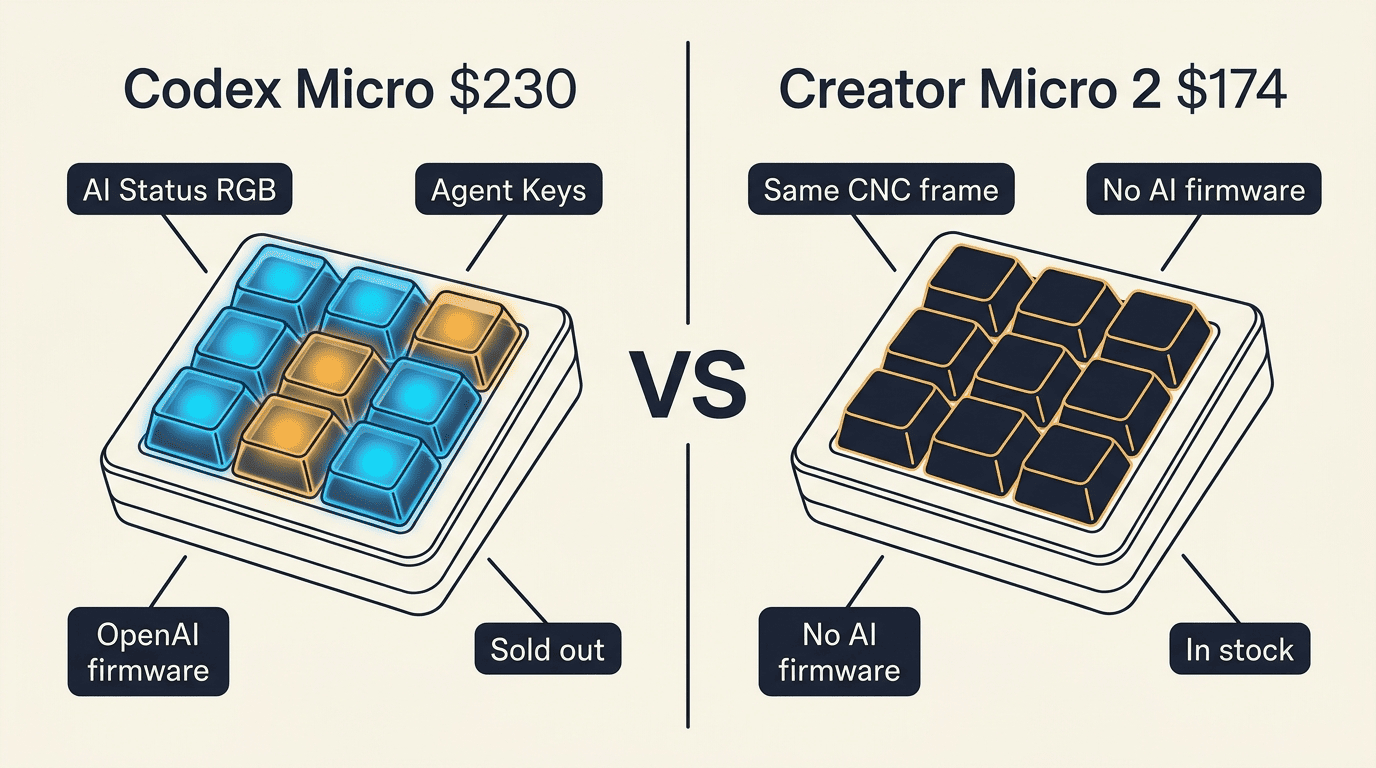
The Codex Micro is built on the Creator Micro 2’s PMMA (acrylic) shell (sandblasted finish) with an anodized aluminum base — the same physical hardware that powers Work Louder’s consumer line. The differentiation lives in firmware and keycaps: six frosted “agent keys” on the top row, 32 custom OpenAI icon keycaps, and direct software integration with ChatGPT Codex via Work Louder’s Input tool.
The result is a reskinned Creator Micro 2 at $230 — $56 more than the Pro model’s starting price. Whether that premium is worth it depends entirely on how many Codex agent threads you run simultaneously.
The Creator Micro 2 vs. Codex Micro: Same Frame, Different Focus
Understanding what Work Louder actually built requires separating hardware from firmware. Both devices share the same physical template: 13 mechanical switches (Work Louder custom low-profile, 55g or 50g linear, silent or clicky), 1 rotary encoder, 1 joystick, 1 touch sensor, Bluetooth (BLE) + USB-C connectivity, and RGB backlighting. The polycarbonate shell and CNC aluminum base construction are identical between the two product lines.
| Feature | Creator Micro 2 Pro | Codex Micro |
|---|---|---|
| Price | from $174 | $230 |
| Keys | 13 standard | 13 (6 frosted agent keys) |
| Keycaps | Standard | 32 icon + 11 solid + frosted |
| OS support | Mac, iOS, Windows, Android, Linux | Mac, Windows only |
| Connectivity | BLE + USB-C | BLE + USB-C |
| Battery | 2100mAh | 2100mAh |
| Codex integration | None | Native RGB status |
| Rotary encoder | General-purpose | Maps to reasoning depth |
| Joystick | Yes | Yes |
The Codex Micro’s premium is the Codex-native firmware integration and the agent key hardware — frosted keycaps with LEDs tuned to Codex status colors. Developers who don’t use Codex regularly will find the Creator Micro 2 Pro offers the same build quality at lower cost with broader platform support.
What the Agent Keys Actually Do
The six top-row agent keys are the Codex Micro’s headline feature. Each key is assigned to a Codex agent thread, and the backlit color reports the thread’s status at a glance without interrupting your editor focus:
- Open Codex and start an agent thread — the first available key lights up white (idle)
- The agent begins processing — the key turns blue (thinking)
- Work completes — the key turns green (complete); tap once to review output
- Agent needs a decision — amber light triggers; double-tap to bring the thread to foreground
- Something breaks — red indicates an error; tap to see the error message
- Push-to-talk (the large bottom button) sends voice input to the active Codex agent
Users can configure whether those six keys track pinned tasks, most recent tasks, or priority tasks needing human input. The practical ceiling: running 7 or more simultaneous agent threads means overflow threads are not represented on the keys — you’ll manage them in the browser as before.
The rotary encoder on the Codex Micro maps to reasoning depth — letting developers dial between lightweight quick completions and slower, deeper agent runs with a physical turn. That control is not present on the consumer Creator Micro 2.
Work Louder’s Input Tool: The No-Code Configurator
Input is Work Louder’s proprietary “no-code” keyboard configurator app. It lets users remap any key, dial action, or joystick gesture across up to six programmable layers without writing firmware. For Codex Micro users, Input also unlocks up to five additional custom layers beyond the Codex-native defaults — meaning the device can pull double duty with any application, not just Codex.
Contextual preset switching is Input’s most practically useful feature: the Micro detects which application is active and automatically loads the corresponding preset. Your keys behave differently in VS Code, in Figma, in a browser — without you doing anything. A community preset library lets creators share and download shortcut configurations made by other users, which dramatically shortens the time needed to get useful layouts for popular apps.
How to set up Input for a new application:
- Download Input from worklouder.cc and connect the Micro via USB-C or Bluetooth
- Open Input and select “New Layer”
- Click any key slot to assign a keyboard shortcut, macro, or action
- Enable “App Detection” and choose the target application from the dropdown
- Save the layer — it will activate automatically when that app is in focus
- Optionally share the preset to the community library
Apps with active community preset libraries include VS Code (code navigation, terminal shortcuts), Figma (component insert, auto-layout, zoom), Adobe Premiere Pro (timeline trimming, playback), and DaVinci Resolve (color grading, cut navigation).
| Input Feature | Creator Micro 2 | Codex Micro |
|---|---|---|
| Programmable layers | 6 | 6 Codex defaults + 5 custom |
| Contextual app switching | Yes | Yes |
| Community presets | Yes | Yes |
| Codex agent status config | No | Yes |
| Joystick radial menu slots | 7 per layer | 7 per layer |
| No-code remapping | Yes | Yes |
The Input tool ships free with every Work Louder device — there is no subscription or premium tier. It works as a desktop app on Mac and Windows.
Work Louder’s Design Philosophy: Why Physical Controls for AI?
The problem Work Louder is solving with the Codex Micro is a new version of an old workflow pain: too much window-switching. Developers running multiple parallel AI coding agents spend significant time clicking between browser tabs to check whether their agents have finished, failed, or are waiting on input. The six agent keys with live RGB status eliminate that loop — the physical surface reports what’s happening without interrupting your editor focus.
This is a natural extension of Work Louder keyboard studio’s core philosophy. The same logic that makes a rotary encoder better than Ctrl+Z for undo, or a joystick radial menu better than hunting through menu bars, applies to AI agent monitoring. Physical controls are faster to read and act on than on-screen indicators precisely because they live in peripheral vision and under your fingers simultaneously.
The Work Louder macropad maker has spent years proving that physical controls reduce context-switching for creative professionals. The Codex Micro extends that argument to AI developers: as agent threads multiply, the bottleneck shifts from the AI’s capability to the human’s ability to manage, monitor, and direct concurrent work without losing focus. Dedicated physical controls — with eyes-free status feedback — are one credible answer to that bottleneck.
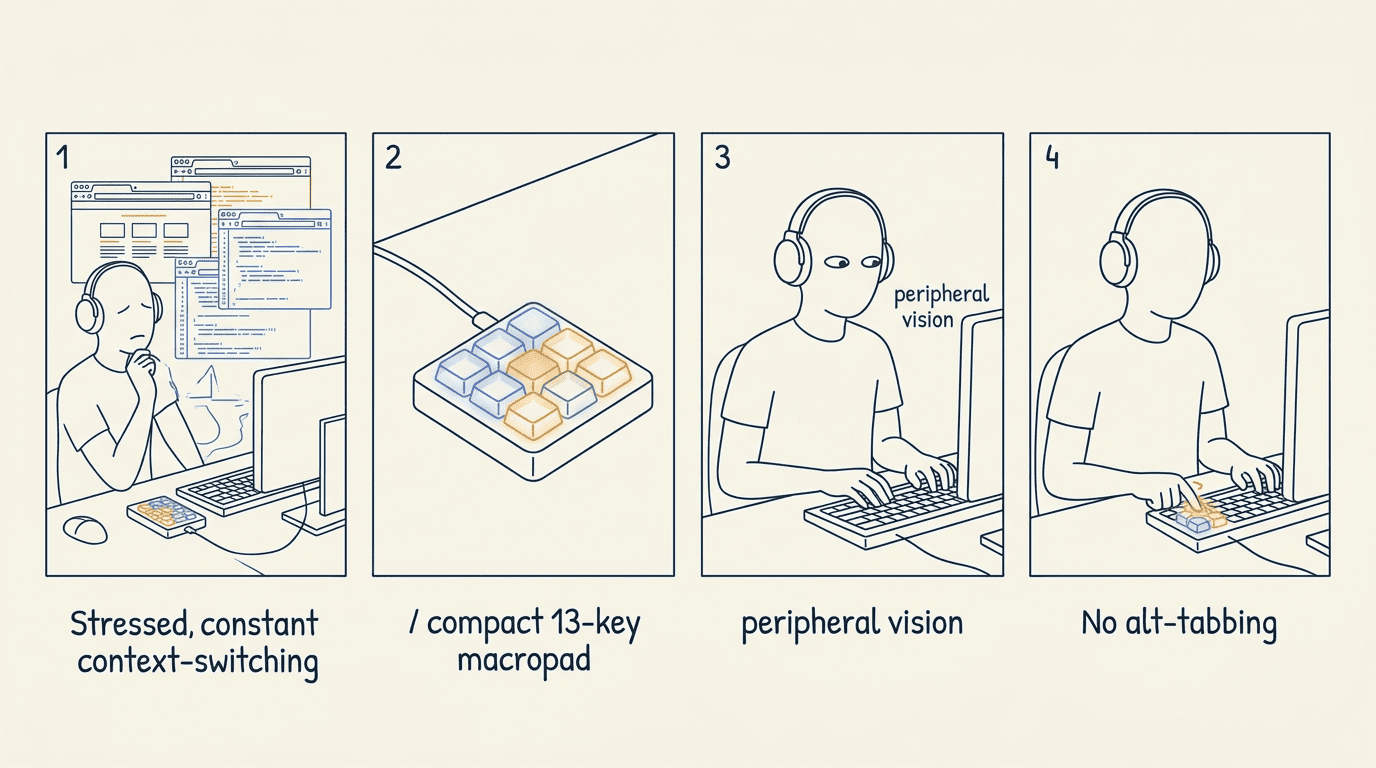
Work Louder AI keyboard’s broader bet is that this problem will only get more acute as AI coding tools mature. The Codex Micro’s dial defaults to adjusting reasoning depth — letting developers switch between quick lightweight completions and slower, deeper runs with a physical turn rather than hunting a dropdown in the UI. That tactile-first approach to AI interaction is Work Louder’s contribution to a question the hardware industry is still working out: what should human-AI interaction hardware look like?