
Jony Ive’s OpenAI Smart Speaker: What the Screenless ChatGPT Device Really Is
The Jony Ive OpenAI smart speaker is a rumored, screen-free home device — reportedly a “computer built for AI” designed by Ive’s studio and OpenAI’s io hardware group, according to Bloomberg. It should not be confused with the Codex Micro macropad, a separate, already-shipping keyboard accessory for developers.
Nothing about the speaker has been announced officially. Everything known so far traces back to Bloomberg’s reporting — an initial account in February 2026, followed by a more detailed Bloomberg report on July 14, 2026 — and every spec below is attributed reporting, not a confirmed feature. If the timeline holds, the device would reportedly arrive sometime in 2027.
What the Jony Ive OpenAI Smart Speaker Is
OpenAI’s io hardware group and Jony Ive’s design studio, LoveFrom, are reportedly building a screen-free companion device meant to feel present rather than passive. Inside OpenAI, people are said to avoid calling it a “speaker” at all — the internal description is closer to a small home computer built around ChatGPT.
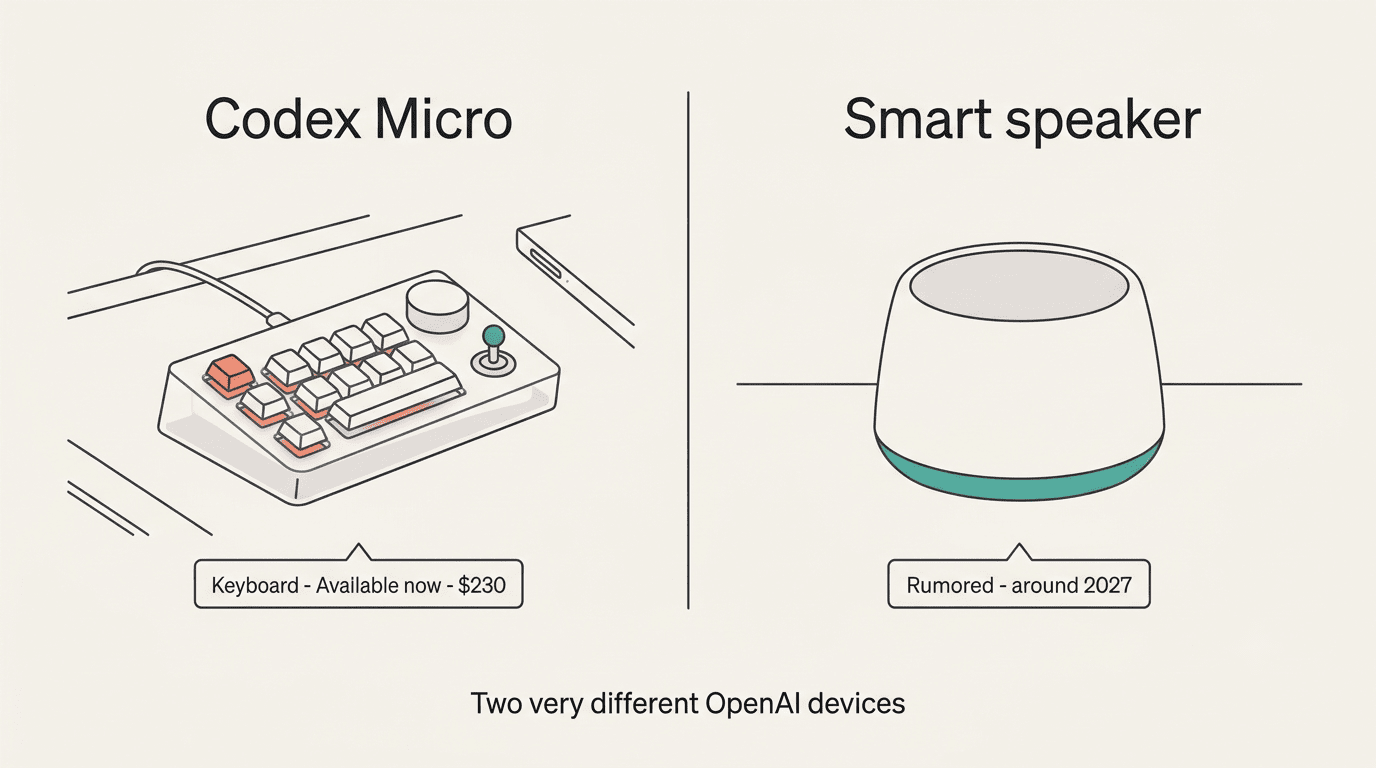
A screenless home computer, not a gadget
According to Bloomberg’s sourcing, the device is a portable, screenless smart speaker with a camera, ambient sensors, and its own battery, so it can be carried from room to room like a lamp rather than staying plugged into one outlet. It reportedly also includes small motorized parts that move on their own, a design choice apparently meant to make the object feel alive instead of idle while it waits for a wake word. None of this has been confirmed by OpenAI, Ive, or LoveFrom directly — it is reported detail, not a spec sheet.
Reported hardware elements include:
- A built-in camera for reading its surroundings
- Ambient environmental sensors
- An internal battery, for portability room to room
- Small motorized parts that move on their own
- No screen of any kind
Proactive personalization
The device is said to grow more personalized and more proactive over time, reportedly pulling in personal data — including email — to anticipate what a person needs and surface it unprompted, rather than only responding to spoken requests. That same proactivity is the device’s biggest privacy question: a home speaker that already reads your inbox is either genuinely useful or genuinely uncomfortable, and reporting so far does not settle which.
Tasks it is reportedly meant to handle out of the box:
- Controlling smart-home appliances
- Playing media on request
- Answering everyday questions
- Responding to messages
- Drawing on ChatGPT’s broader capabilities for open-ended tasks
Codex Micro vs the Smart Speaker: Two Different OpenAI Devices
It helps to be blunt about the naming collision, because both products get called “OpenAI’s first device” in casual conversation, and only one of them actually exists yet.
The shipping device vs the rumored one
Codex Micro is a compact macropad for developers, built with boutique keyboard maker Work Louder through OpenAI’s official co-lab program and running on OpenAI Codex as its underlying coding agent — it has already shipped to customers who ordered it. The smart speaker is something else entirely: io’s first planned consumer product, still unannounced and, as of this writing, unreleased. People conflate the two mostly because of the shared “OpenAI’s first hardware” framing, but one is a $230 accessory sitting on a desk today, and the other is a rumored home device that may not exist in finished form for another year. For a look at the keyboard side of that comparison, see Work Louder’s keyboard, the physical product Codex Micro is built on.
| Codex Micro | Jony Ive smart speaker | |
|---|---|---|
| Status | Shipping | Rumored, unannounced |
| Maker | OpenAI + Work Louder | OpenAI’s io + LoveFrom |
| Form factor | Physical keyboard macropad | Screenless speaker |
| Software engine | OpenAI Codex | GPT-Live (reported) |
| Reported price | ~$230 | ~$200-$300 |
| Target user | Developers | Home / consumer |
Who Is Building It: Jony Ive, io, and LoveFrom
The team behind the rumored speaker is a small group of former Apple hardware leaders now working under OpenAI, alongside Ive’s own design firm.
Jony Ive is the former Apple chief design officer who led the look of the iPhone and much of Apple’s hardware line for over two decades, and who now runs the independent design studio LoveFrom, according to Ive’s Wikipedia entry. io Products is the hardware startup he co-founded that OpenAI has acquired outright, per io’s Wikipedia page. Evans Hankey and Tang Tan, both ex-Apple hardware executives, are reported to lead the speaker’s development and hardware strategy respectively.
The $6.5bn io acquisition
OpenAI reportedly acquired io Products for roughly $6.5 billion in 2025, after already holding about a 23% stake, paying an additional sum in the neighborhood of $5 billion to take the rest. io was co-founded by Jony Ive alongside former Apple executives Scott Cannon, Evans Hankey, and Tang Tan. LoveFrom, Ive’s design studio, is reported to be steering the product’s design language. Altman and Ive are said to have been collaborating on hardware ideas for close to two years before any of this became public.
The names most associated with the project so far:
- Jony Ive — LoveFrom founder, former Apple chief design officer, co-founder of io
- Evans Hankey — reportedly leading development of the speaker itself
- Tang Tan — reported chief hardware officer at OpenAI’s io group
- Scott Cannon — io co-founder, former Apple hardware executive
- Paul Meade — formerly led Apple’s Vision Pro team, reportedly hired into the project
AI is an incredible technology, but great tools require work at the intersection of technology, design, and understanding people and the world. No one can do this like Jony and his team.Sam Altman, “A letter from Sam & Jony,” OpenAI
Price, Release Date, and the Apple Lawsuit
Two things stand between “rumored” and “on shelves”: a firm launch date, and a lawsuit that could delay or block one entirely.
When and how much. OpenAI is reportedly targeting an announcement sometime this year, with an actual release pushed out to 2027. Reported pricing lands in the $200 to $300 range — above Amazon’s $99 Echo Dot, and roughly in line with or slightly under Apple’s HomePod mini. None of these figures are confirmed by OpenAI.
| Milestone | Reported status |
|---|---|
| Official announcement | Not yet — expected sometime in 2026 |
| Consumer release | Targeted for 2027 |
| Price | Rumored $200-$300, unconfirmed |
| Apple lawsuit | Filed July 10, 2026; outcome pending |
| Software engine | Advanced GPT-Live, unconfirmed final build |
Apple’s trade-secret suit. Apple filed suit against OpenAI on July 10, 2026, alleging the misuse of Apple’s trade secrets and naming more than 400 former Apple employees who have since joined OpenAI. Apple is reportedly seeking an injunction that could block sales of the device outright. OpenAI has said it sees no merit in the claims. Markets reacted unevenly: Sonos shares dropped more than 10% on the news, while Apple’s own stock slipped less than 1%, touching a low around $313.52.
Here is a quick way to track whether the device is on schedule:
- Watch for an official OpenAI or io announcement — as of this writing, none has happened.
- Check whether Apple’s injunction request is granted or denied; a granted injunction could delay any release past 2027.
- Look for confirmed pricing from OpenAI directly, not just reported ranges.
- Track whether Evans Hankey or Tang Tan make any public statements about the hardware roadmap.
- Note any change in the reported 2027 release window — hardware timelines slip often.
How It Works and Where It Fits
Even the rumored software layer traces back to voice technology OpenAI already ships today, and the hardware category it would enter has a rough history.
Voice-first, full-duplex. The speaker is reported to run on an advanced version of GPT-Live, OpenAI’s full-duplex voice technology that listens and speaks at the same time, tolerates pauses mid-sentence, and is designed to stay focused on a speaker’s voice in a noisy room. More than 150 million people already use ChatGPT’s Voice and Dictation modes on a weekly basis, giving OpenAI a large existing base to build a hardware product around.
Learning from past AI hardware. The graveyard of standalone AI gadgets is not encouraging: the Humane AI Pin shut down after HP acquired its assets for $116 million, and Rabbit’s r1 struggled to find a lasting audience. ElliQ, a 2022-era companion device with its own moving parts, aimed at a similar “feels alive” pitch aimed at older users. OpenAI’s bet, as reported, is that LoveFrom’s specific expertise in making technology feel personal will succeed where earlier attempts failed — which is fundamentally a design argument, not a technical one.
Companies that have tried a screen-free AI companion device before include:
- Humane, with the AI Pin (discontinued, assets sold to HP)
- Rabbit, with the r1
- Amazon, with the Echo line (screen-free variants like Echo Dot)
- Intuition Robotics, with ElliQ