
Work Louder Creator Micro 2: The Boutique Macropad Behind a New Wave of Custom Keyboards
The Work Louder Creator Micro 2 is a compact programmable macropad built by a small boutique keyboard studio, designed to sit beside a main keyboard and handle shortcuts, media controls, and app-specific actions. According to the official Work Louder product page, the device ships in two versions and pairs with free companion software for remapping every input. It has also become the hardware base for branded builds like the Codex Micro, which repurposes the same chassis for a coding-agent workflow.
If you’ve seen a tiny keyboard with a joystick and a spinning dial pop up in a developer’s setup photo, there’s a good chance it’s a Creator Micro 2 or one of its rebrands.
Who Is Work Louder?
Work Louder is a small studio that designs keyboards and macropads with a playful, creator-friendly take on industrial design — bright colors, rounded shells, and a focus on tactile, everyday shortcuts rather than competitive gaming aesthetics. Its current lineup centers on the Creator Micro and Creator Micro 2 macropads, alongside the XYZ Work Board r2, an Alice-inspired split 40% keyboard kit with Choc V2 magnetic low-profile switches and magnetic tenting that entered production in April 2026. An earlier 60% ortholinear model, the Creator Board, has since been phased out of the current lineup.
The studio’s approach is simple: rather than chasing enthusiast keyboard trends like hot-swap PCBs and group buys, it builds small, opinionated tools meant to sit next to a laptop and absorb repetitive keystrokes. The current product lineup breaks down as:
- Creator Micro (v1) — the original compact macropad, since superseded
- Creator Micro 2 — the current macropad, reviewed here
- XYZ Work Board r2 — split 40% keyboard with magnetic Choc V2 switches and tenting
- Creator Board — 60% ortholinear keyboard, phased out of the current lineup
What Is the Creator Micro 2?
The Creator Micro 2 packs 13 mechanical switches, one capacitive touch sensor, one rotary encoder (a spinning dial), and a joystick into a single compact unit, all wrapped in RGB backlighting with matching underglow. Every input maps to a custom action, so the whole board functions as a second screen for shortcuts positioned right next to a primary keyboard — the same idea behind any programmable macropad for developers that consolidates repetitive commands onto dedicated keys.
Instead of typing full words, the Micro is meant for the actions people repeat dozens of times a day, such as:
- Undo/redo and save
- Switching between browser or app tabs
- Muting or unmuting a call
- Triggering a multi-step custom macro chain
Specs and Materials
The shell is molded PMMA, paired with a CNC-machined aluminum frame and bottom plate for weight and rigidity. Keycaps are single-shot PBT in a low-profile design, chosen for durability over cheaper printed alternatives.
| Component | Detail |
|---|---|
| Shell | PMMA |
| Frame/bottom | CNC aluminum |
| Keycaps | Single-shot PBT, low profile |
| Inputs | 13 switches, 1 touch sensor, 1 rotary encoder, 1 joystick |
| Lighting | RGB backlight + RGB underglow |
| OS support | Mac, iOS, Windows, Android, Linux |
The board ships with spare OS-specific keycaps so buyers can swap the modifier row to match their operating system out of the box, rather than hunting down aftermarket caps.
Base vs Pro: Wired or Wireless
Work Louder sells the Creator Micro 2 in two configurations that differ mainly in connectivity and frame material.
| Base | Pro | |
|---|---|---|
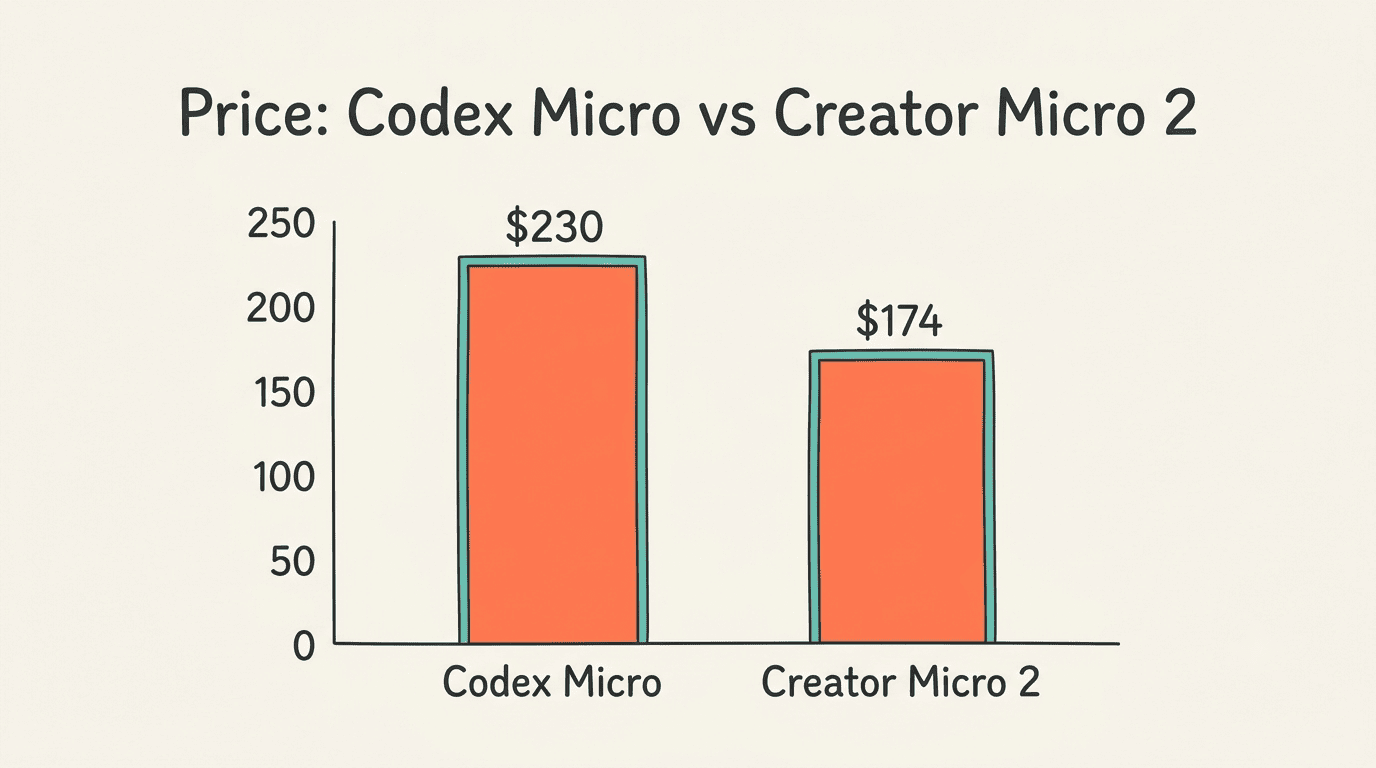
| Price | From $144 | From $174 |
| Frame | Basic PC frame | CNC metal frame + PC core |
| Connectivity | Wired only (USB-C) | Bluetooth + USB-C |
| Battery | None | 2100mAh |
| Cable | Braided USB-C | Braided USB-C |
The Pro is the only version with Bluetooth, and switching into wireless mode follows a fixed sequence:
- Hold the touch sensor for three seconds until the underglow turns blue (BLE mode)
- Tap again to cycle through Bluetooth channels 1, 2, or 3
- A fourth tap drops the board back into wired mode (underglow turns white)
That distinction matters most for anyone who wants a completely cable-free desk — the $30 price gap between Base and Pro buys a metal frame, Bluetooth, and a battery, while the Base version stays a budget option for people who don’t mind a permanent USB-C tether.
Input Software, Layers, and AppSense
Every key, dial, and joystick gesture is remapped through Input, Work Louder’s own free configurator. It is a separate ecosystem from the QMK/VIA tools that most mechanical keyboard enthusiasts already know, built specifically for macropad-style workflows rather than full typing layouts.
Six layers give the board real depth. Each layer carries its own set of 13 key assignments, a 7-slot radial menu triggered by the joystick, and one dial function — meaning a single Micro can hold well over a hundred distinct shortcuts across its layer stack.
AppSense automates the switching. Rather than manually flipping layers, AppSense detects which application currently has focus and jumps to its assigned preset automatically, so a video editor’s layer loads when the editing app opens and a design tool’s layer loads when that app takes over.
As Work Louder’s own product page puts it:
Moving the joystick opens up a fully customizable on-screen radial menu, putting all your favorite tools right at your fingertip.
Work Louder, Creator Micro 2 product page
Switches and v1 Compatibility
The Creator Micro 2 uses Work Louder’s own custom low-profile switches, rated at 55g or 50g of actuation force in either a silent or clicky linear variant. The stem is made from POK material and the housing from POM, following the general mechanical-switch design conventions described on Wikipedia’s keyboard technology overview — a spring-loaded stem travels inside a housing to complete an electrical contact — but built to a regular MX stem shape rather than the shorter Choc profile.
That MX stem is the key compatibility detail buyers need to know: keycaps from the original Creator Micro (v1), which used Choc-style low-profile stems, do not fit the Micro 2 at all. Anyone upgrading from the first-generation board needs a full new keycap set, not just a chassis swap.
Here’s a quick way to confirm switch and cap compatibility before buying spare parts:
- Check whether the listing specifies “Choc-style” (v1) or “MX-style” (v2/Micro 2) stems.
- Confirm the switch force rating — 55g or 50g linear — matches your typing preference.
- Decide between silent and clicky variants based on where the board will sit (open office vs. home desk).
- Verify the keycap profile is listed as low profile, since standard-height caps won’t clear the case.
- If reusing old caps from a v1 board, stop — they are Choc-stem only and will not seat on the Micro 2.
The Framer Collaboration
Framer, the web design and publishing platform, partnered with Work Louder to release a branded edition of the CM-2 built specifically around its own workflow. Compared with the standard Micro 2, the Framer edition swaps in:
- 12 mechanical switches (one fewer than standard) plus a 2D joystick
- 31 custom Framer-icon keycaps and 14 solid-color caps
- A 1900mAh battery, with pairing to up to three devices over Bluetooth
- Dedicated keys mapped to Framer actions like publishing a site or opening the CMS panel
That collaboration illustrates how Work Louder’s business model actually works: the same core hardware gets re-skinned with a partner’s icon set and default shortcut layout, rather than each partner engineering new switches or firmware from scratch. It’s the same template behind other branded builds tied to specific software ecosystems, including the OpenAI Codex macropad aimed at agentic coding workflows. OpenAI’s own supply page for its collaboration with Work Louder frames the partnership the same way — one physical platform, remapped for a different daily task.