
GLM Coding Plan: Tiers, Pricing, Models, and Setup (2026 Guide)
The Z.ai coding platform from Zhipu AI offers the GLM Coding Plan — a flat-rate subscription that gives developers access to GLM-5.2 and companion models inside Claude Code, Cline, and 20+ other coding agents. At Lite ($18/month) through Max ($160/month), it positions itself as the budget-conscious alternative to Claude Code Pro and GitHub Copilot. The GLM model series originates from Tsinghua University’s NLP research group, making Z.ai one of the few API providers whose flagship model is both open-weight and academically rooted. This guide breaks down exactly what you get on each tier, how the quota mechanics work, how to point your tools at the API, and whether the plan is worth it in 2026.
What Is GLM Coding Plan?
What Z.ai Is and Where GLM Comes From
Z.ai is the international developer platform from Zhipu AI, a Beijing-based AI lab founded in 2019 out of Tsinghua University. The GLM (General Language Model) series underpins their coding products. The Z.ai Coding Plan launched June 13, 2026, rolling out GLM-5.2 across all subscription tiers simultaneously.
Zhipu AI has been a key player in Chinese foundation model research since its inception — the GLM architecture predates many Western frontier models and has been steadily refined through academic and commercial releases. What changed in 2026 is a deliberate shift toward international developer adoption under the Z.ai brand.
What the Plan Actually Is (and Isn’t)
The GLM Coding Plan is not a standalone coding IDE or out-of-the-box assistant. It is an API subscription: you sign up at the Z.ai official platform, obtain an API key, and configure it in your existing tool — Claude Code, Cline, Roo Code, or another supported agent. The plan gives you access to the underlying models; your existing interface remains unchanged. If you are looking for a turnkey coding environment rather than a model backend, ZCode (covered below) is the separate product you want.
GLM-5.2: The Engine Under the Hood
GLM-5.2 is a Mixture-of-Experts model with 753 billion total parameters, with 40 billion active per request. Its 1-million-token context window lets it process entire mid-sized repositories in a single pass — a meaningful advantage for agentic workflows that need to reason across large codebases simultaneously. Output is capped at 131,072 tokens per response, which is enough for large-scale code modifications in one shot.
Z.ai released GLM-5.2 weights under an MIT license, meaning anyone can download, modify, and self-host the model commercially. The full weights and technical report are available through the THUDM GitHub organization alongside the BigModel developer API docs. For teams with data residency requirements or the infrastructure to run inference locally, that openness is a significant differentiator from Claude or GPT-5.5, which remain closed.
The GLM series has always aimed to be a genuinely open research contribution, not just a commercial product. MIT licensing GLM-5.2 reflects that commitment — anyone building on it can do so without legal friction.THUDM (Tsinghua University Knowledge Engineering Group), GLM-5.2 release notes
GLM Coding Plan Tiers: Lite vs Pro vs Max
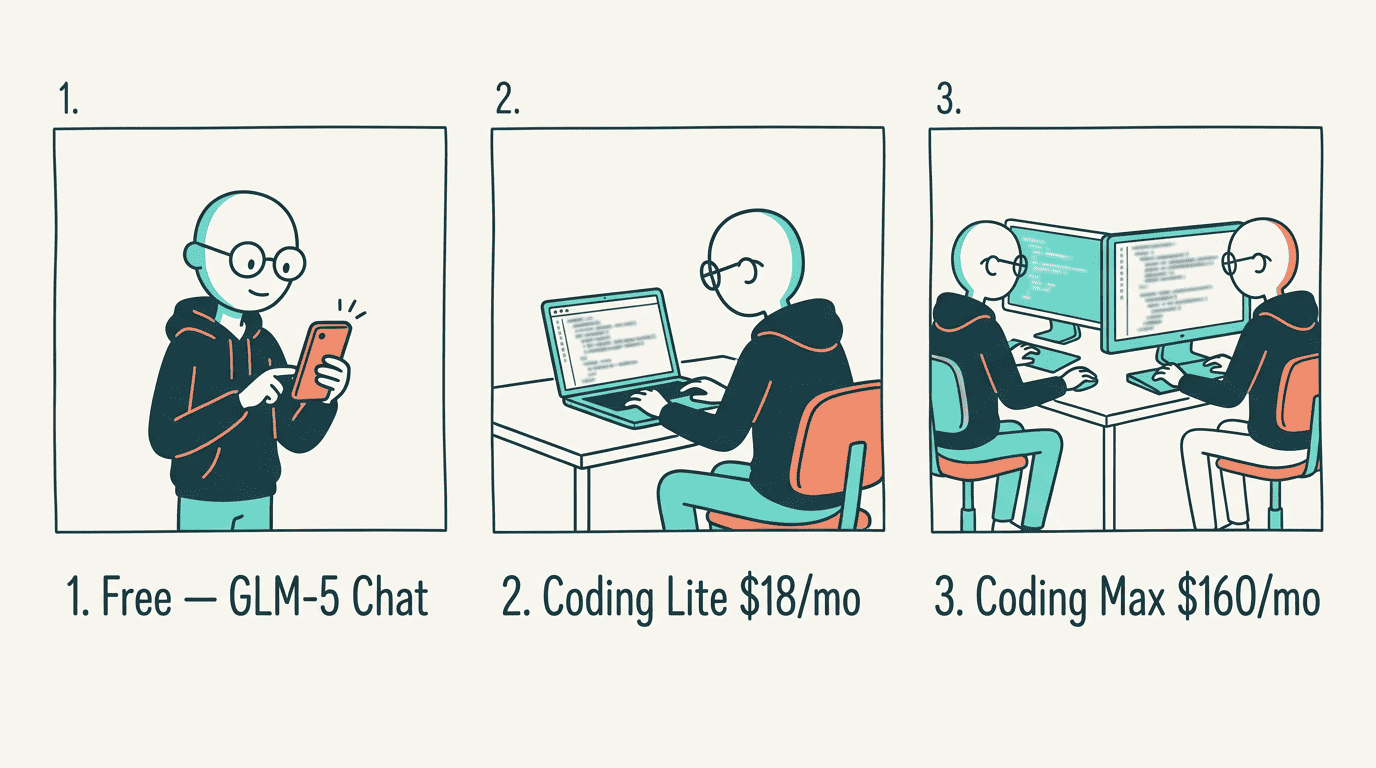
All three tiers carry the same 30% introductory discount through September 2026. Below are the headline numbers:
| Tier | Monthly | Annual (per month) | Weekly Prompts | 5-Hour Cap | MCP Calls/Mo |
|---|---|---|---|---|---|
| Lite | $18 ($12.60 promo) | ~$12.60 | ~400 | ~80 | 100 |
| Pro | $72 ($50.40 promo) | ~$50.40 | ~2,000 | ~400 | 1,000 |
| Max | $160 ($112 promo) | ~$112 | ~8,000 | ~1,600 | 4,000 |
Annual billing saves an additional 30% off the regular monthly price (not stacked on the promo rate). The practical implication: a developer who commits to a full year on Pro pays $50.40/month, not $72.
What Models You Get on Every Tier
Model access is identical across all three tiers. Every GLM coding subscription includes:
- GLM-5.2 — flagship model, best for complex coding and architecture tasks
- GLM-5-Turbo — balanced quality and speed for mid-complexity tasks
- GLM-4.7 — budget model for routine tasks, documentation, and boilerplate
- GLM-4.5-Air — lightweight model suited to quick questions and autocomplete
The only tier difference is quota volume and MCP call allowance — not model quality. Paying more does not unlock a better model; it unlocks more capacity.
Free Tier: What’s Available Without Paying
Z.ai provides three free API models available at $0 per token:
- GLM-4.7 Flash — text reasoning and code, free tier
- GLM-4.5 Flash — lightweight text, free tier
- GLM-4.6V Flash — vision-capable model, free tier
These are suitable for light experimentation and autocomplete, but they lack the capability of paid-tier models for agentic multi-step workflows where reasoning depth matters.
For teams evaluating the platform before committing, the free tier offers a no-risk entry point. The quality gap between Flash and the full GLM-4.7 is noticeable on complex reasoning tasks, but acceptable for simple scaffolding, boilerplate generation, and syntax correction.
How the Quota System Works
The GLM API subscription uses two concurrent limits: a rolling 5-hour cap and a rolling weekly cap that resets 7 days from your subscription start date. When either ceiling is hit, API calls pause until the next window opens. There is no overage billing and no auto-upgrade — when you hit the limit, requests stop.
Understanding both ceilings together is essential for planning sessions. A developer who burns through their 5-hour cap in one aggressive morning sprint will need to wait for that window to reset before the weekly quota becomes accessible again. The ceilings are independent: hitting the 5-hour cap does not reduce your weekly quota, and vice versa.
Peak and Off-Peak Multipliers
Prompt consumption is not 1:1. During peak hours (14:00–18:00 UTC+8, which is 06:00–10:00 UTC / 08:00–12:00 CEST / 02:00–06:00 ET), every prompt costs 3× your base quota. Off-peak normally costs 2×. Through September 2026, off-peak runs at a promotional 1× rate — meaning Western developers working US or European business hours currently get effective triple the quota compared to what the standard rate would provide.
| Time Zone | Peak Hours (3×) | Off-Peak Promo (1×) |
|---|---|---|
| UTC+8 (Beijing) | 14:00–18:00 | All other hours |
| UTC / London | 06:00–10:00 | All other hours |
| CEST (Berlin) | 08:00–12:00 | All other hours |
| ET (New York) | 02:00–06:00 | All other hours |
Real-World Quota Consumption
A 30-minute GLM-5.2 session on a complex refactoring task consumes roughly 44% of the 5-hour quota block; a GLM-4.7 session on lighter work uses about 35%. In a real 3-week Pro plan test on client repositories, weekly consumption averaged ~1,300 of 2,000 prompts during normal development weeks. On two heavy Next.js 16 migration weeks, the weekly cap was hit on day 5, requiring overflow back to Claude Max for the remainder.
The practical takeaway: Pro handles a typical solo developer’s workload comfortably through Thursday, then gets tight on heavy sprint weeks. Max is better suited to teams sharing a single subscription or solo developers with sustained high throughput needs.
GLM API Pricing: Pay-Per-Token vs Subscription
For developers who prefer pay-per-use over flat-fee subscriptions, Z.ai also offers standard token-based API pricing (see the Z.ai API pricing page for the latest rates; CNY pricing is listed on BigModel pricing (CNY)):
| Model | Input ($/M tokens) | Output ($/M tokens) | Cached Input |
|---|---|---|---|
| GLM-5.2 | $1.40 | $4.40 | $0.26 |
| GLM-5-Turbo | $1.20 | $4.00 | $0.24 |
| GLM-4.7 | $0.60 | $2.20 | $0.11 |
| GLM-4.5-Air | $0.20 | $1.10 | $0.03 |
GLM-5.2 at $1.40/$4.40 per million tokens costs roughly one-sixth of GPT-5.5. Only DeepSeek V4 Pro ($0.44/$0.87/M) undercuts GLM on raw API pricing. Cached input rates run approximately one-fifth of standard input pricing, making long-running sessions with repeated context significantly cheaper.
A single complex agentic prompt with a large codebase context can consume 20,000–50,000 tokens per call. For developers running multiple sessions daily, the flat-fee Coding Plan becomes cheaper than per-token billing very quickly — especially with the current off-peak 1× promo running through September 2026. The break-even point for Pro tier vs pay-per-token on GLM-5.2 is roughly 36,000 tokens of output per day across the month.
How to Set Up GLM Coding Plan with Claude Code and Cline
Z.ai is the only provider besides Anthropic itself that offers an Anthropic-compatible endpoint. This means GLM-5.2 works as a drop-in replacement for Claude inside Claude Code and any tool built on the Anthropic SDK — without changing your workflow, your prompts, or your agent configurations.
Here is the step-by-step setup for the most common tools:
- Sign up at z.ai and create an account (email or GitHub login).
- Subscribe to a Coding Plan tier at z.ai/subscribe — Lite, Pro, or Max.
- Generate an API key from your account dashboard under API Keys.
- Configure your tool using the environment variables or settings panel below.
- Test the connection by running a simple prompt to confirm the endpoint resolves correctly.
Claude Code setup — set three environment variables in your shell profile:
ANTHROPIC_BASE_URL=https://api.z.ai/api/anthropic
ANTHROPIC_AUTH_TOKEN=<your_z.ai_api_key>
ANTHROPIC_MODEL=GLM-5.2[1m]
Cline setup — open Cline settings, select “Z AI” as the provider, paste your API key. The base URL is configured automatically; no manual entry needed.
OpenAI-compatible endpoint — for tools like Aider and Continue.dev that expect an OpenAI-style API, use https://api.z.ai/api/openai/v1 with the same API key.
The most common setup error is pointing Claude-compatible tools at the wrong endpoint path — paas/v4 instead of api/anthropic. If your tool returns authentication errors despite a valid key, verify the base URL exactly matches the string above.
Supported Tools
The flat-fee coding tier officially supports 20+ tools including Claude Code, Cline, Roo Code, Kilo Code, OpenCode, Goose, OpenClaw, and ZCode. Cursor lacks native Z.ai support; Cursor users must rely on the OpenAI-compatible endpoint with a custom provider configuration, which does not support all Cursor features.
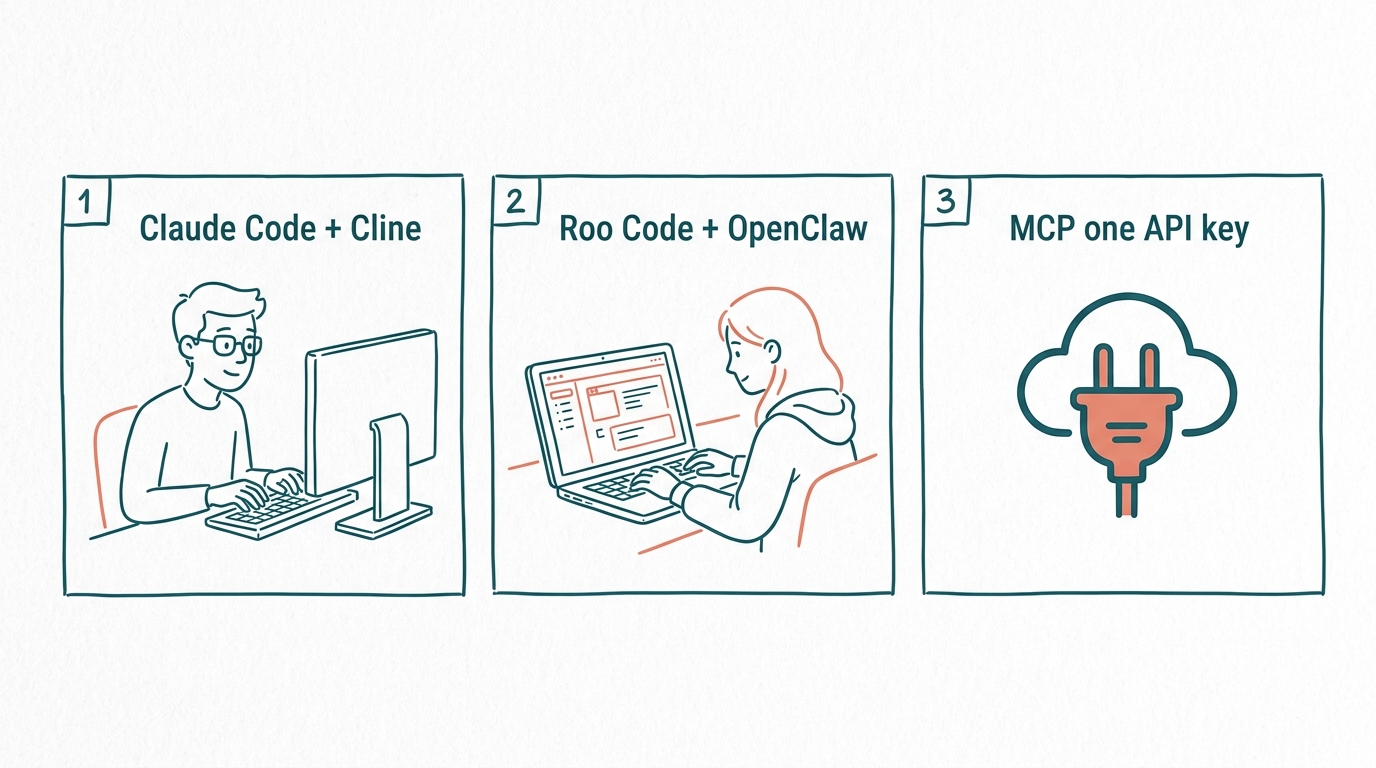
For users of Zhipu AI’s full model ecosystem, MCP (Model Context Protocol) integration is also available within the Coding Plan quota — 100 calls/month on Lite, up to 4,000/month on Max.
GLM Coding Plan vs Claude Code, Cursor, and GitHub Copilot
Benchmark Performance
GLM-5.2 scores 62.1% on SWE-bench Pro, ahead of GPT-5.5 (58.6%) but behind Claude Opus 4.8 (~69%). On Terminal-Bench 2.1, GLM-5.2 reaches 81.0 vs Claude Opus 4.8’s 85.0. GLM-4.7 scores 73.8% on SWE-bench Verified and 84.9 on LiveCodeBench V6.
For the wide middle of daily development work — adding features, refactoring existing code, writing tests, debugging stack traces — the 7-point SWE-bench gap between GLM-5.2 and Claude Opus 4.8 matters less than the price gap. On complex architectural reasoning and novel problem-solving, the gap is more visible.
Price Comparison
| Tool | Monthly Price | Prompt Volume |
|---|---|---|
| GLM Coding Plan Lite | $18 ($12.60 promo) | ~400/week |
| GLM Coding Plan Pro | $72 ($50.40 promo) | ~2,000/week |
| GLM Coding Plan Max | $160 ($112 promo) | ~8,000/week |
| Claude Code Pro | $20 | ~2,000/week |
| Claude Code Max | $100 | ~8,000/week |
| GitHub Copilot Pro | $10–39 | Unlimited |
| Cursor Pro | $20 | Unlimited |
At full price, GLM Pro ($72) costs more than 3× Claude Code Pro ($20) for similar weekly volume. At the annual discount rate ($50.40/mo), Pro becomes more competitive — particularly for developers who can schedule work during off-peak hours while the 1× promo runs through September 2026. In a real-world switch from Claude Max (~$200/mo) to GLM Pro at the standard monthly price ($72), the saving was approximately $128 per month during normal weeks — rising to ~$150 on the annual plan.
The comparison with hardware-accelerated inference options like Huawei Ascend shows the broader Z.ai ecosystem targets diverse compute budgets — from API subscriptions to on-premise deployment.
Cursor and GitHub Copilot offer unlimited prompts at their price points, which makes them structurally different products. The GLM Coding Plan competes primarily with Claude Code (which also has weekly prompt caps) rather than with IDE-integrated tools that count completions differently.
What Is ZCode (and How It Differs from the Coding Plan)
ZCode, launched the week of July 1, 2026, is Z.ai’s own Agentic Development Environment — a proprietary coding agent, not just an API. Unlike the GLM API subscription (which gives you API keys for use in Claude Code or Cline), ZCode is Z.ai’s answer to Claude Code itself as a standalone product.
Key ZCode features include:
- Five execution modes with varying levels of autonomy
- Custom subagents configured via Markdown files
- SSH and Docker support for remote environments
- Remote control via WeChat, Feishu, and Telegram
The Telegram integration in particular makes ZCode relevant for developers who want to trigger and monitor agentic sessions from a mobile device.
ZCode comes with a 5-day free trial: 3 million GLM-5.2 tokens plus 2 million GLM-5-Turbo tokens per day. That is enough to evaluate whether it suits your workflow before committing to a subscription — and it is far more generous than typical API trial credits.
The relationship between ZCode and the Coding Plan is complementary rather than competitive: developers who prefer their existing Claude Code or Cline setup use the Coding Plan API; developers who want Z.ai’s own agent experience use ZCode. Both run on the same GLM-5.2 backend.
Who Should Use GLM Coding Plan?
Budget-conscious solo developers who run Claude Code or Cline daily and want to cut spend without switching interfaces represent the clearest use case. The Pro tier at $50.40/month (annual) against Claude Max at ~$200/month is a credible 75% cost reduction for workloads that fit within the weekly quota.
Teams routing tasks by complexity get structural value from the model-per-task approach. GLM-4.7 handles boilerplate generation, documentation, and routine refactors at low cost; GLM-5.2 handles architecture decisions and hard debugging. Routing peak-hour complex work to Claude as overflow keeps spend predictable.
Developers exploring multilingual or Chinese-language codebases benefit from GLM-4.7’s native multilingual capabilities and chain-of-thought reasoning in Chinese — something Western-origin models handle less consistently.
- Developers requiring guaranteed SLAs or production API uptime commitments will find no such commitments in the Coding Plan terms
- Teams with strict data residency regulations outside China face a structural conflict: Z.ai infrastructure is based in China
- Developers working early US mornings (02:00–06:00 ET) frequently hit the 3× peak multiplier, which compresses effective weekly quota significantly
- Developers whose primary tool is Cursor will find limited native integration
The sweet spot is a developer or small team already invested in Claude Code or Cline workflows, working primarily during US or European business hours (off-peak for Z.ai), and running the Pro annual plan through at least September 2026 while the 1× off-peak promo is active. Under those conditions, the Z.ai Coding Plan is the best-value frontier-adjacent coding subscription currently available.
FAQ
What is GLM Coding Plan?
GLM Coding Plan is a flat-rate API subscription from Z.ai (formerly Zhipu AI) that provides access to GLM-5.2 and companion models for use in coding agents like Claude Code and Cline. It launched June 13, 2026, with three tiers: Lite ($18/mo), Pro ($72/mo), and Max ($160/mo).
How much does GLM Coding Plan cost?
Lite starts at $18/month ($12.60 with the current 30% promo through September 2026). Pro is $72/month ($50.40 promo), and Max is $160/month ($112 promo). Annual billing locks in the 30% discount year-round.
What models are included in GLM Coding Plan?
All tiers include the same four models: GLM-5.2 (flagship), GLM-5-Turbo (balanced), GLM-4.7 (budget coding), and GLM-4.5-Air (autocomplete). The only difference between tiers is weekly prompt quota and MCP call allowance — not model quality.
What is the difference between Lite, Pro, and Max tiers?
All three tiers access the same models. Lite gives ~400 prompts/week and 100 MCP calls/month. Pro gives ~2,000 prompts/week and 1,000 MCP calls/month. Max gives ~8,000 prompts/week and 4,000 MCP calls/month. Each also has a corresponding 5-hour rolling cap.
How does the GLM Coding Plan quota system work?
There are two limits: a rolling 5-hour cap and a rolling 7-day weekly cap. When either is hit, API calls pause with no overage charges. Peak hours (14:00–18:00 UTC+8) consume quota at 3× the base rate. Off-peak normally costs 2×, with a promotional 1× rate running through September 2026.
How do I set up GLM Coding Plan with Claude Code?
Set three environment variables: ANTHROPIC_BASE_URL=https://api.z.ai/api/anthropic, ANTHROPIC_AUTH_TOKEN=, and ANTHROPIC_MODEL=GLM-5.2[1m]. Z.ai is the only provider besides Anthropic with an Anthropic-compatible endpoint, so GLM-5.2 works as a drop-in replacement in Claude Code CLI.
Is ZCode the same as GLM Coding Plan?
No. The GLM Coding Plan gives you an API key to use GLM models inside your existing tools. ZCode, launched July 1, 2026, is Z.ai’s own standalone Agentic Development Environment with five execution modes, custom subagents, and remote control via WeChat, Feishu, and Telegram.
Is GLM Coding Plan worth it in 2026?
For developers using Claude Code or Cline who work during US or European business hours, the Pro tier at $50.40/month (annual) offers significant savings vs Claude Max. The off-peak 1× promo through September 2026 effectively multiplies usable quota. Main caveats: peak-hour 3× burn, no native Cursor support, and data residency in China.