
Zhipu AI (Z.ai): China’s GLM Platform That Challenged OpenAI and Listed on HKEX
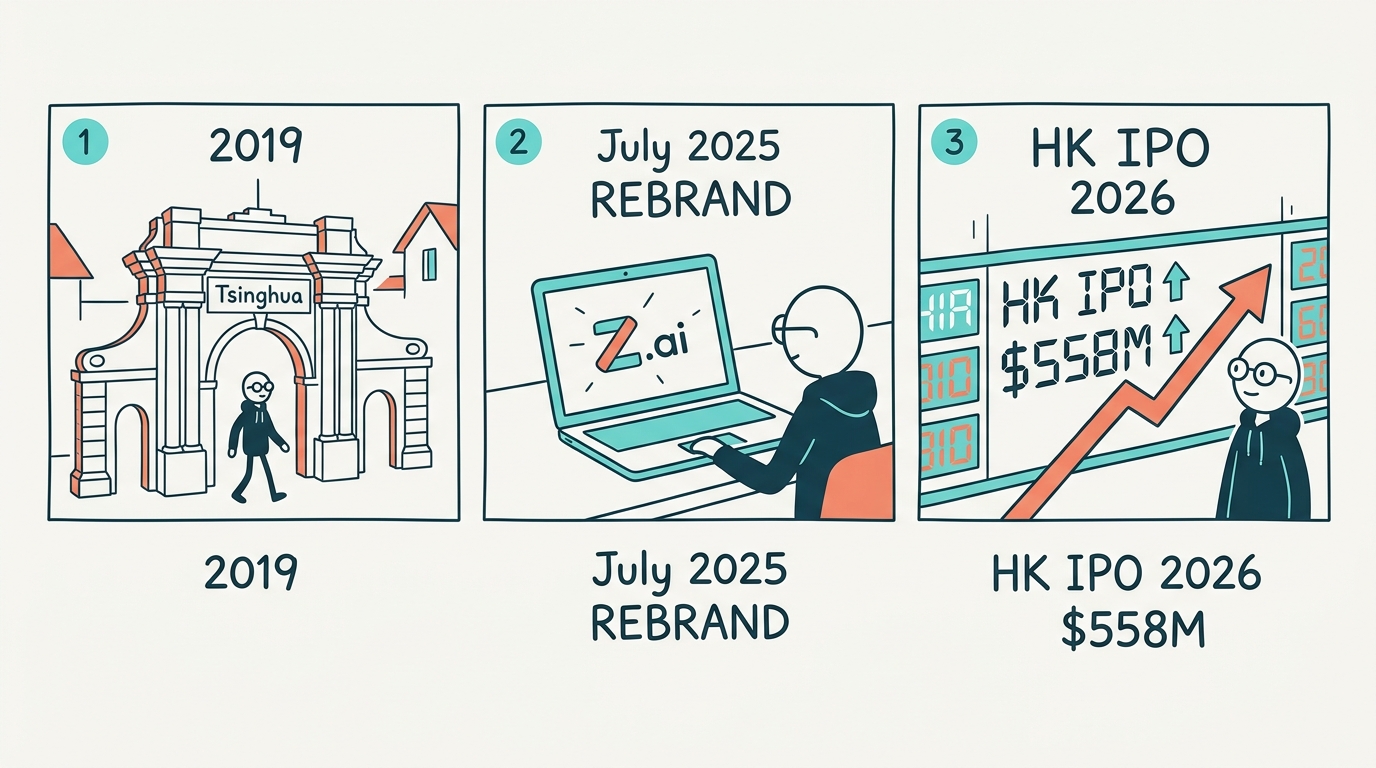
Zhipu AI — now operating globally as Z.ai — is the Chinese AI lab behind the GLM family of large language models, founded in 2019 as a Tsinghua University spinout and now listed on the Hong Kong Stock Exchange. In mid-2026, its flagship GLM-5.2 ranked 2nd globally on SWE-bench Pro with a 62.1% score, placing it within striking distance of Anthropic Claude Opus 4.8, at roughly one-fifth the price. This guide covers who built Zhipu AI, how the GLM model family evolved, what the Z.ai platform offers today, and what the HKEX IPO means for China’s AI industry.
What Is Zhipu AI and Who Founded It
Zhipu AI (Beijing Zhipu Huazhang Technology Co., Ltd.) was founded in 2019 by Tang Jie and Li Juanzi — both professors from Tsinghua University’s Knowledge Engineering Group (KEG), housed under the THUDM lab. The company began as an enterprise AI provider, offering knowledge graph and NLP tooling before pivoting to large language models in 2021 when it released GLM-130B, one of the first bilingual open-source models at that scale. According to the Z.ai Wikipedia entry, by 2023 the public ChatGLM series had become a flagship open-source alternative to ChatGPT for Chinese-language users and developers worldwide.
The Z.ai Rebrand (July 2025)
In July 2025, Zhipu AI officially rebranded to Z.ai, aligning its global identity with its flagship product domain. The company now operates under the Z.ai name internationally while retaining the Chinese identity 智谱AI domestically. The rebrand coincided with the pre-IPO phase and a clear push to position GLM models as a genuine alternative to Western frontier models from OpenAI and Anthropic.
Team and Scale
The company employs 800+ people, with 60–70% of headcount dedicated to R&D. The leadership trio — Tang Jie (Chief Scientist), Li Juanzi (co-founder), and Zhang Peng (CEO) — all have deep academic roots in Tsinghua’s AI research tradition, a lineage that has shaped both the technical direction and the open-source culture of the GLM platform.
The GLM Model Family: From GLM-130B to GLM-5.2
The GLM (General Language Model) family is Zhipu AI’s core technical output — a line of models that evolved from an open-source bilingual research release into a set of frontier-scale systems trained on sovereign Chinese compute.
GLM-130B and ChatGLM (2021–2023): The Open-Source Roots
Zhipu AI’s first milestone was GLM-130B (2022) — a 130-billion parameter bilingual model that was fully open-sourced, becoming one of the largest publicly available models at the time. It demonstrated that a non-U.S. lab could train and release a frontier-scale model. ChatGLM (2023) followed as a more accessible, chat-optimized derivative that rapidly gained adoption among Chinese developers and enterprises, establishing the THUDM GitHub organization as a go-to resource for open Chinese LLMs.
| Release | Year | Key Specs | License |
|---|---|---|---|
| GLM-130B | 2022 | 130B params, bilingual | Open-source |
| ChatGLM | 2023 | Chat-optimized, Chinese-first | Open-source |
| GLM-5 | Feb 2026 | 744B params (40B active), 200K ctx | Proprietary |
| GLM-5.2 | Jun 2026 | 753B params, 1M ctx | MIT |
GLM-5 (February 2026): Scale and Sovereign Compute
GLM-5, released in February 2026, marked a major architectural leap. The model uses a Mixture of Experts (MoE) architecture with 744 billion total parameters, but only 40 billion are active at inference time — allowing frontier-grade quality at lower per-token compute cost. It was trained on 28.5 trillion tokens with a 200,000-token context window. Critically, GLM-5 was trained entirely on Huawei Ascend 910B/910C chips across a cluster of 100,000 units, eliminating any NVIDIA dependency — a proof that Chinese labs can reach frontier performance without NVIDIA A100 or H100 hardware.
The decision to train on domestic silicon was partly driven by U.S. export controls, but it also demonstrated concretely that Chinese AI labs could achieve frontier results without NVIDIA A100 or H100 access — a proof point with significant strategic implications.
GLM-5.2 (June 2026): The Benchmark Challenger
GLM-5.2, released in June 2026, pushed the architecture further still. The model expanded to 753 billion parameters and introduced a 1 million token context window — five times the capacity of GLM-5. Zhipu AI released it under the MIT License, making it one of the most permissive licenses ever granted to a frontier-scale model: fully open for commercial use, modification, and redistribution.
On benchmarks, GLM-5.2 posted a 62.1% score on SWE-bench Pro, ranking 2nd globally. Its adoption curve on Vercel was described as the fastest in 2026, with customer counts growing 80× in the first deployment week and token volume increasing 27× week-over-week. A detailed technical breakdown is available in the GLM-5.2 model deep-dive.
“China’s Zhipu is closing in on top U.S. AI models.”CNBC, June 2026
Z.ai Platform: Chatbot, API, and Agentic Products
Z.ai is not just a model lab — it operates a full-stack AI platform covering consumer chat, a developer API, and specialized agentic tools. The platform serves both individual users and enterprise customers across multiple modalities.
Z.ai Chat Interface
The Z.ai chatbot (accessible at z.ai) is the consumer face of the platform — a conversational assistant powered by GLM-5.2. It supports multimodal input (text, images, documents) and is available in both Chinese and English. Compared to ChatGPT or Claude.ai, Z.ai emphasizes deep coding and agentic capabilities out of the box, reflecting the lab’s research strengths.
BigModel API: Full-Stack Multimodal
The BigModel developer API (open.bigmodel.cn) exposes the complete GLM model stack across modalities:
- Text generation: GLM-5, GLM-5.2, GLM-4 series with context/speed trade-offs
- Vision: image understanding and generation via the CogView series
- Video: CogVideoX for AI video generation
- Audio: speech-to-text and TTS
- Embeddings: semantic search and RAG pipelines
Pricing as of mid-2026 sits at approximately $1.40 per million input tokens and $4.40 per million output tokens for GLM-5.2 — significantly below comparable U.S. models. Developer plans for coding (CodeGeeX) start at approximately $6–$20/month depending on tier.
| Product | Type | Starting Price |
|---|---|---|
| GLM-5.2 (input) | Text generation | $1.40 / 1M tokens |
| GLM-5.2 (output) | Text generation | $4.40 / 1M tokens |
| CogVideoX | Video generation | Usage-based |
| CogView | Image generation | Usage-based |
| CodeGeeX Coding | Developer plan | $6–$20/month |
AutoGLM: Agentic Automation
AutoGLM is Zhipu AI’s flagship agentic product — a tool-use agent framework that allows GLM models to browse the web, write code, execute files, and complete multi-step tasks autonomously. It competes directly with OpenAI’s Operator and Anthropic’s Claude computer-use capabilities, and is the primary way enterprise customers deploy GLM for workflow automation.
CodeGeeX: Developer Coding Assistant
CodeGeeX is a specialized coding AI built on the GLM stack, with VS Code and JetBrains integrations. It supports 100+ programming languages and competes with GitHub Copilot and Cursor in the developer tooling space.
Zhipu AI IPO: The World’s First Listed LLM Company
On January 8, 2026, Zhipu AI listed on the Hong Kong Stock Exchange under ticker 02513, becoming the world’s first large language model company to list on a major stock exchange — a milestone that drew intense attention from both the AI industry and capital markets.
The IPO metrics were striking:
| Metric | Value |
|---|---|
| Exchange | HKEX (Hong Kong Stock Exchange) |
| Ticker | 02513.HK |
| IPO Date | January 8, 2026 |
| Funds Raised | ~HK$4.35B (~US$558M) |
| Oversubscription | 1,159× (retail) |
| Post-IPO Market Cap | ~US$6.5B |
The 2025 financial year showed strong revenue growth alongside continued investment-phase losses. Revenue reached RMB 724M (~$105M), up 132% year-over-year, while the net loss ran to approximately RMB 4.7B — driven by heavy R&D spend and the compute costs of training frontier models at scale.
Pre-IPO investors span China’s entire tech ecosystem:
- Alibaba
- Tencent
- Ant Group
- Meituan
- Xiaomi
- Hillhouse Capital
A pre-IPO round in 2024 raised an additional ~$400M at a ~$3B valuation, before the public listing more than doubled that figure. The Z Ventures arm manages strategic investments in adjacent AI startups.
Zhipu AI vs OpenAI, Anthropic, and DeepSeek
How does the Chinese AI lab actually stack up against the world’s leading AI companies? The 2026 benchmarks provide a clear picture.
Benchmark Positioning
On SWE-bench Pro 2026 — the leading agentic coding benchmark — GLM-5.2 placed second globally:
| Model | SWE-bench Pro Score |
|---|---|
| Claude Opus 4.8 (Anthropic) | 69.2% |
| GLM-5.2 (Z.ai) | 62.1% |
| GPT-5.5 (OpenAI) | 58.6% |
GLM-5.2 beats GPT-5.5 outright and sits within 7 percentage points of Claude Opus 4.8 — the current global leader on that benchmark. This is not a “close but not quite there” result; it represents a genuine peer-level performance from a Chinese lab training on domestic hardware.
The Cost Advantage
The price-to-performance ratio is Zhipu AI’s clearest competitive edge. GLM-5.2 API runs at approximately $1.40/$4.40 per million input/output tokens. Comparable Claude Opus 4.8 pricing sits at approximately $5/$25 per million tokens — a 3–6× pricing gap (depending on whether you compare input or output rates) that makes GLM-5.2 particularly attractive for high-volume production workloads where model spend is a meaningful cost line.
According to CNBC reporting from June 2026, Chinese models collectively crossed 30% of total volume on OpenRouter by February 2026, reaching a peak of 46% by mid-2026 — driven largely by price-sensitive developers discovering that frontier-quality output was available at dramatically lower cost.
vs DeepSeek
DeepSeek is Zhipu AI’s closest domestic rival in China. Both labs pursue open-source strategies and train on Huawei Ascend or domestic compute. DeepSeek’s R1/R2 series has an edge on pure reasoning tasks; GLM-5.2 leads on agentic coding and multimodal. The two labs are not directly competing for the same product surface — they are complementary signals that China now has multiple frontier-caliber AI labs operating in parallel.
Huawei Ascend Training and Compute Sovereignty
GLM-5 and GLM-5.2 are trained entirely on Huawei Ascend 910B/910C clusters. The GLM-5 training run stands out on several dimensions:
- 100,000 Huawei Ascend 910B/910C chips in a single cluster
- 28.5 trillion training tokens consumed
- Zero NVIDIA hardware involved at any stage
- No dependency on H100 or A100 GPUs restricted under U.S. export controls
This made Zhipu AI one of the most prominent proofs that Chinese labs can train frontier models without the NVIDIA hardware that has been restricted under U.S. export controls since 2022.
In January 2025, the U.S. Commerce Department added Zhipu AI to the Entity List — restricting U.S. technology exports to the company without a license. In practice, the business impact was limited: the lab’s training stack relies entirely on domestic Huawei silicon, and its primary markets are China and global enterprises outside the United States. Industry observers largely viewed the Entity List addition as an implicit recognition of Zhipu AI’s strategic capabilities rather than a crippling sanction.
The decision to go all-in on Ascend hardware was consequential in another respect: it gave Zhipu AI deep engineering expertise in optimizing for non-NVIDIA hardware, which may prove advantageous as the global AI industry diversifies compute supply chains.
Open Source Strategy: MIT License and THUDM GitHub
Zhipu AI has maintained a strong open-source commitment since GLM-130B in 2022. GLM-5.2 is released under the MIT License — permitting commercial use, modification, and redistribution — making it one of the most permissive licenses ever granted to a frontier-scale model. The THUDM GitHub organization publishes all official releases:
- Model weights (GLM-130B, ChatGLM, GLM-5, GLM-5.2)
- Inference code and fine-tuning scripts
- Evaluation benchmarks and test suites
- Documentation in Chinese and English
This strategy mirrors DeepSeek and Meta’s Llama approach: release open weights to accelerate ecosystem adoption, then monetize through API access and enterprise services. The MIT license in particular removes legal friction for enterprise customers who want to fine-tune or deploy GLM weights in proprietary pipelines.
The result: a growing ecosystem of third-party fine-tunes, integrations, and community benchmarks building on the GLM foundation — independent of whether users pay for the BigModel API.
How to Access Z.ai and the BigModel API
Getting started with the Z.ai platform follows two main paths, with a third option for developers who prefer aggregated model access.
- Visit z.ai and create a free account. The web interface gives immediate access to GLM-5.2 with multimodal input (text, images, documents). A free tier with rate limits is available; paid plans unlock higher throughput.
- Register at open.bigmodel.cn to access the BigModel API. Generate an API key from the dashboard. The API follows the OpenAI ChatCompletion spec, so most existing OpenAI SDK code works with a single base URL swap — no rewrite required. Available endpoints cover chat, vision, embedding, image generation (CogView), video generation (CogVideoX), and audio.
- Use OpenRouter (model ID:
z-ai/glm-5.2) for a multi-provider gateway. GLM-5.2 is also natively supported in Vercel AI SDK, LangChain, and LlamaIndex through standard provider integrations.
- CodeGeeX IDE plugin: install the CodeGeeX extension in VS Code or JetBrains, connect with your BigModel API key, and use inline completions and chat directly in your editor.
- AutoGLM for agents: access the AutoGLM endpoint to deploy tool-use agents that can browse the web, execute code, and manage files — suitable for workflow automation without building a custom agent loop.
Developer documentation is available at open.bigmodel.cn/dev/api.
FAQ
What is Zhipu AI?
Zhipu AI (now Z.ai) is a Chinese AI research lab and product company founded in 2019 as a spinout from Tsinghua University’s Knowledge Engineering Group. It develops the GLM family of large language models and operates the Z.ai chatbot and BigModel API platform. It is publicly listed on the Hong Kong Stock Exchange (ticker: 02513.HK).
What is Z.ai?
Z.ai is the rebranded international identity of Zhipu AI, adopted in July 2025. The z.ai domain hosts both the consumer GLM-5.2 chatbot and the BigModel developer API platform. The underlying company remains Beijing Zhipu Huazhang Technology Co., Ltd.
Is Zhipu AI the same as Z.ai?
Yes. Z.ai is the name Zhipu AI adopted in July 2025 for its international operations. The models are still called GLM (Generative Language Model). Domestically, the company still uses the 智谱AI identity.
What is the GLM model?
GLM stands for General Language Model — a family of large language models developed by Zhipu AI / THUDM. The current flagship is GLM-5.2 (June 2026), with 753 billion parameters, a 1 million token context window, and an MIT license. Earlier milestones include GLM-130B (2021) and ChatGLM (2023).
How does Zhipu AI compare to OpenAI or Anthropic?
On SWE-bench Pro 2026, GLM-5.2 scores 62.1% — second globally, above GPT-5.5 (58.6%) and within 7 points of Claude Opus 4.8 (69.2%). The key differentiator is price: GLM-5.2 costs roughly one-fifth of comparable Claude pricing per token.
Is Zhipu AI open source?
Partially. GLM-5.2 weights are released under the MIT License via the THUDM GitHub organization, freely usable for commercial projects. Training infrastructure and proprietary fine-tuning layers are not open-sourced.
Is Zhipu AI publicly listed?
Yes. Zhipu AI listed on the Hong Kong Stock Exchange (HKEX) on January 8, 2026, under ticker 02513.HK, raising approximately US$535M. It is the world’s first large language model company to list on a major stock exchange.
How do I access the GLM API?
Register at open.bigmodel.cn, obtain an API key, and use any OpenAI-compatible client — set the base URL to the BigModel endpoint. GLM-5.2 is also available on OpenRouter (model ID: z-ai/glm-5.2) if you prefer a multi-provider gateway.
What happened when Zhipu AI was added to the U.S. Entity List?
In January 2025, the U.S. Commerce Department added Zhipu AI to the Entity List, restricting U.S. technology exports to the company. In practice, the impact was limited: Zhipu trains on Huawei Ascend chips with no NVIDIA dependency, and its primary markets are China and non-U.S. enterprises.