
OpenAI Codex and GPT-5.6: The AI Coding Agent That Rewrites What’s Possible
OpenAI Codex received its most powerful engine yet when chat gpt 5.6 arrived on July 9, 2026 — bringing three model tiers, a 1,050,000-token context window, and native multi-agent execution to the platform’s 5 million weekly users. Codex is no longer a standalone developer tool but the coding layer of a unified AI platform with 1,400+ plugins and support for repositories, terminals, browsers, and mobile.
What Is OpenAI Codex with GPT-5.6?
Codex began as an open-source CLI released April 16, 2025 — a terminal agent that could write and edit code, run tests, and execute commands. By July 9, 2026 it had become the coding engine of ChatGPT’s unified desktop app, with GPT-5.6 as its flagship model. More than 5 million developers now use Codex weekly, double the figure three months prior. The desktop merger consolidated repository access, terminal integration, browser control, and mobile support under one interface. Each Codex task runs in a sandboxed cloud environment preloaded with the user’s repository, where the agent reads and edits files, runs tests, and invokes code-checking tools before returning logs; most tasks complete in 1 to 30 minutes depending on complexity and tier.
GPT-5.3-Codex was the first model instrumental in creating itself — a milestone in AI-assisted software development that shaped our roadmap for GPT-5.6.OpenAI Research Team, February 2026
GPT-5.6 Model Tiers: Sol, Terra, and Luna
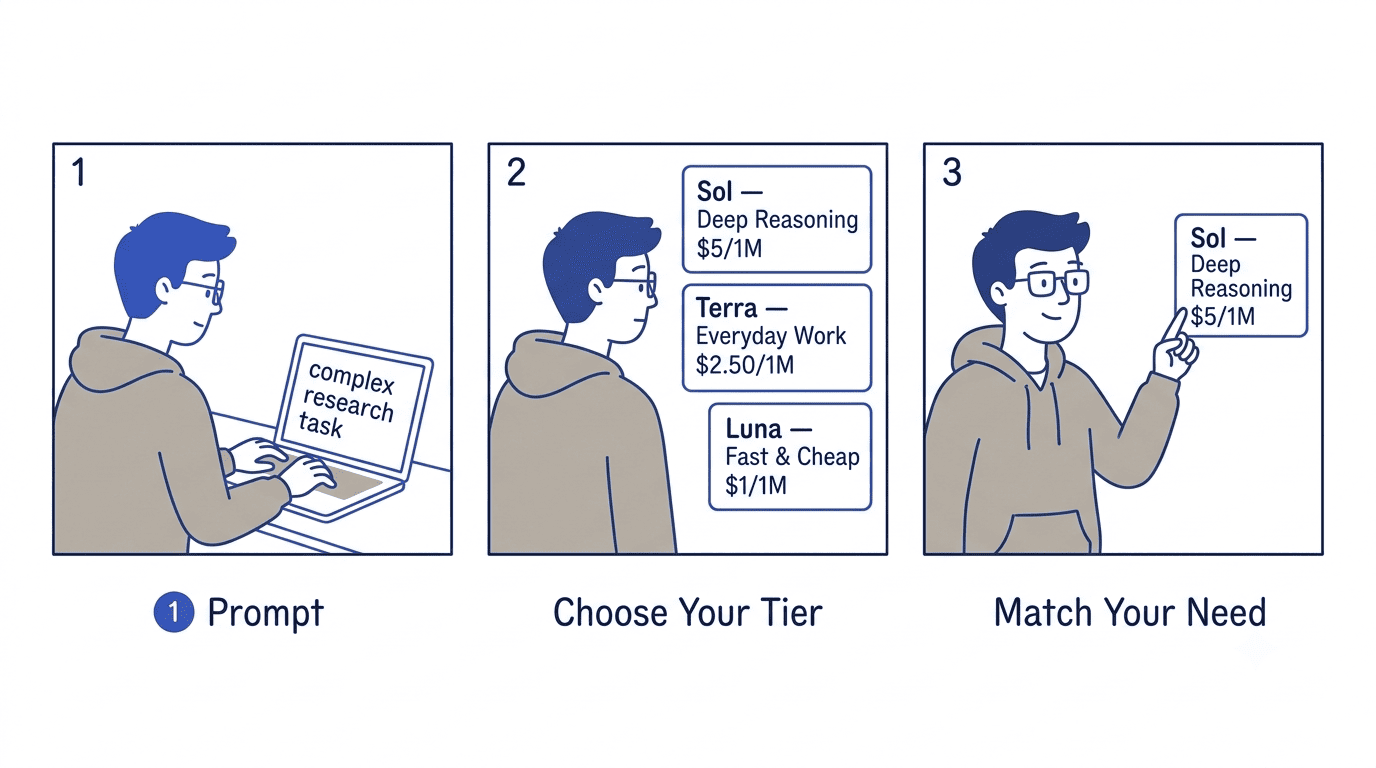
| Tier | Best For | Effort Modes | Input Price (per 1M tokens) | Context Window |
|---|---|---|---|---|
| Sol | Complex multi-file tasks, security audits | max, ultra | $5.00 | 1,050,000 tokens |
| Terra | Everyday development, team workflows | max | $2.50 | 1,050,000 tokens |
| Luna | Batch processing, repetitive refactoring | max | $1.00 | 1,050,000 tokens |
Sol is the highest-capability variant, scoring 80 on the Artificial Analysis Coding Agent Index at launch — at or near state-of-the-art for agentic coding. It supports both max and ultra effort modes; ultra (Plus plan and up) enables deeper reasoning passes and extended autonomy for tasks where the model must backtrack and self-verify. See the GPT-5.6 Sol deep dive for its architecture. Terra balances capability and cost at $2.50 per million input tokens — the tier most engineering teams settle on for sprint-level feature work, automated PR review, and integration testing. Luna, at $1.00 input / $6.00 output per million tokens, targets automated test generation, repetitive refactoring, and batch review where throughput economics dominate; it still supports the full agent feature set including programmatic tool calling and the 1,050,000-token context window.
GPT-5.6 Pricing and API Access
GPT-5.6 is available through the OpenAI API with model-level billing per million tokens. The gpt-5.6 alias points to Sol by default.
| Model ID | Input (per 1M tokens) | Output (per 1M tokens) | Cached Input | Context Window |
|---|---|---|---|---|
| gpt-5.6-sol | $5.00 | $30.00 | $0.50 (90% off) | 1,050,000 tokens |
| gpt-5.6-terra | $2.50 | $15.00 | $0.25 (90% off) | 1,050,000 tokens |
| gpt-5.6-luna | $1.00 | $6.00 | $0.10 (90% off) | 1,050,000 tokens |
A 90% read discount applies to cached prompt tokens, cutting costs for repeated-context workflows such as iterative debugging or long-running review pipelines. Callers select max effort across all GPT-5.6 models via the Responses API’s effort parameter; ultra is exclusive to Plus subscribers and above, giving programmatic control over the cost-performance tradeoff per request.
Agent Features: Multi-Agent and Programmatic Tool Calling
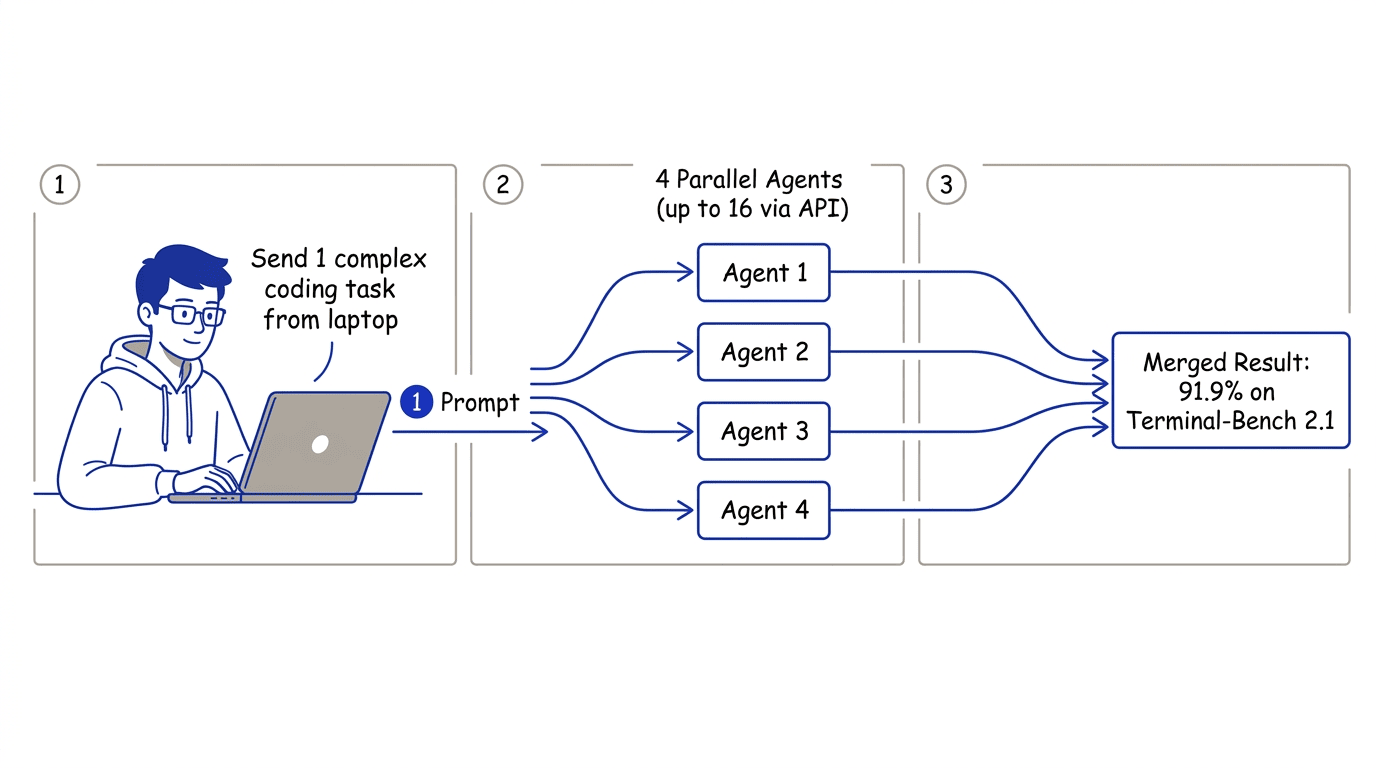
Programmatic Tool Calling lets the model write and run in-memory programs that coordinate multiple tools and process intermediate results within a single request — no external orchestration. Codex can query a database, run a test suite, parse output, and propose a fix in one turn. Multi-Agent Coordination (Responses API beta) lets GPT-5.6 spawn concurrent subagents and synthesize their outputs in one request — parallel code review, simultaneous branch analysis, or coordinated security scanning. It became stable in Codex CLI v0.145.0 (July 21, 2026) with configurable subagent models, reasoning levels, and concurrency limits, and supports Model Context Protocol (MCP) for packaging workflows into distributable plugins. Together these capabilities separate Codex from single-turn code completion tools.
How OpenAI Codex Evolved to GPT-5.6
| Date | Milestone |
|---|---|
| April 16, 2025 | Codex CLI released as open-source terminal agent |
| May 16, 2025 | Codex Cloud research preview (codex-1, o3-based) |
| February 5, 2026 | GPT-5.3-Codex; 25% faster than GPT-5.2-Codex |
| February 12, 2026 | GPT-5.3-Codex-Spark (Cerebras, ~15× faster interactive) |
| March 5, 2026 | GPT-5.4 for Codex; 2M+ weekly active users |
| July 9, 2026 | GPT-5.6 (Sol/Terra/Luna); Codex merged into ChatGPT desktop |
OpenAI described GPT-5.3-Codex as “the first model instrumental in creating itself,” a recursive capability that shaped GPT-5.6: each generation increasingly participates in its own development cycle. GPT-5.6 powers Codex across the ChatGPT desktop app (1,400+ plugins), the Codex CLI on Windows/macOS/Linux, VS Code and JetBrains plugins, Xcode 26.3, and Amazon Bedrock (Sol as default since CLI v0.145.0). The CLI /import command migrates settings, MCP servers, plugins, and sessions from Cursor or Claude Code.
Codex with GPT-5.6 vs. Competing Coding Agents
Per Reuters and Fortune reporting, Codex usage rose from ~5% of Claude Code’s user base to ~40% between September 2025 and January 2026, with enterprise customers including Cisco, Ramp, Rakuten, and Harvey deploying it at scale. On benchmarks, GPT-5.5 scored 88.7% on SWE-bench Verified and 82.7% on Terminal-Bench 2.0; on SWE-bench Pro it scored 58.6% versus Claude Opus 4.8’s 69.2%, while outperforming Claude Opus 4.7 by 13.3 points on Terminal-Bench 2.0. Official GPT-5.6 SWE-bench figures were unpublished at launch, but Sol’s 80 on the Artificial Analysis Coding Agent Index signals high-end positioning. The GPT-5.6 ultra mode guide explains how extended reasoning deepens the advantage on the hardest tasks.
| Coding Agent | Context Window | Multi-Agent | Key Differentiator |
|---|---|---|---|
| OpenAI Codex (GPT-5.6) | 1,050,000 tokens | Yes (beta) | Three tiers + ChatGPT unified platform |
| GitHub Copilot | up to 1M tokens (model-dependent) | No | Deep IDE integration, per-seat pricing |
| Claude Code | 200,000 tokens (1M on Opus 4.6+) | No | Strong SWE-bench Pro scores, terminal-native |
| Cursor | up to 312,000 tokens (agent mode) | No | AI-native editor for solo developers |
Codex Security — derived from internal project Aardvark — builds threat models and scans for vulnerabilities. Across 1.2 million commits over 30 days, it found nearly 800 critical vulnerabilities and 10,000+ high-severity issues in projects including Chromium, GnuTLS, and GnuPG, issuing 14 CVE identifiers and cutting false positives by more than 50% during beta — a capability GitHub Copilot and Cursor do not currently offer as integrated agents.
FAQ
What is OpenAI Codex GPT-5.6?
OpenAI Codex is an AI coding agent developed by OpenAI that, as of July 9, 2026, runs on GPT-5.6 — a three-tier model family (Sol, Terra, Luna) integrated directly into the ChatGPT desktop app. It writes code, fixes bugs, runs tests, and executes multi-agent workflows inside sandboxed cloud environments preloaded with the user’s repository.
What are the GPT-5.6 Sol, Terra, and Luna model tiers?
Sol is the flagship model (scored 80 on the Artificial Analysis Coding Agent Index), Terra is the balanced everyday model for high-volume team use, and Luna is the most cost-efficient tier for automated pipelines. All three share a 1,050,000-token context window and support the full Codex agent feature set including programmatic tool calling.
How much does GPT-5.6 cost through the OpenAI API?
Sol costs $5 per million input tokens and $30 per million output tokens. Terra costs $2.50 input / $15 output. Luna costs $1 input / $6 output. A 90% discount applies to cached prompt tokens across all three tiers.
How does GPT-5.6 compare to GPT-5.5 for coding?
GPT-5.5 scored 88.7% on SWE-bench Verified and 82.7% on Terminal-Bench 2.0. GPT-5.6 Sol scored 80 on the Artificial Analysis Coding Agent Index at launch. Official SWE-bench figures for GPT-5.6 had not been published as of the July 9, 2026 release date.
Is Codex available in ChatGPT with GPT-5.6?
Yes. Since July 9, 2026, Codex is fully integrated into the ChatGPT desktop app. Users access it alongside 1,400+ plugins, terminal integration, and repository management — no separate Codex app required.
When was GPT-5.6 released?
GPT-5.6 was announced and began rolling out globally on July 9, 2026, completing the global rollout in approximately 24 hours.
What context window does GPT-5.6 support?
All three GPT-5.6 variants — Sol, Terra, and Luna — support a 1,050,000-token context window, as documented in official OpenAI API references and confirmed in the Codex CLI v0.144.6 hotfix notes released July 18, 2026.