
OpenAI Sol Model: GPT-5.6 Sol Explained — Benchmarks, Pricing & API Guide
GPT-5.6 Sol is the flagship tier of the OpenAI GPT-5.6 model family, engineered for the most demanding professional tasks — from long-horizon coding agents to cybersecurity research and biology workflows. Built by OpenAI and released publicly on July 9, 2026 as part of the chat gpt 5.6 generation, it scores 88.8% on the key agentic benchmark Terminal-Bench 2.1 — and its compute-intensive Sol Ultra configuration pushes that to 91.9%.
What Is the OpenAI Sol Model?
Sol is OpenAI’s most capable frontier model for complex professional work. Its API model ID is gpt-5.6-sol, with the alias gpt-5.6 routing automatically to it. The context window is 1,050,000 tokens with a maximum output of 128,000 tokens; the knowledge cutoff is February 16, 2026. It accepts text and image input, outputs text only. OpenAI shipped it in two stages — a limited preview on June 26, 2026 restricted to vetted partners at the White House’s request over safety concerns, then general availability on July 9 after safeguards were confirmed. OpenAI stated such access restrictions “should not become the norm.” The GPT-5.6 naming replaced legacy suffixes (Turbo, Preview, Mini) with a three-tier system: the number identifies the generation, the suffix the capability tier. Sol is the “sun” — the highest-intensity tier, for work where correctness matters more than cost per token.
Sol vs Terra vs Luna: Which Tier to Choose
| Tier | Input (per 1M) | Output (per 1M) | Best For |
|---|---|---|---|
| GPT-5.6 Sol | $5.00 | $30.00 | Complex agents, coding, cybersecurity, biology |
| GPT-5.6 Terra | $2.50 | $15.00 | Bounded implementation, first-pass review |
| GPT-5.6 Luna | $1.00 | $6.00 | High-volume chatbots, classification, summaries |
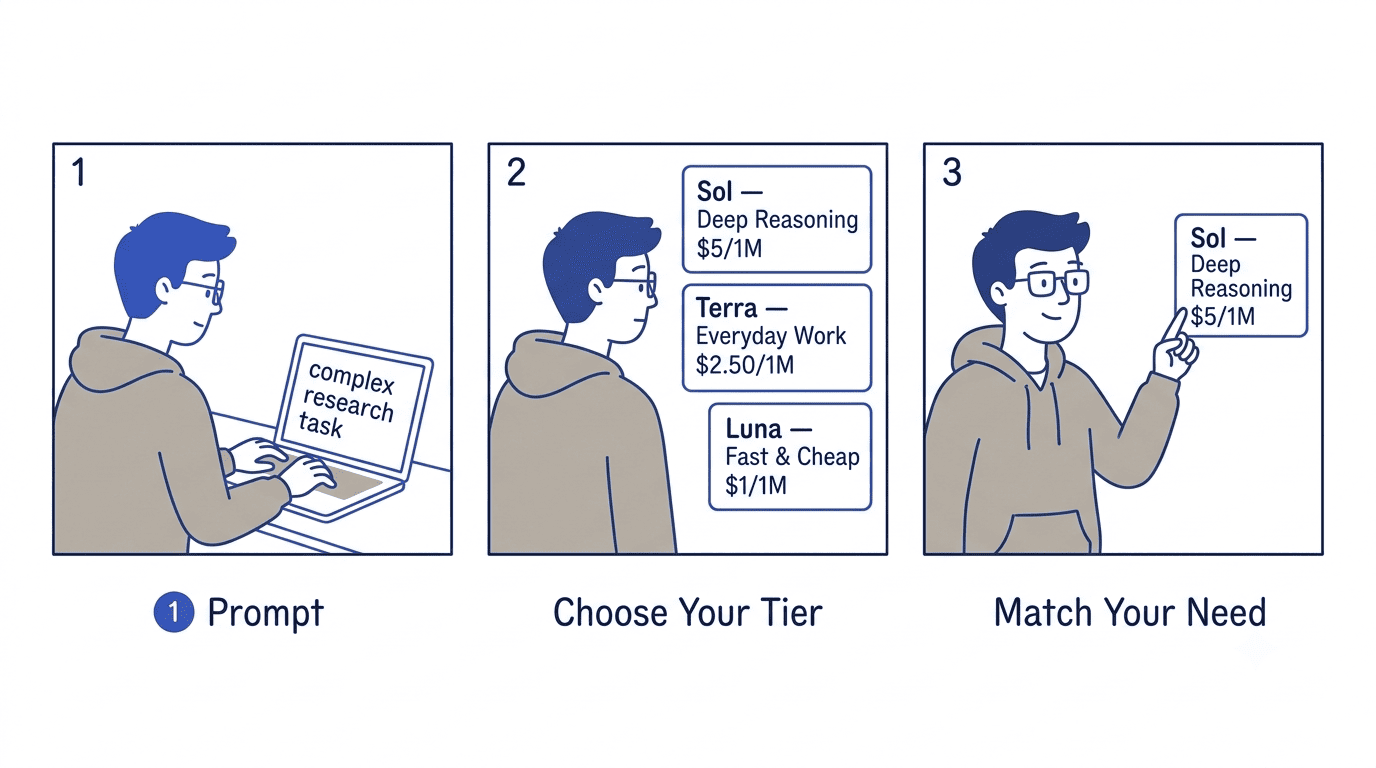
Sol at $5/$30 per 1M tokens delivers the most capability at the same price point as GPT-5.5. Terra delivers roughly GPT-5.5-level quality at about half the cost (see the GPT-5.6 Terra comparison); Luna is the fastest, cheapest tier. The right tier depends on what happens when the model fails: use Sol for correctness-critical, multi-file, multi-step jobs; Terra for scoped implementation and first-pass review; Luna for high-volume preprocessing and labeling. Sol Ultra allocates more compute per request — 91.9% versus 88.8% on Terminal-Bench 2.1 — at the same $5/$30 rate (more tokens, not a higher rate), accessed via reasoning.effort: "max" in the Responses API.
Benchmarks vs Competitors
| Benchmark | GPT-5.6 Sol | Sol Ultra | GPT-5.5 | Claude Fable 5 |
|---|---|---|---|---|
| Terminal-Bench 2.1 | 88.8% | 91.9% | 88.0% | 84.3% |
| DeepSWE v1.1 | 72.7% | — | 67.0% | 69.7% |
| AA Coding Agent v1.1 | 80.0 | — | 76.4 | — |
| BrowseComp | 90.4% | 92.2% | 84.4% | 84.3% |
| OSWorld 2.0 | 62.6% | — | 47.5% | 54.8% |
| Agents’ Last Exam | 52.7% | — | 46.9% | 40.5% |
| SWE-Bench Pro | 64.6% | — | — | 80.0% |
| AA Intelligence v4.1 | 58.9 | — | — | 59.9 |
Sol’s profile is uneven in ways that matter for routing: it dominates agentic and computer-use tasks but trails Claude Fable 5 on pure repository coding. On the Artificial Analysis Coding Agent Index v1.1, Sol scored 80/100 — 2.8 points above Fable 5, a new state-of-the-art at lower cost and faster speed. OSWorld 2.0 (computer use) is the most striking jump: Sol at 62.6% is 15.1 points above GPT-5.5’s 47.5%. Sol also leads on BrowseComp deep web research (90.4%, Ultra 92.2%) and Agents’ Last Exam (52.7%). The clearest counterpoint is SWE-Bench Pro, where Fable 5’s 80.0% beats Sol’s 64.6% by 15.4 points — concentrated in open-ended architectural judgment and cold-start code generation, not multi-step agentic persistence.
“We want the GPT-5.6 family to give developers a stable, durable vocabulary for routing — not a model you configure with sliders, but a tier you choose based on task depth.”OpenAI, GPT-5.6 Launch Post, July 2026
The practical takeaway: test both Sol and Fable 5 on actual repository tasks before committing — the 15-point SWE-Bench Pro gap does not hold uniformly across real-world codebases and languages.
API Pricing: Complete Rate Card
Pricing has two regimes based on context length. Crossing 272,000 input tokens reprices the entire request at long-context rates — not just the tokens above the threshold — so it must be modeled explicitly.
| Rate Type | Input | Cached Input | Cache Write | Output |
|---|---|---|---|---|
| Standard (≤272K) | $5.00/M | $0.50/M | $6.25/M | $30.00/M |
| Long Context (>272K) | $10.00/M | $1.00/M | $12.50/M | $45.00/M |
| Batch/Flex | $2.50/M | $0.25/M | $3.13/M | $15.00/M |
| Priority | $10.00/M | $1.00/M | $12.50/M | $60.00/M |
A standard 200K-input / 20K-output request runs about $1.60; a long-context 500K / 50K request runs $7.25, with long-context rates applying to the whole request. Prompt caching (30-minute minimum, explicit breakpoints) drops cache reads to $0.50/M — 90% cheaper than uncached input — but cache writes cost $6.25/M (1.25× uncached), so repeatedly writing context that is never reused increases cost. Measure cache hit rate directly, not just whether caching is enabled.
How to Access GPT-5.6 Sol
Sol reached general availability July 9, 2026 across the OpenAI API and ChatGPT. Via the API, use model ID gpt-5.6-sol (or the gpt-5.6 alias) on Chat Completions or the Responses API; set reasoning effort (medium, high, or max for Sol Ultra). Batch pricing applies at $2.50/$15 per 1M. In ChatGPT, Free and Go have no Sol access; Plus offers Medium and High reasoning; Pro, Business, and Enterprise add Extra High and Pro. Sol also powers the ChatGPT Work context on Plus and above — see the ChatGPT Work overview.
Programmatic Tool Calling and Coding Persistence
Programmatic Tool Calling is Sol’s most significant new API capability: instead of calling one tool at a time and routing each result back through context, Sol writes a JavaScript orchestration script in a hosted runtime that coordinates multiple tool calls in a single round trip. One launch customer running the same agent on the same tools consumed 63.5% fewer tokens — from ~150,000 tokens per question to under 55,000 — making previously cost-prohibitive pipelines viable. It is best for filtering, joining, ranking, and aggregation over structured tool results; direct tool calls stay clearer where each result needs fresh semantic interpretation. Sol also adds persisted reasoning across turns, explicit cache breakpoints, and a multi-agent beta with parallel subagents.
Sol’s operational differentiator in coding is persistence — following through on step 8 of a 10-step task where most models stop, running verification and catching unrelated warnings before submitting rather than stopping at one passing happy-path test. On a 100-task run across TypeScript, Go, Python, JavaScript, and Rust, Sol hit a 63.7% pass rate at ~20,968 output tokens/task versus Terra’s 40.7% at 55,594 tokens/task. In code review it passed 69.7% of actionable cases but generated more noise (31.6% actionable precision), so production review with Sol needs a filtering layer.
Cybersecurity and Biology
Per OpenAI’s system card, Sol assists effectively with threat modeling, code review, patching, and blue teaming, but cannot carry out autonomous cyberattacks; OpenAI classified both Sol and Terra below the “Cyber Critical” threshold. Real-time cyber and biology misuse classifiers may block requests near capability boundaries, including some legitimate work — validate refusal behavior before deploying. Sol shows meaningful gains on SecureBio biology benchmarks over GPT-5.5 (exact scores unpublished) and is positioned as a research assistant, not a standalone autonomous tool.
FAQ
What is the OpenAI Sol model?
The OpenAI Sol model is GPT-5.6 Sol — the flagship, highest-capability tier in OpenAI’s GPT-5.6 model family. It is designed for complex professional work including long-horizon coding agents, cybersecurity, biology research, computer use, and multi-tool agentic workflows. Released publicly July 9, 2026; API model ID: gpt-5.6-sol.
How much does GPT-5.6 Sol cost?
Standard rates (up to 272K input tokens): $5.00 per 1M input tokens and $30.00 per 1M output tokens. Cached input: $0.50/M. Cache writes: $6.25/M. Requests above 272K input tokens trigger long-context rates ($10.00 input / $45.00 output per 1M) for the entire request, not just the overflow.
What is the difference between Sol, Terra, and Luna?
Sol is the flagship tier for the hardest tasks where correctness matters most ($5/$30 per 1M tokens). Terra is the balanced everyday tier — roughly GPT-5.5-level quality at $2.50/$15 per 1M tokens. Luna is the fastest and cheapest tier at $1/$6, best for high-volume, latency-sensitive work like classification and summarization.
What is Sol Ultra mode?
Sol Ultra is a compute-intensive, high-effort configuration of GPT-5.6 Sol that spends more compute per request. On Terminal-Bench 2.1, it scored 91.9% versus base Sol’s 88.8%. Access it via reasoning.effort: "max" in the Responses API. Pricing is the same as base Sol — Sol Ultra uses more tokens per request, not a different rate.
How does GPT-5.6 Sol compare to Claude Fable 5?
Sol leads on Terminal-Bench 2.1, BrowseComp, OSWorld 2.0, and Agents’ Last Exam; Fable 5 leads on SWE-Bench Pro (80.0% vs 64.6%) and open-ended architectural judgment. Test both on your actual repository tasks before deciding.
Is GPT-5.6 Sol available via the OpenAI API?
Yes. GPT-5.6 Sol reached general API availability on July 9, 2026. Use model ID gpt-5.6-sol or the alias gpt-5.6. Supported via Chat Completions, Responses API, Batch, Realtime, and Assistants endpoints.
What ChatGPT plans include GPT-5.6 Sol?
Plus: Medium and High reasoning options. Pro, Business, and Enterprise: Medium, High, Extra High, and Pro options. Free and Go plans have no Sol access. Plan entitlements and usage limits can change — check OpenAI’s Help Center for current access details.
Does GPT-5.6 Sol support fine-tuning?
No. Fine-tuning is not currently supported on GPT-5.6 Sol. Streaming, function calling, structured outputs, reasoning, and the full Responses API tool suite are all supported.