
OpenAI Luna Model: GPT-5.6’s Fastest, Most Affordable Tier Explained
The OpenAI Luna model — officially GPT-5.6 Luna — is the speed-and-cost tier in OpenAI’s GPT-5.6 family, positioned alongside Sol and Terra. Part of the chat gpt 5.6 lineup launched on July 9, 2026, it runs at $1 per million input tokens and $6 per million output tokens — the lowest-cost way to access frontier-class GPT-5.6 intelligence. With a 1,050,000-token context window, Programmatic Tool Calling, and benchmark scores that rival models two to three times its price, Luna is built for teams running AI at volume.
What Is the OpenAI Luna Model?
OpenAI released three tiers simultaneously on July 9, 2026 (GA after a June 26 preview): Sol for maximum reasoning depth, Terra for balanced performance, and Luna for throughput and economy — all sharing the same 1,050,000-token context window. Think of them as concentric circles: Sol at the center (highest intelligence, highest price), Terra the middle ring, Luna the outer ring covering the widest range of everyday, high-repetition tasks. The naming shift from numbered suffixes to Sol/Terra/Luna signals OpenAI wants each tier to stand as a branded product. Luna is designed for well-defined tasks at scale — chat, classification, lightweight agentic pipelines, document workflows, customer support automation — not deep multi-step reasoning (Sol’s territory) or versatile single-model use (Terra’s role). The economic lever is stark: Luna costs 5× less than Sol per input token and 2.5× less than Terra, a gap that compounds fast at millions of tokens per day.
GPT-5.6 Luna Pricing
| Model | Input (per 1M tokens) | Output (per 1M tokens) |
|---|---|---|
| GPT-5.6 Sol | $5.00 | $30.00 |
| GPT-5.6 Terra | $2.50 | $15.00 |
| GPT-5.6 Luna | $1.00 | $6.00 |
At typical production volumes — roughly 5 million tokens/day — Luna costs around $5/day versus about $25/day for Sol, a $7,300 annual difference from a single workload. Luna supports prompt caching on both the Responses and Chat Completions APIs: cache writes at 1.25× the base input rate, cache reads at $0.10 per million tokens — a 90% discount on repeated context. For applications with large, stable system prompts (RAG, document Q&A, legal review), steady-state input cost drops below $0.20 per million tokens; minimum cache duration is 30 minutes.
“Prompt caching allows models to reuse previously processed content, which reduces costs and latency for prompts that include recurring context such as lengthy instructions or structured background information.”OpenAI Platform Documentation — Prompt Caching
Luna trades breadth for price: fine-tuning, the Realtime API, and the Assistants API are not available in this tier — teams needing any of these should evaluate Sol or Terra.
GPT-5.6 Luna Benchmarks
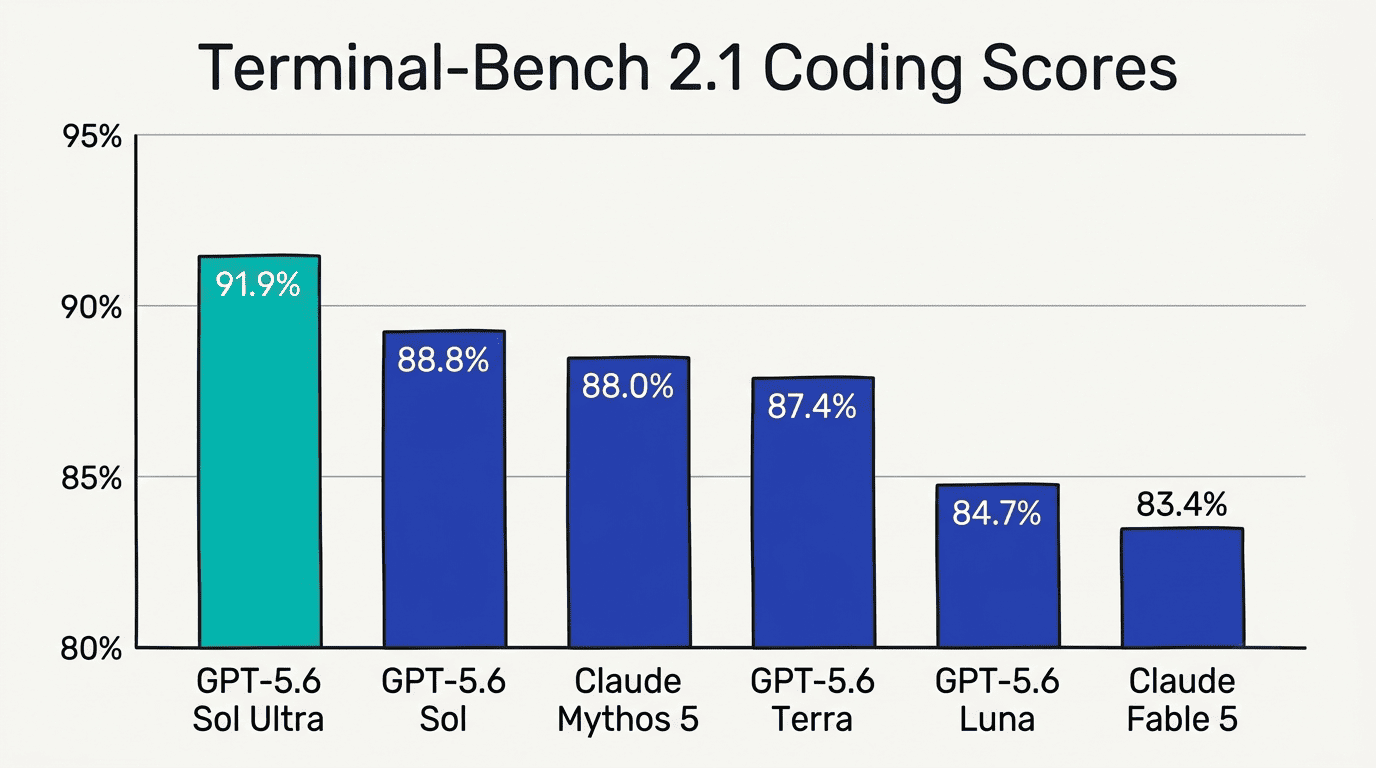
Luna hits near-frontier scores while remaining the cheapest tier in its family. On Terminal-Bench 2.1 (agentic coding) it scores 84.7% versus Sol’s 88.8% and Sol Ultra’s 91.9%. It achieves 92.3% on GPQA Diamond (PhD-level science) and 78.6% on FrontierMath — rivaling models several times its price — and ranks #22 out of 200 on BenchLM’s cross-model index. On SWE-Bench Pro (real GitHub issue resolution) Luna scores 62.7% versus Sol’s 64.6%, with Claude Mythos 5 leading at 80.3%; for complex open-ended engineering, Sol or an Anthropic model may outperform Luna meaningfully. Luna shares GPT-5.6 Sol’s agentic tool-use architecture — both use Programmatic Tool Calling via a V8 JavaScript sandbox — so Luna slots into multi-step agent chains without a separate integration path.
| Benchmark | GPT-5.6 Luna | GPT-5.6 Sol | Claude Mythos 5 |
|---|---|---|---|
| Terminal-Bench 2.1 | 84.7% | 88.8% | 88.0% |
| GPQA Diamond | 92.3% | — | — |
| FrontierMath | 78.6% | — | — |
| SWE-Bench Pro | 62.7% | 64.6% | 80.3% |
| BenchLM Rank | #22/200 | — | — |
Technical Specifications
Luna shares its core architecture with Sol and Terra — the differences are latency, throughput, and price, not context capacity. Context window: 1,050,000 tokens (roughly 750,000 words); maximum output 128,000 tokens per request. Knowledge cutoff is February 16, 2026, and prompts above 272,000 tokens trigger a higher pricing tier. Safety classifications are covered in the GPT-5.6 System Card. Per OpenAI’s model documentation (model ID gpt-5.6-luna), Luna supports text and vision input, function calling and structured output, and both the Responses and Chat Completions APIs. All three GPT-5.6 models — including Luna — support Programmatic Tool Calling, where JavaScript executes in an isolated V8 runtime instead of generating raw JSON per tool call; on tool-heavy pipelines this cuts token consumption by 38–63.5% and reduces latency, a meaningful multiplier on top of Luna’s low base price.
Where to Access GPT-5.6 Luna
Luna is accessible across four surfaces. API access (model ID gpt-5.6-luna in any Responses or Chat Completions call) is the most flexible; rate limits scale by tier from 200 RPM (Tier 1) to 10,000 RPM (Tier 5). ChatGPT Work includes Luna as a selectable model, though it is not in the free consumer app. Codex and GitHub Copilot both support Luna as of July 9 — for teams already in Copilot, switching the coding agent to gpt-5.6-luna is a direct cost reduction with no workflow change.
GPT-5.6 Luna vs Competitors and Siblings
Head-to-head, Luna is about 3× faster than Claude Opus 4.8 and roughly one-fifth the price per token, matching or exceeding Opus 4.8 on GPQA Diamond and Math; Opus 4.8 leads only on SWE-Bench Pro (69.2% vs 62.7%). For high-volume applications where frontier SWE performance is not decisive, Luna is the clear economic choice. Within the family, Luna is the volume play, Terra the versatility play, Sol the capability play — both Terra and Luna outperform Claude Fable 5 at roughly one-sixteenth the cost. See the detailed breakdown in GPT-5.6 Terra for how Terra closes the gap with Sol at 2.5× Luna’s price. Choose Luna when throughput and cost are the primary constraints — large-scale chat, million-document classification, lightweight coding assistance, cacheable RAG systems, content moderation, and structured support routing. Choose Terra for meaningfully better software engineering or a broader task mix; choose Sol for maximum coding intelligence, complex autonomous agent chains, or research-grade reasoning depth.
FAQ
What is the OpenAI Luna model?
The OpenAI Luna model (GPT-5.6 Luna) is the fastest and most affordable tier in OpenAI’s GPT-5.6 family, released July 9, 2026. It costs $1 per million input tokens and is optimized for high-volume, latency-sensitive workloads like classification, chat, and lightweight agent pipelines.
How much does GPT-5.6 Luna cost?
GPT-5.6 Luna costs $1.00 per million input tokens and $6.00 per million output tokens. With prompt caching enabled, cache reads drop to $0.10 per million tokens — a 90% discount for repeated context.
What is the difference between GPT-5.6 Sol, Terra, and Luna?
Sol ($5/M input) is the highest-capability tier for complex reasoning and coding. Terra ($2.50/M) is the balanced middle tier. Luna ($1/M) is the speed-and-cost tier, optimized for high-volume pipelines where latency and economy matter most. All three share the same 1,050,000-token context window.
Is GPT-5.6 Luna available in ChatGPT?
Luna is available in ChatGPT Work (the business tier) but not in the free ChatGPT consumer app. It is also accessible via the OpenAI API, Codex, and GitHub Copilot as of July 9, 2026.
What benchmarks does GPT-5.6 Luna achieve?
Luna scores 84.7% on Terminal-Bench 2.1, 92.3% on GPQA Diamond, 78.6% on FrontierMath, and 62.7% on SWE-Bench Pro. It ranks #22 out of 200 models on BenchLM’s cross-model index.
Is GPT-5.6 Luna better than Claude Opus 4.8?
On GPQA Diamond and most reasoning benchmarks, GPT-5.6 Luna matches or outperforms Claude Opus 4.8 while costing roughly one-fifth the price per token. For pure software engineering tasks on SWE-Bench Pro, Opus 4.8 (69.2%) leads Luna (62.7%).
What is the context window of GPT-5.6 Luna?
GPT-5.6 Luna has a 1,050,000-token context window — shared with Sol and Terra — allowing it to process documents up to roughly 750,000 words in a single API call.