
Agent Keys Macropad: How the Codex Micro’s RGB Status Keys Work
The six Agent Keys on the Codex Micro are not shortcut buttons — they are a live hardware dashboard that shows you exactly what each of your AI coding agents is doing, the moment it changes. Launched by OpenAI and Work Louder on July 15, 2026, this $230 programmable mechanical macropad is the first consumer peripheral built specifically for supervising parallel AI agent runs.
Understanding how Agent Keys work — and what limits them — tells you immediately whether this physical command center for AI agents belongs on your desk.
What Are Agent Keys and How Do They Work
Each of the six frosted translucent keys on the top row of the Codex Micro is bound to one live Codex thread. Unlike the macro keys on a standard programmable pad that fire static keyboard shortcuts, Agent Keys receive data from the Codex platform and change color automatically whenever that thread’s state changes — no developer input required. The hardware reads from OpenAI’s Codex App Server continuously over a bidirectional JSON-RPC interface built on three conversation primitives: an Item (the atomic input/output unit), a Turn (one unit of work per user request), and a Thread (the durable session container). Each Thread carries a live state field; the Codex Micro maps six of those states onto six LEDs in real time.
A single tap on an Agent Key selects that thread in the background. A double-tap brings the Codex window to the foreground. The whole loop is: glance at the key color, tap to unblock the agent, return to your editor — no window switching.
The Five RGB States Explained
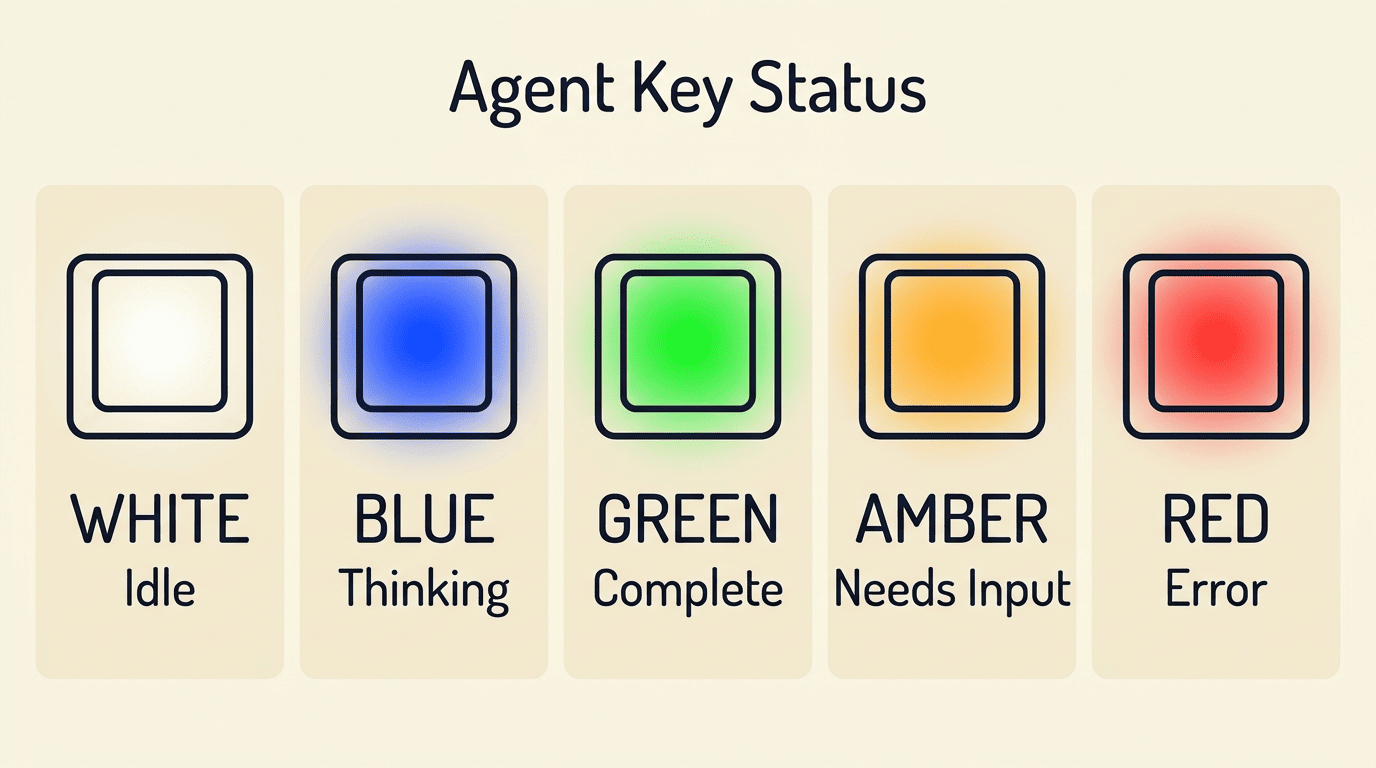
The five active LED states map directly to the Codex thread state machine and are confirmed across all launch coverage:
| Color | State | What it means |
|---|---|---|
| White | Idle | Thread is open, no task running — ready for the next prompt |
| Blue | Thinking | Agent is actively reasoning or executing |
| Green | Complete | Output is ready and waiting for your review |
| Amber | Needs Input | Agent is blocked — approval or clarification required |
| Red | Error | The run failed — check the thread |
Amber is the state the entire device was designed to surface quickly. When a key turns amber, your agent has hit an approval gate and every second you spend unaware of it is dead compute time. The physical command center for AI agents solves that by moving status off your screen and onto your desk, visible in peripheral vision without any context switch.
Architecture: Why This Isn’t Just a Fancy Stream Deck
The Agent Keys work because of OpenAI’s Codex App Server, published in early 2026. A generic macropad or Stream Deck sends HID keystrokes outward to whatever app has focus. The Agent Keys do the opposite — they receive data from Codex and display it. That bidirectional flow is the technical distinction that justifies the $31 premium over Work Louder’s base Creator Micro 2. The device itself does not connect to Codex’s cloud infrastructure directly; a client-side bridge handles that translation, which is also the source of this device’s most important constraint.
The Critical Constraint: ChatGPT Desktop App Required
Before ordering, one fact matters more than any other: the Agent Key RGB feedback only functions if the ChatGPT desktop app is running as the client-side bridge.
The desktop app reads Codex’s live thread states via the JSON-RPC protocol and translates them into LED control signals sent to the Codex Micro over USB or Bluetooth. The device itself has no direct cloud connection. This has clear, binary implications depending on how you access Codex:
- ChatGPT desktop app users → Agent Keys work exactly as advertised
- CLI users → the six top-row keys sit static and dark
- VS Code or Cursor extension users → same: no live status, static keys
- Browser or JetBrains plugin users → no Agent Key functionality
The standard command keys below the Agent row — accept changes, reject, branch thread, push-to-talk, new chat — send normal HID keystrokes and work with any application. But the live agent status display, the feature that defines the Codex Micro’s value proposition over a cheaper agentic coding tool controller, is locked to one client.
ChatGPT Work launched July 9, 2026, merging Codex into the unified ChatGPT desktop app. Developers who updated on or after that date already have the integration in place. If you use Codex through an IDE extension and have no plans to move to the desktop app, the Agent Keys are non-functional by design — not a bug, a structural dependency.
“Codex is designed to handle long-horizon tasks with minimal interruptions, delegating routine implementation to agents while keeping developers in control of approvals and direction.”
OpenAI, Codex product page
Hardware: What You’re Actually Getting
The Codex Micro shares its physical chassis with Work Louder’s Creator Micro 2 — a well-regarded base the company has iterated on for several years at worklouder.cc. The hardware is a known quantity before the Agent Key firmware overlay is even considered:
| Component | Specification |
|---|---|
| Switches | 13 low-profile MX-style, clicky (POM) or silent (POK) |
| Actuation | 40 ± 10 gf, 2.8 ± 0.25 mm travel |
| Durability | 50 million keypresses per switch |
| Frame | CNC polycarbonate with diffused RGB edge lighting |
| Base | Sandblasted anodised aluminium with anti-slip ring |
| Connectivity | Bluetooth Low Energy + USB-C (cable included) |
| Compatibility | macOS and Windows |
| Layers | 6 programmable via Work Louder Input |
| In the box | 32 Codex icon keycaps + 11 solid-color caps, USB-C cable |
The six Agent Keys use frosted shine-through keycaps that diffuse the RGB LEDs into a soft, even glow rather than a harsh point of light — visible in peripheral vision without being distracting on camera. The LED-lit acrylic edge strip around the device also illuminates during push-to-talk sessions, giving a clear visual indicator that the microphone is live.
Rotary Encoder: Reasoning Depth on a Dial
The rotary encoder sits at the top-right and adjusts Codex’s reasoning effort in real time — the same parameter you’d reach via the reasoning slider in the desktop app or reasoning controls in the CLI. Twist clockwise for deeper, more computationally intensive reasoning on complex architectural tasks; counter-clockwise for fast, low-latency completions on simple edits. Making reasoning depth a physical dial means it becomes a continuous, task-sensitive adjustment rather than a set-and-forget configuration that defaults to maximum or minimum for every task equally.
Planar Joystick: Workflow Shortcuts at a Flick
The four-directional planar joystick triggers preset Codex workflow shortcuts. Default directions target the most repetitive agent-supervision actions: reviewing a pull request, debugging an error, refactoring code, and a custom skill slot. The joystick is also clickable and opens a radial menu for additional Codex workflow shortcuts. All four directions are fully remappable through the Input configurator, letting you bind your most frequent actions to a flick of the thumb.
Push-to-Talk and Voice Input
The largest key on the bottom row activates push-to-talk voice input. A double-tap starts recording; the ambient RGB edge shifts to a snaking green pattern to confirm the mic is live. Once you stop speaking, a white effect takes over while Codex processes the voice input, then a solid white cue signals readiness to send. The edge-lighting pattern means you never need to glance at the screen to confirm recording state.
How to Set Up the Codex Micro Agent Keys in 5 Steps
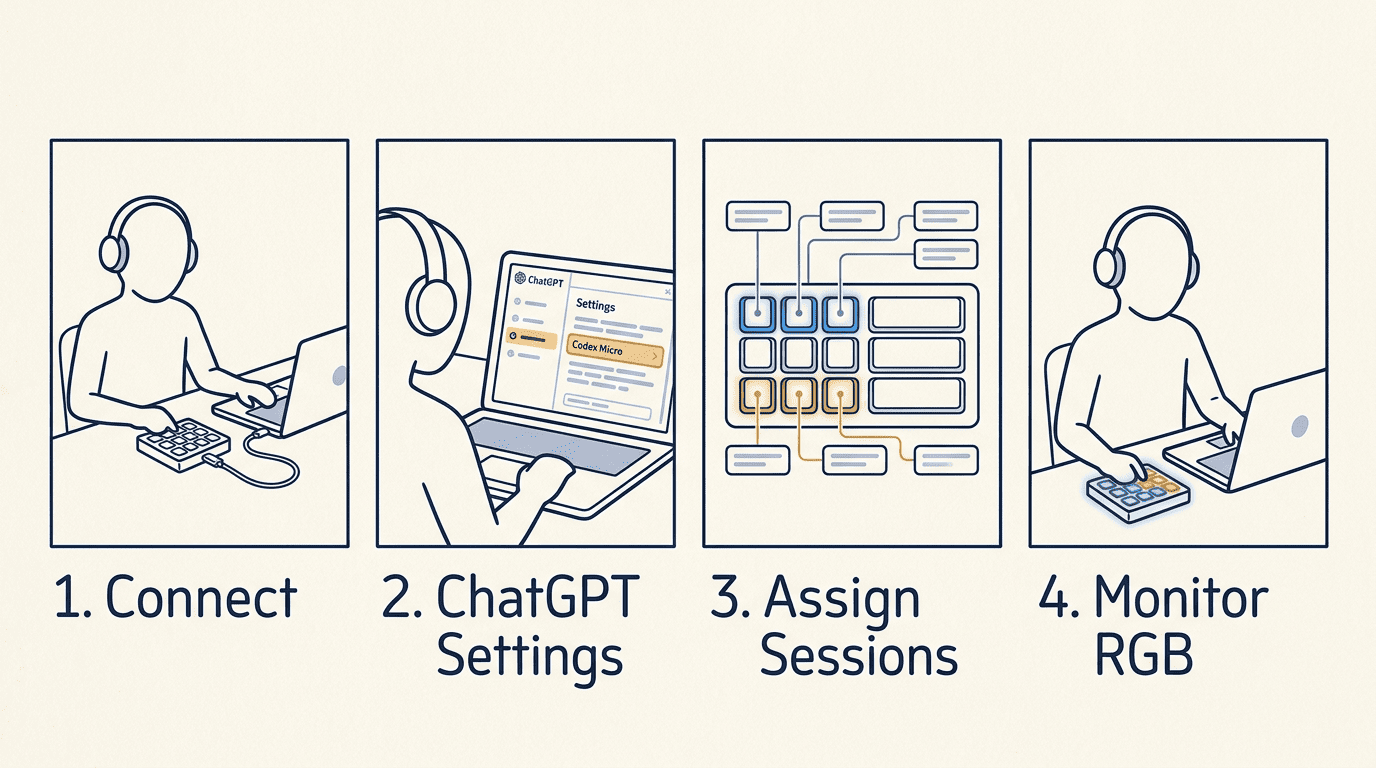
- Install the ChatGPT desktop app (macOS or Windows), version released July 9, 2026 or later — this build includes the Codex thread bridge required by the Agent Keys
- Connect the Codex Micro via USB-C or pair over Bluetooth Low Energy; both methods support live Agent Key status updates
- Open Codex and start a thread — the corresponding Agent Key should immediately shift to blue (thinking) or white (idle), confirming the bridge is active
- Open Work Louder Input to confirm the device is on the Codex layer and to assign any custom skills to the joystick directions or remap the Agent Keys to suit your workflow
- Dispatch parallel agents — start two or more Codex threads and watch each Agent Key track its thread state independently; an amber key means one agent needs your attention now
If a key stays dark after step 3, confirm the ChatGPT desktop app is the active client (not the CLI or browser), and verify the device firmware is on the current version available from Work Louder’s site.
Customization: VIA, Input App, and Layer Remapping
Every key, dial, and joystick direction is remappable through two tools that Work Louder ships with the hardware. The combination covers both quick HID-level remapping and complex multi-layer workflow programming:
- Work Louder Input — proprietary configurator for multi-step macros, per-app layer switching (the device automatically activates a different layer when Codex comes into focus versus when you switch to your IDE), and custom workflow skill assignments
- VIA — open-source GUI built on QMK firmware that enables real-time HID remapping without reflashing firmware, the same system used across the entire Creator Micro line
Six programmable layers are available, which means the developer desk controller doubles as a general-purpose productivity controller for design tools, DAWs, or terminal workflows whenever Codex isn’t in active use. The Codex Icon Keyset ships 32 custom-designed keycaps with Codex-specific icons, plus novelty “yolo” and “yeet” caps that acknowledge the current vibe-coding era, letting you visually match the physical layout to your configured workflow.
The per-app layer switching deserves particular attention for multi-tool developers. The AI agent controller can present one full layout when the Codex window is in focus and a completely different set of bindings the moment you switch to Figma or your terminal. That flexibility makes the $230 easier to justify if you already use a programmable macropad as part of your daily stack.
Codex Micro vs. Creator Micro 2 vs. Alternatives
For developers evaluating options for controlling OpenAI Codex from a physical device, three practical tiers exist — and the differences are sharper than the price gaps suggest.
Codex Micro ($230) is $31 more than the Creator Micro 2. That $31 buys exactly one thing: the live Agent Key firmware integration with Codex’s thread state system. Every other hardware element — chassis, switches, VIA/Input stack, rotary dial, joystick — is identical to the cheaper model. If you use the ChatGPT desktop app and run parallel agents regularly, that premium delivers measurable approval-latency reduction. If you don’t, you’re buying a $230 programmable macropad with a static top row.
Work Louder Creator Micro 2 ($199) is the hardware platform the Codex Micro is built on, minus the Agent Key firmware bridge. For developers not using the ChatGPT desktop app, this is functionally the same device at $31 less. Build quality and the full customization stack are identical. A complete side-by-side of what the base platform gives you is available on our Work Louder review page.
Stream Deck+ / generic macropad ($30–$250) can emulate most Codex Micro controls. A Stream Deck+ profile demonstrated in July 2026 replicates voice input, approval, cancellation, and thread branching. What it cannot replicate is the live Agent Key status display — that requires the proprietary Codex-to-LED firmware bridge built into the Codex Micro hardware. A generic QMK macropad handles key-mapping at £20–30 but delivers no agent observability.
M5Stack Core2 DIY alternative appeared around July 18, 2026, when developer IAMLIUBO released open-source firmware for the ESP32-based M5Stack Core2 touchscreen device that emulates the Codex Micro’s agent-control functions at substantially lower cost. macOS compatibility was confirmed at launch; Windows was anticipated to work but awaited broader community verification at time of writing. For technically comfortable developers, it’s the closest functional alternative to the Agent Keys experience — at the cost of setup time and a less polished physical result.
| Device | Price | Agent Key Status | HID Commands | Desktop App Required |
|---|---|---|---|---|
| Codex Micro | $230 | Yes (6 keys) | Yes | Yes |
| Creator Micro 2 | $199 | No | Yes (remappable) | No |
| Stream Deck+ | ~$200 | No | Yes (profiles) | No |
| M5Stack Core2 DIY | ~$47 | Partial (open-source) | Yes | macOS confirmed (Jul 2026) |
Who Should Buy the Codex Micro Agent Keys Macropad
The buy decision reduces to three questions. Answer each honestly before adding the device to your cart.
Do you use Codex through the ChatGPT desktop app? If no, the Agent Keys are non-functional hardware. The live RGB status display — the entire differentiating feature — does not activate for CLI users, VS Code extension users, or anyone working through a browser. The Codex Micro becomes a $230 programmable macropad. Stop here and consider the Creator Micro 2 or a generic VIA-compatible pad.
Do you run three or more parallel Codex agents regularly? At one or two concurrent agents, checking the app sidebar takes seconds and the marginal value of a dedicated hardware dashboard is low. The approval-latency reduction the AI agent controller promises earns its keep once you’re dispatching multiple agents, switching to other work, and then periodically scanning which threads need attention — frequently enough that the interruption cost adds up.
Do you want out-of-band, peripheral-vision feedback over software status checks? The Agent Keys move status off your screen and onto your desk. A glance at the hardware — not a tab switch, not a sidebar check — tells you which agents need attention. If that matters to your focus strategy at the scale you work, the supervision hardware justifies itself. If you’re comfortable checking a software panel, it doesn’t add enough to be worth the price.
Codex has surpassed 8 million weekly active users, with 5 million reached by early June 2026 and growth accelerating through July. But multi-agent parallel workflows represent a specific usage pattern within that base. The 6-key ceiling is not arbitrary — it maps to the practical maximum of parallel threads a developer can actively supervise without losing track. Teams managing seven or more parallel sessions simultaneously will find the Agent Keys give a partial dashboard rather than a complete fleet supervision panel.