
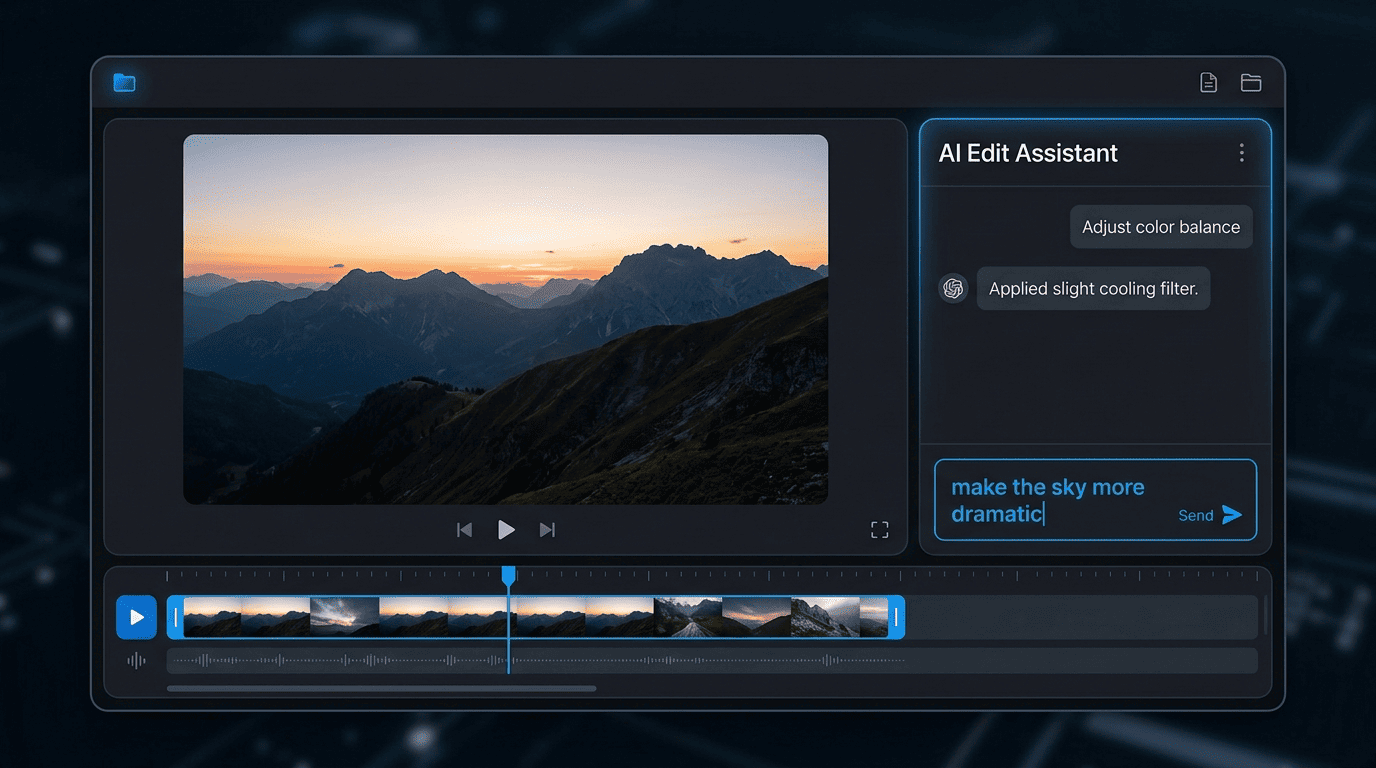
Conversational Video Editing AI: How Multi-Turn Editing Changes Video Creation
Conversational video editing AI lets you refine a video through natural-language chat instead of dragging keyframes on a timeline. You describe a change — “make the sky more dramatic,” “switch the jacket to red” — and the model applies it while preserving everything you didn’t ask to touch. This capability sits at the heart of gemini omni, Google DeepMind’s unified multimodal model announced at Google I/O 2026 and currently the only production system with true multi-turn editing built in.
What Makes Editing “Conversational”
Three properties define it: multi-turn context (the model remembers the previous turn and builds on it), selective preservation (edits touch only what you specified), and a natural-language interface (no parameter panels). Systems that re-prompt from zero don’t qualify — genuine conversational editing requires persistent session state.
Under the hood, Gemini Omni fuses four subsystems: the Gemini reasoning engine (interprets your instruction), Veo rendering (synthesizes 720p video), Genie world-physics simulation (keeps motion physically plausible), and Nano Banana frame-level image editing. A reasoning layer above the renderer turns intent into precise editing operations.
The Interactions API
The official Gemini API exposes editing through an Interactions API endpoint separate from generateContent:
POST https://generativelanguage.googleapis.com/v1beta/interactionsIt supports four task modes — text_to_video, image_to_video, reference_to_video, and edit. The edit task is the conversational mode: each response returns a session ID that carries the latent video forward, so you pass it back with your next instruction to continue the conversation. Output is always a base64-encoded MP4.
Conversational vs. One-Shot Generators
| Feature | Gemini Omni | One-shot generators |
|---|---|---|
| Session memory | Persists across turns | Resets each call |
| Selective editing | Preserves unchanged elements | Full regeneration |
| Audio/speech editing | Withheld (safety) | Varies |
| Multi-turn refinement | Yes | No |
Editing or replacing speech in existing videos is deliberately disabled pending safety testing, to prevent voice-cloning abuse. Every output carries a SynthID watermark that survives compression and re-encoding. For longer narrative productions, Google Flow surfaces the same editing engine with scene-management and shot-continuity tools.
Getting Started
Consumers use Gemini Omni Flash free on YouTube Shorts and the YouTube Create App. Developers get a key from Google AI Studio, then call the Interactions API with model gemini-omni-flash-preview: a text_to_video call opens the session, edit calls refine it. Pricing is $0.10 per second of output — a 10-second 720p clip costs $1.00.
FAQ
How is it different from re-prompting a video AI?
Re-prompting generates a new video from zero. Conversational editing maintains a session: the model knows what it generated before and applies your new instruction only to the elements you specified, preserving everything else.
Can it edit speech in existing videos?
Not currently. The capability exists in the model but is deliberately disabled pending safety testing to prevent voice-cloning and deepfake abuse. All outputs carry SynthID watermarks.
What formats and limits apply?
Gemini Omni Flash outputs 720p MP4 clips up to 10 seconds in 9:16 or 16:9. It accepts MP4/WebM video, JPEG/PNG/WebP images, and text.