
How to Use the chat.z.ai Chatbot: A Practical Getting-Started Guide
Chatbots built on Chinese open-weight models are becoming a serious free alternative to Western tools, and the z ai model family is one of the more capable ones you can try in a browser today. You can open chat.z.ai right now with no install and no signup for a first message. This guide walks through the chatbot step by step — signing up, choosing free vs paid, turning on reasoning, and putting it to work on coding and document tasks.
The free tier is generous enough for most everyday use, and everything runs entirely inside a browser tab, so there’s no software to configure before your first prompt. The chatbot is one product inside the wider z.ai ecosystem, which also covers the GLM model API and developer tools.
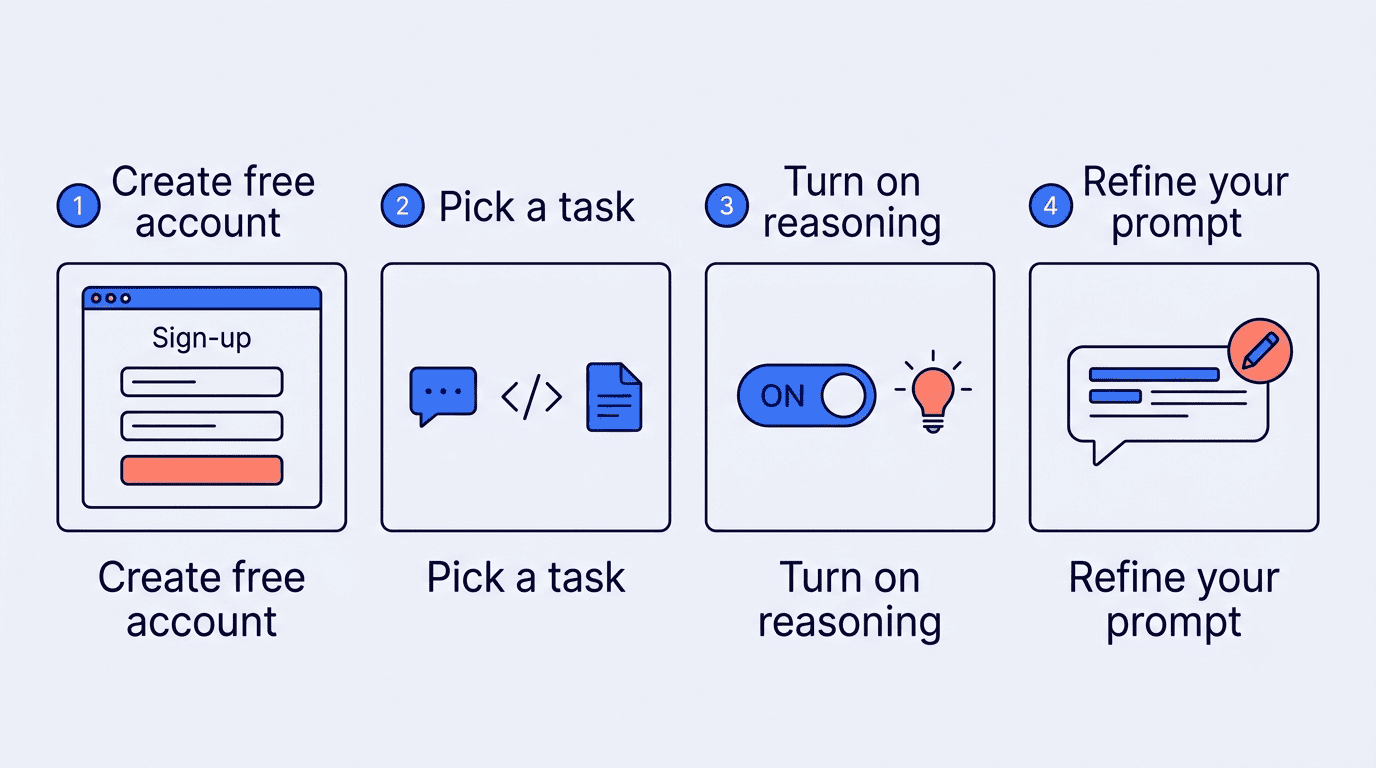
Getting Started: Sign-Up and First Prompt
Before deciding whether to create an account, it helps to know that chat.z.ai deliberately keeps the barrier to entry low — you can judge the tool on a real answer before typing in any personal details.
Try it as a guest first
Go to chat.z.ai and start typing — no account needed for a first conversation. This is the fastest way to judge whether the tone and answer quality fit your task before committing to sign-up.
Create a free account for full features
Sign in with a Google account to unlock conversation history, longer memory across sessions, and access to extra tools. Registration takes under a minute and doesn’t require a phone number. Once signed in, the free tier typically includes:
- Everyday chat, writing help, and quick research questions
- Basic document drafting and summarizing
- Saved conversation history across sessions
- Access to standard (non-Max) thinking mode
Free Tier vs the Paid Coding Plan
What’s included for free. The free tier covers everyday chat, writing help, quick research questions, and basic document work without a subscription. It now runs on GLM-5.2 itself, but rate-limited — fine for casual, everyday use, less so for sustained coding sessions.
When the paid plan makes sense. If your work is coding-heavy — refactoring across many files, working with a large repository, or running long agent sessions — the GLM Coding Plan removes the free tier’s rate limits and adds much higher prompt allowances for GLM-5.2, which reaches 62.1% on SWE-bench Pro, ahead of GPT-5.5’s 58.6% on the same benchmark. Plans start around $18/month for light usage and scale up for teams, as detailed in Z.ai’s official documentation.
| Plan | Approx. price | Weekly prompt allowance | Model access |
|---|---|---|---|
| Free | $0 | Rate-limited everyday use | GLM-5.2 |
| Lite | ~$18/mo | ~400 prompts/week | GLM-5.2 |
| Pro | ~$72/mo | ~2,000 prompts/week | GLM-5.2 |
| Max | ~$160/mo | ~8,000 prompts/week | GLM-5.2 |
| Team | seat-based | Pooled across seats | GLM-5.2 |
Turning On Reasoning (Thinking) Mode
When a question needs multi-step logic — planning, math, or untangling a messy problem — switching on thinking mode changes how the chatbot answers. Instead of producing a response in one pass, the model works through intermediate steps first and only then commits to a final answer, which tends to catch mistakes a faster reply would miss.
There are two levels to choose from. High suits most everyday reasoning tasks, while Max is reserved for genuinely complex, multi-part work where the model needs to backtrack and double-check itself. The trade-off is speed: turning on reasoning makes replies slower and uses roughly 20-50% more tokens than a plain answer. For quick factual questions or casual chat, it’s worth leaving off — you’ll get a faster response with no real quality loss.
To turn it on for a specific question, the steps are the same whether you’re a guest or signed in:
- Open a new or existing conversation in chat.z.ai
- Type your question but don’t send it yet
- Toggle thinking mode on and pick High or Max depending on complexity
- Send the prompt and wait slightly longer for the reasoned answer
- Turn it back off for your next, simpler question to save time and tokens
Coding and Document Tasks with Agent Mode
Writing and debugging code
Paste a function or describe what you need, and the model can write, explain, or debug code directly in the chat window. With the 1,000,000-token context window available on GLM-5.2, it can hold an entire small repository in memory at once, which matters when you’re asking it to trace a bug across several files rather than one snippet.
Generating documents and reports
Switch to Agent mode when you need an actual deliverable — a report, spreadsheet, or slide deck — rather than just an answer in the chat. Agent mode can:
- Produce .docx, .pdf, and .xlsx files directly
- Pull in web search for supporting facts
- Work through a multi-step request without you re-prompting at every stage
| Model | Context window | SWE-bench Pro score | Access |
|---|---|---|---|
| GLM-5.2 | 1,000,000 tokens (up to 128,000-token output) | 62.1% | Free tier (rate-limited) and GLM Coding Plan (higher volume) |
AutoGLM: Taking Actions on Your Phone
What it does differently from chat. Rather than just answering a question, AutoGLM reads what’s on your phone screen and carries out the action itself — tapping through apps to book something, fill a form, or complete a routine multi-app task, based on a plain natural-language instruction. It works across more than 50 supported apps and understands both English and Chinese instructions.
Where it’s most useful. It’s best suited to repetitive multi-step phone chores across supported apps, where describing the goal once is faster than doing the taps yourself:
- Filling out recurring forms across apps
- Booking or scheduling tasks that follow a fixed sequence
- Multi-app routines, like checking one app then acting in another
Under the hood, this kind of automation typically relies on the same low-level interface Android developers use to script a device:
Android Debug Bridge (adb) is a versatile command-line tool that lets you communicate with a device.
Android Developers
Reliability still varies by app, so treat early results as a starting point rather than a guarantee, especially for anything involving payments or irreversible actions.
What to Know Before You Rely on It
GLM-5.2 itself only reads and writes text — screenshots, PDFs-as-images, audio, and video aren’t processed directly. If your task involves visual material, you’ll need a separate vision-capable tool, since a distinct GLM-5V model handles image understanding rather than the main chat model.
Language quality is another thing worth checking before you commit to a workflow. The model performs best in English, with somewhat lower nuance in other languages, and a few interface elements can still show Chinese text even in the English UI. That’s worth keeping in mind for teams doing high-stakes work in other languages, or for anyone comparing it against tools built primarily for one language from the start. The limitations worth flagging are:
- No native image, audio, or video input on the main model
- Noticeably stronger output quality in English than in other languages
- A few residual Chinese-language UI elements even in English mode
- Free-tier access to GLM-5.2 is rate-limited; heavy, sustained coding sessions need the paid Coding Plan
Zhipu AI, the company behind the broader z.ai chat ecosystem, continues to ship updates to the GLM family, so some of these gaps may narrow with future releases — but they’re accurate as of the current version.