
Stream Deck vs AI Macropad: Which Control Surface Is Right for Your Workflow?
Macro pads used to be simple: pick a device with LCD keys, load your OBS profile, and go live. The Codex Micro — OpenAI’s AI keyboard built on the Work Louder Creator Micro 2 chassis — has split the programmable keypad market into two distinct categories. This guide breaks down the full Stream Deck lineup, when it earns its price, when an AI macropad makes more sense, and how to choose based on what you actually do all day.
The quick answer: if you stream, edit video, or want drag-and-drop shortcuts across any app, the Elgato Stream Deck is still the benchmark streaming controller. If you run autonomous AI coding agents for hours at a time, an AI-optimized control surface with RGB status keys and a reasoning dial changes how you interact with your work.
What Is a Stream Deck — and Which Model Is Right for You?
The Elgato Stream Deck family covers five models at distinct price points. Every key is an actual LCD screen — you see the icon, not a label sticker. The drag-and-drop software assigns any action (OBS scene switch, Spotify control, Teams mute, Philips Hue toggle) to any key in seconds, with no scripting required.
The Stream Deck lineup in 2026
| Model | Keys | Price | Best for |
|---|---|---|---|
| Stream Deck Mini | 6 LCD | ~$59 | Entry-level, remote work |
| Stream Deck MK.2 | 15 LCD | $149.99 | Most streamers and creators |
| Stream Deck + | 8 LCD + 4 rotary dials | $199.99 | Audio mixing, video editing |
| Stream Deck XL | 32 LCD | $249.99 | Professional multi-app setups |
| Stream Deck Neo | 8 LCD + 2 touch points | ~$99 | Travel, minimal desk space |
The Elgato Stream Deck MK.2 features 15 customizable LCD keys and sits at $149.99 — the model most buyers land on. The XL’s 32-key grid makes sense only if you’re managing several simultaneous applications and refuse to use folder pages. The Stream Deck + adds four rotary dials for continuous parameter control, which matters for audio mixing and color grading where a dial beats a button press.
What makes LCD keys work
Each LCD key shows your custom icon at a glance — no memorizing which button does what. The folder system nests profiles within profiles, so the physical key count is never actually your ceiling. A single “Going Live” button can switch your OBS scene, start your stream, post a tweet, and send a Discord notification simultaneously. Software stability matters more than key count: a macro pad with flaky software ends up in a drawer regardless of how many keys it has.
Stream Deck vs Macro Keyboard: The Core Difference
Stream Deck emphasizes visual control — each LCD key shows exactly what it does. Traditional macro keyboards use physical switches you learn by feel. Hybrid devices like the Codex Micro combine both approaches: mechanical switches for tactile confidence plus RGB color states for live status feedback.
| Feature | Stream Deck | Traditional Macro Keyboard | AI Macropad (Codex Micro) |
|---|---|---|---|
| Key type | LCD touchscreen | Physical switches | Mechanical + RGB LEDs |
| Visual feedback | Custom icon per key | None (or label stickers) | Color-coded LED states |
| Best use case | Streaming, scene switching, multi-app control | Dev shortcuts, text expansion, layer-heavy workflows | AI agent management |
| Software | Elgato plugin ecosystem (hundreds of integrations) | QMK/Via or proprietary | ChatGPT desktop app |
| Price range | $59–$249.99 | $30–$100 | $230 |
For streaming and live production, Stream Deck’s visible icons win on reliability: you never misfire a scene switch on air because you can see exactly what each key does. For broader productivity, mechanical macro keyboards offer more tactile confidence and are often fully open-source customizable via QMK. For AI coding agent management, neither traditional category solves the core problem — which is where purpose-built AI macropads enter the picture.
Stream Deck and the Plugin Ecosystem
The Stream Deck plugin library is what separates it from cheaper LCD alternatives. Beyond OBS and Twitch, the ecosystem spans nearly every professional application category:
- Creative tools: Adobe Creative Cloud, DaVinci Resolve, Final Cut Pro
- Communication: Zoom, Teams, Discord, Slack
- Audio: Spotify, VOICEMEETER, GoXLR
- Smart home: Philips Hue, Govee, WLED
- Developer tools: GitHub, VSCode macros, terminal shortcuts
Multi-action macros chain multiple commands behind a single keypress. Profile switching maintains separate button layouts for different apps — one profile for OBS, another for Premiere, another for your browser — and the control surface updates automatically when you switch focus. The folder system means physical key count is never the ceiling; you nest additional pages infinitely.
Budget alternatives like the VSDINSIDE M18 offer similar drag-and-drop software at ~$50–60, but with a smaller plugin library and less ecosystem depth. For most people starting out, Elgato’s marketplace breadth justifies the price over a no-name LCD keypad — setup is measured in minutes when your apps are already listed.
Here’s how to set up a Stream Deck from scratch:
- Install the Elgato Stream Deck desktop app (Windows or macOS)
- Plug in your Stream Deck via USB-C
- Open the marketplace tab and install plugins for your apps (OBS, Zoom, Spotify, etc.)
- Drag actions onto keys in the visual editor
- Create folders for each major app or workflow context
- Enable automatic profile switching so layouts change with your active window
- Test each macro before going live — a single misfire during a stream is one too many
Pricing Comparison: Stream Deck vs AI Macropads
The pricing landscape across streaming controllers and AI macropads covers four distinct tiers.
| Device | Price | Keys | Standout Feature |
|---|---|---|---|
| VSDINSIDE M18 | ~$50–60 | 15 LCD + 3 physical | Budget MK.2 alternative |
| Stream Deck Mini | ~$59 | 6 LCD | Cheapest Elgato entry point |
| Stream Deck MK.2 | $149.99 | 15 LCD | Best all-around streaming controller |
| Stream Deck + | $199.99 | 8 LCD + 4 dials | Audio/video mixing |
| Stream Deck XL | $249.99 | 32 LCD | Maximum key count |
| Work Louder Creator Micro 2 | ~$174 | 13 mech + rotary | Open customization chassis |
| Codex Micro | $230 | 13 mech + Agent Keys | AI agent management |
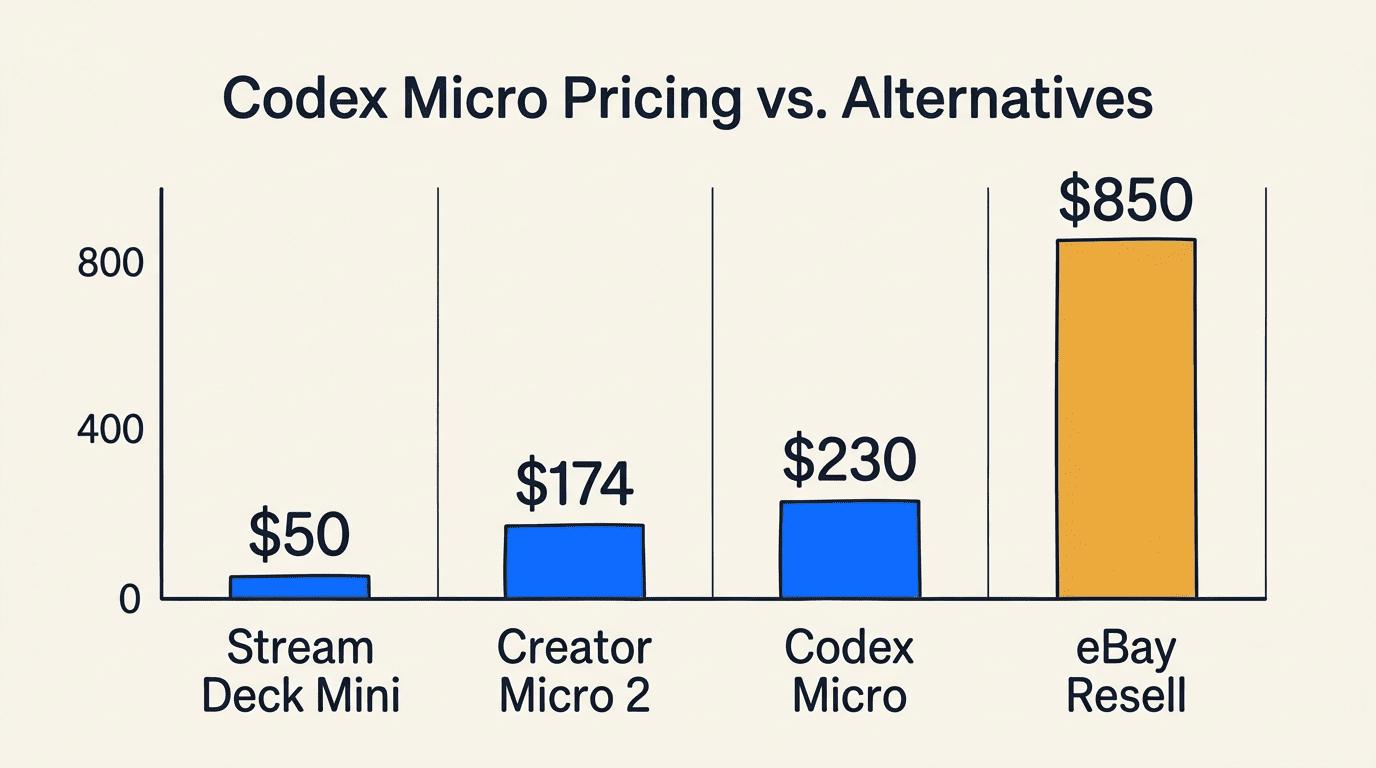
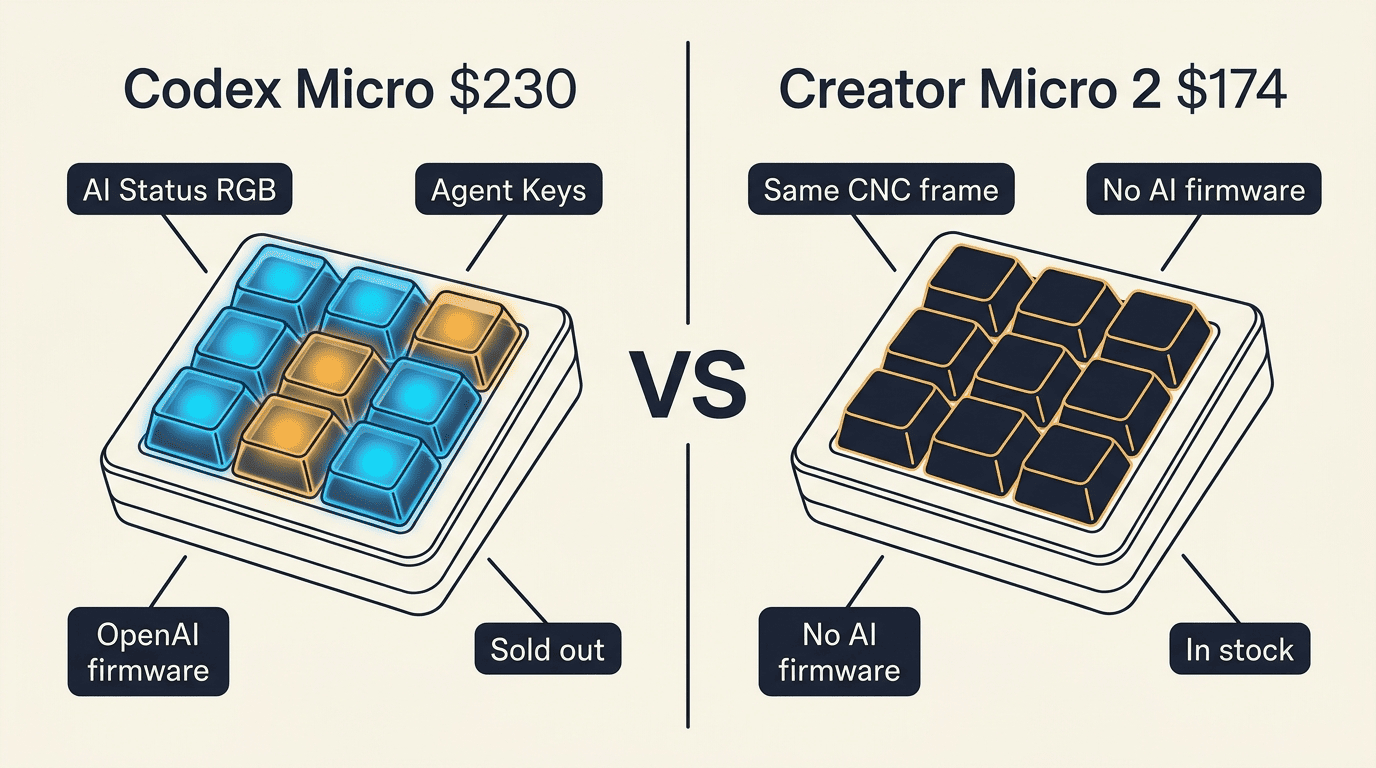
The Stream Deck Mini ($59) is the budget entry into a mature ecosystem. The MK.2 at $149.99 is where most buyers land. Work Louder’s Creator Micro 2 sits at around $174 — the same chassis that underlies the Codex Micro. The Codex Micro itself is $230 for the OpenAI-branded limited run with Codex-specific firmware and Agent Keys.
If your workflow doesn’t involve running Codex agents all day, the $80 premium over a Stream Deck MK.2 doesn’t buy anything actionable. The Stream Deck’s plugin ecosystem covers far more apps and scenarios. If you’re a developer spending 4+ hours daily managing AI coding agents, that gap closes fast when you stop alt-tabbing to check agent status twenty times an hour.
When AI Agent RGB Beats LCD: The Case for Codex Micro’s Agent Keys
The Codex Micro is built on the Work Louder Creator Micro 2 chassis — 13 mechanical switches plus a rotary dial and joystick — but ships with OpenAI-specific firmware that makes it a genuinely different product category. The Codex Micro’s Agent Keys do something no LCD key can do out of the box: they reflect live AI agent state without any clicking required.
Six illuminated Agent Keys change color depending on what your Codex agent is doing — idle, thinking, complete, needs feedback, or erroring out. That color signal replaces the constant alt-tab to check whether your agent is still running or silently stuck waiting for input. On a Stream Deck, you would need to build a custom plugin to pull agent state from an API and update an LCD icon — that integration doesn’t exist as of mid-2026.
The reasoning dial is the other major differentiator. A rotary encoder adjusts Codex’s reasoning intensity in real time — dial up for a complex refactor, dial back for a simple rename — without touching a menu or typing a command. Core Codex Micro actions available from the hardware include:
- Accept or reject code changes without touching a keyboard
- Push-to-talk during agent sessions
- Trigger debug, refactor, and branch thread commands
- Adjust reasoning level via the rotary dial in real time
“The future of developer tooling is ambient — hardware that keeps you informed at the periphery so your focus stays on the problem, not the interface.”
Work Louder — Creator Micro design documentation
The Codex Micro ships in both clicky and silent mechanical variants and connects via Bluetooth or USB-C. Configuration flows through the ChatGPT desktop app rather than standalone software — that dependency on OpenAI’s ecosystem is worth knowing before you buy. For Work Louder’s hardware philosophy and the Codex Micro’s physical design in depth, see the Work Louder hardware overview.
Who Should Buy a Stream Deck (and Who Shouldn’t)
The right choice depends almost entirely on how you spend your working hours, not on which device has more features in a spec sheet.
Buy a Stream Deck if you stream live on Twitch or YouTube, edit video in Adobe Premiere, DaVinci Resolve, or Final Cut Pro, manage Zoom or Teams calls and want one-touch mute and camera toggle, use multiple apps and want visual shortcuts across all of them, or value a mature plugin ecosystem with hundreds of ready-made integrations. The Stream Deck MK.2 carries a 4.8/5 average rating across major retailers — a reflection of how well it fits its intended audience.
Skip the Stream Deck if you spend most of your day running autonomous AI coding agents, need real-time agent state visible at your peripheral without glancing at your monitor, want a reasoning-intensity dial as a first-class hardware control, or are a developer already deep in OpenAI’s Codex ecosystem.
For AI-agent-heavy developers, the Codex Micro closes the context-switching gap that a Stream Deck leaves open. For everyone else — streamers, video editors, content creators, remote workers — the Stream Deck MK.2’s mature ecosystem and $149.99 price make it the rational first choice among programmable keypads in 2026.
Stream Deck Alternatives: Budget Options Worth Considering
If you want Stream Deck functionality without the Elgato price, several alternatives deliver real value at lower cost points:
- VSDINSIDE Macro Keypad / M18: 15 LCD keys plus 3 physical side buttons, drag-and-drop software, OBS/Discord/YouTube integrations. Around $50–60 — roughly a third of the MK.2 price — with load times testing 20–30% faster than Elgato on some machines. Tradeoffs: lighter build quality, smaller plugin library.
- FIFINE AmpliGame D6: 15 LCD keys with an RGB accent ring, budget pricing, solid OBS integration for entry-level streamers.
- Loupedeck Live S: LED touch buttons combined with dials, 200+ plugins, strong creative workflow support. Better for video editing than live streaming.
- HUION Keydial Mini: 18 programmable keys with Bluetooth wireless — the only mainstream wireless option in this category, ideal for desk setups where cable management matters.
Budget alternatives cut the right corners — case quality, brand polish — without losing core functionality. They won’t match Elgato’s ecosystem depth or long-term software support, but for a first setup or light use, they deliver real value at a fraction of the cost. The VSDINSIDE M18 in particular is a legitimate budget alternative that deserves serious consideration before spending $150 on a Stream Deck MK.2.