
Kimi K3: Moonshot AI’s 2.8-Trillion-Parameter Open Model, Explained
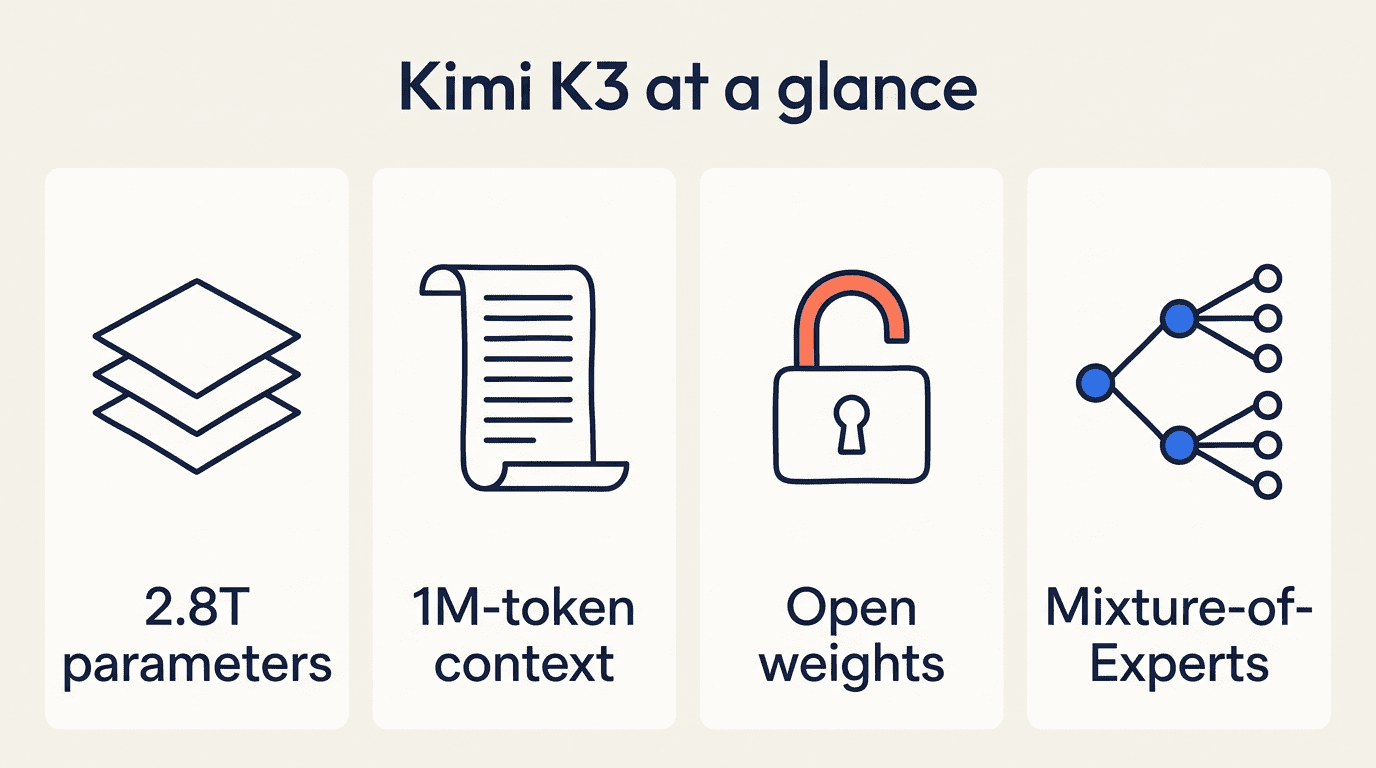
When people search “Kimi 3” they mean Kimi K3 — Moonshot AI’s flagship large language model, launched July 16, 2026. According to Moonshot AI’s official announcement, Kimi K3 is a Mixture-of-Experts system with roughly 2.8 trillion total parameters and a 1-million-token context window, making it the largest open-weight model available today.
Moonshot says K3 still trails Anthropic’s Claude Fable 5 and OpenAI’s GPT-5.6 Sol overall, but beats Claude Opus 4.8 and GPT-5.5 on some coding and agent benchmarks — at a fraction of the price. This guide covers what the model is, how it performs, what it costs, and where to try it.
What Is Kimi K3?
The model and who built it
Kimi K3 is Moonshot AI’s most capable flagship to date, launched July 16, 2026 as the successor to the Kimi K2 family, which included:
- Kimi K2, the original release
- Kimi K2.5, a mid-cycle update
- Kimi K2.6, a further refinement
- Kimi K2.7 Code, a coding-focused variant
Moonshot AI is a Beijing startup founded in 2023, best known for the Kimi chatbot and for releasing K2 under a Modified MIT license. That earlier open-weight move is part of why K3’s launch drew attention: it’s the same company doubling down on giving away model weights while competitors keep theirs closed.
The company has grown quickly around that bet. Moonshot AI raised a Series C round in January 2026 at a $4.3 billion valuation, then closed a further $2 billion round in May 2026 at a $20 billion valuation, with annual recurring revenue reportedly above $200 million.
Two variants at launch
K3 shipped in two flavors: K3 Max, tuned for chat and agent tasks, and K3 Swarm Max, built for large-scale parallel processing. Both went live first on Kimi Code and inside the Kimi app, including iOS. Early enterprise adopters cited in coverage of the launch include:
- Cursor, which integrated Kimi models into its Composer 2 agent
- DoorDash, an existing Kimi user ahead of the K3 rollout
- Thinking Machines, another early adopter of Moonshot’s models
Each of these had already used earlier Kimi models before K3 shipped, which shortened their path to testing the new flagship.
Kimi K3 Specs and Architecture
Kimi K3’s headline numbers are its parameter count and its context window, but the architecture underneath is what makes those numbers usable on real hardware.
Parameters and context window
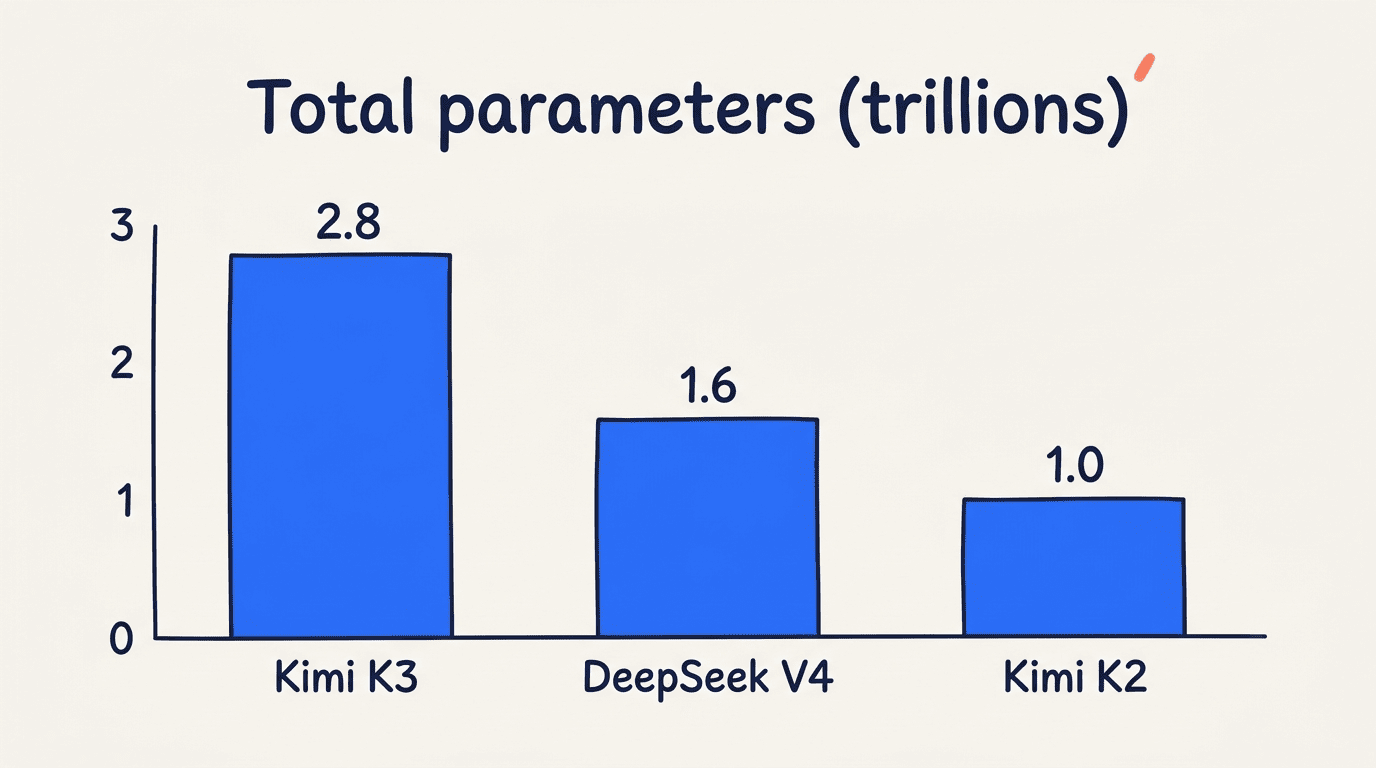
Kimi K3 packs 2.8 trillion total parameters — the largest open-weight LLM available at launch, though Fortune’s coverage cited a slightly lower figure of 2.7 trillion. Alongside that scale sits a 1-million-token context window with native visual understanding, letting a single prompt hold a whole codebase or a book-length document without chunking.
Moonshot has not disclosed how many of those 2.8 trillion parameters are active per token, which is the figure that actually determines inference cost and speed. The specification table below summarizes the numbers Moonshot has confirmed publicly.
| Spec | Kimi K3 |
|---|---|
| Total parameters | ~2.8 trillion |
| Context window | 1,000,000 tokens |
| Attention mechanism | Kimi Delta Attention (KDA) + Attention Residuals |
| MoE framework | Stable LatentMoE, 16 of 896 experts active per token |
| Vision support | Native |
| Scaling efficiency vs K2 | ~2.5x |
| Variants | K3 Max, K3 Swarm Max |
The new architecture: KDA + LatentMoE
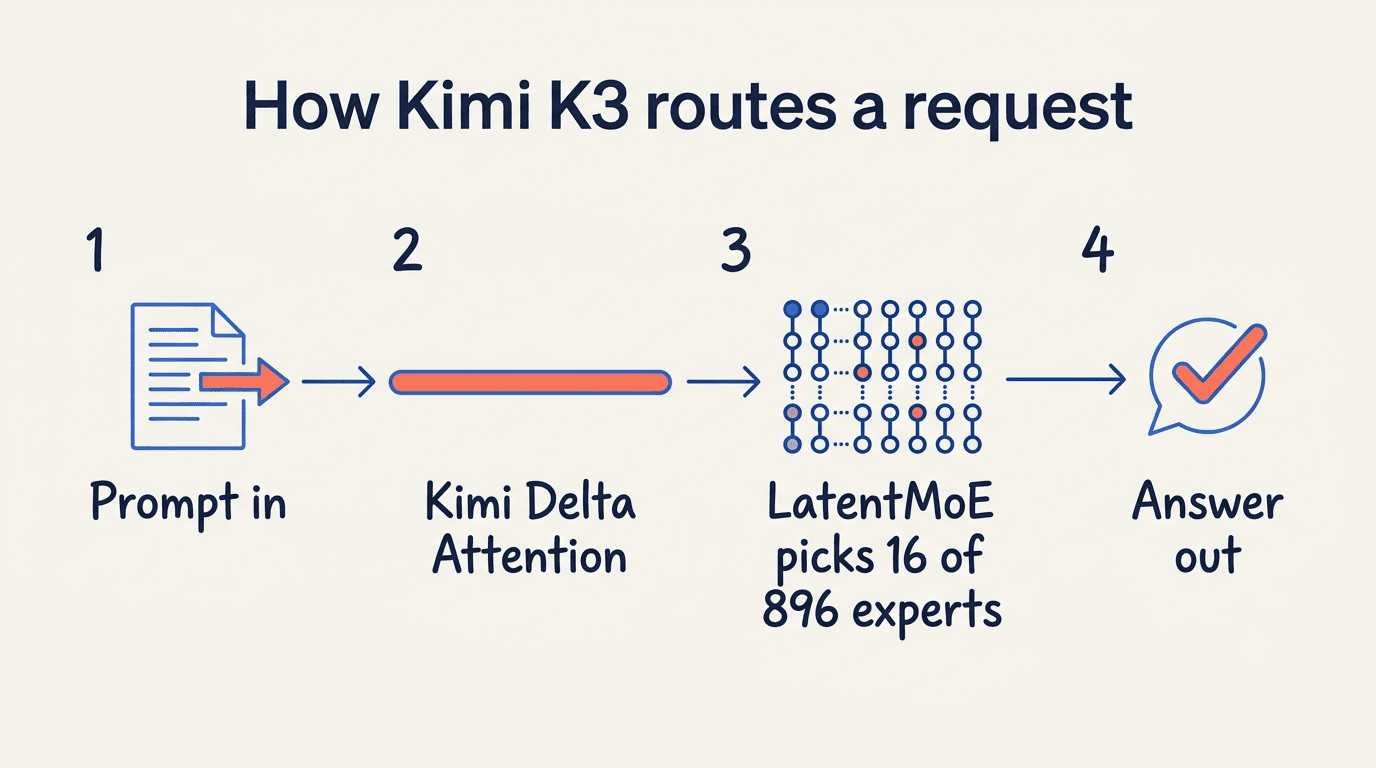
Kimi K3 is built on Kimi Delta Attention (KDA), a hybrid linear attention mechanism, combined with what Moonshot calls Attention Residuals. On top of that sits the Stable LatentMoE framework — a refinement of the sparse Mixture-of-Experts design used across most large models today — which activates just 16 of 896 experts per token rather than running the full parameter count on every request. Together, these two design choices give K3 roughly 2.5 times the scaling efficiency of K2 — turning limited compute into usable capability under the export restrictions that constrain access to cutting-edge chips in China.
That efficiency framing matters more for Moonshot than for most Western labs. Chip export controls limit how much raw compute a Beijing-based company can buy, so squeezing more capability out of the same hardware budget is less an optimization and more a survival requirement for staying competitive with better-funded rivals.
How Kimi K3 Performs vs Claude, GPT and DeepSeek
Benchmark comparisons are the part of any new-model launch that readers care about most, and K3’s are mixed on purpose: strong in some areas, behind in others.
It trails the two current leaders overall. On Moonshot’s own published benchmarks, K3 trails Claude Fable 5 and GPT-5.6 Sol in general capability. Moonshot doesn’t dispute this — the company frames K3 as closing the gap rather than leading outright.
It beats Opus-class and GPT-5.5 on coding and agents. The same benchmark set shows K3 “substantially outperformed” Claude Opus 4.8 and GPT-5.6 Sol’s sibling model GPT-5.5 on coding tasks and general agent workloads, and performed “competitively” with Fable 5 on a subset of tests. Independent testers who got early access have placed its practical coding performance around Opus 4.8’s level.
The numbers come with a caveat. These benchmarks were curated and run by Moonshot itself. Independent evaluations on standard suites such as SWE-Bench Verified and Terminal-Bench 2.1 are still pending until the open weights are released, so the comparison should be treated as directional rather than final. DeepSeek V4, another Chinese open-weight model frequently benchmarked alongside K3, runs at roughly 1.6 trillion parameters — smaller than K3 but priced far lower.
Kimi K3 is our most capable open-weight model to date, built to close the gap with closed frontier systems at a fraction of their cost.
Moonshot AI, official K3 announcement
Reaction beyond the benchmark tables was immediate in Chinese markets on the day of K3’s announcement:
- Z.ai shares fell almost 30% in Hong Kong trading
- MiniMax shares dropped about 16%
- Nvidia dipped around 2%
- Japan’s Nikkei closed down 4%, and Taiwan’s market fell more than 6%, on renewed efficiency concerns
Kimi K3 Pricing and Open Weights
API price
Kimi K3’s API is priced at $15 per million output tokens, $0.30 per million cache-hit input tokens, and $3.00 per million cache-miss (standard) input tokens, on a flat pay-as-you-go basis with no context-length tiering. That’s expensive by Chinese standards — z.ai’s GLM-5.2 costs $4.40 per million output tokens and DeepSeek V4 costs $0.87 — but it remains far below Claude Fable 5’s $50 per million output tokens.
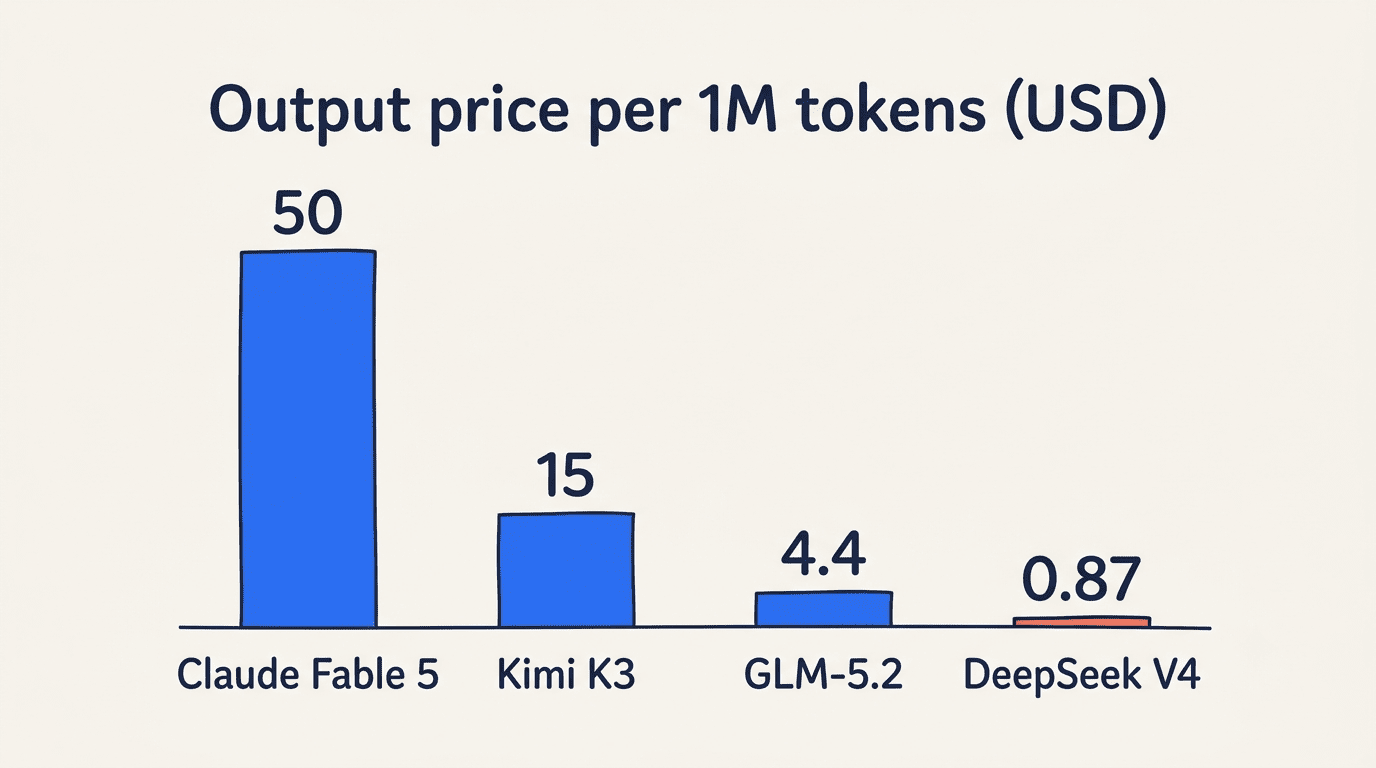
Flat, non-tiered pricing also simplifies budgeting for teams building on the API: a long-context request that fills the full 1-million-token window costs the same per token as a short one, unlike providers that charge more once a prompt crosses a length threshold.
| Model | Output price (per 1M tokens) |
|---|---|
| Claude Fable 5 | $50.00 |
| Kimi K3 | $15.00 |
| GLM-5.2 (z.ai) | $4.40 |
| DeepSeek V4 | $0.87 |
Open weights on July 27, 2026
Kimi K3 is an open-weight model. Moonshot has said full weights will ship by July 27, 2026, following the Modified MIT license precedent it set with K2. Once the weights are downloadable, enterprises will be able to fine-tune K3 on their own infrastructure — the same dynamic that helped Meta’s Llama models become a default choice for in-house deployments.
Three ways individuals and teams can pay for access exist side by side:
- Pay-as-you-go API billing at the per-token rates above
- A ¥199 monthly subscription for app-only access, no API required
- Self-hosting the open weights for free once they ship on July 27, 2026
Where and How to Try Kimi K3
Getting hands-on with Kimi K3 doesn’t require API access — most of the surfaces below are free to open in a browser.
- Open kimi.com in a browser to try K3 in Moonshot’s web chat interface.
- Install the Kimi app on iOS (or use the web version) for the same model on mobile.
- Try Kimi Code if the task is a coding or agent workflow rather than open-ended chat.
- Try Kimi Work for document- and workspace-oriented tasks.
- Sign up for API access at the developer platform — new registrations are currently open.
- Point an OpenAI-compatible SDK at Moonshot’s endpoint, setting
model="kimi-k3"andbase_url="https://api.moonshot.ai/v1". - Leave thinking mode on — it’s enabled by default on K3 and can’t currently be toggled off.
Everything from step 5 onward uses the same API key and billing as the pricing table above, so testing through the SDK is the fastest way to compare K3’s real output against whatever model a team is already running in production.
Kimi K3 vs Kimi K2: What Changed
Side-by-side
The Kimi K2 family — spanning K2, K2.5, K2.6, and K2.7 Code — ran at 1 trillion total parameters with 32 billion active per token, a 256,000-token context window, and a Modified MIT license. Kimi K3 roughly triples the total parameter count to 2.8 trillion, quadruples the context window to 1 million tokens, and replaces K2’s attention design with the new KDA-plus-LatentMoE architecture aimed specifically at long-horizon agent workloads.
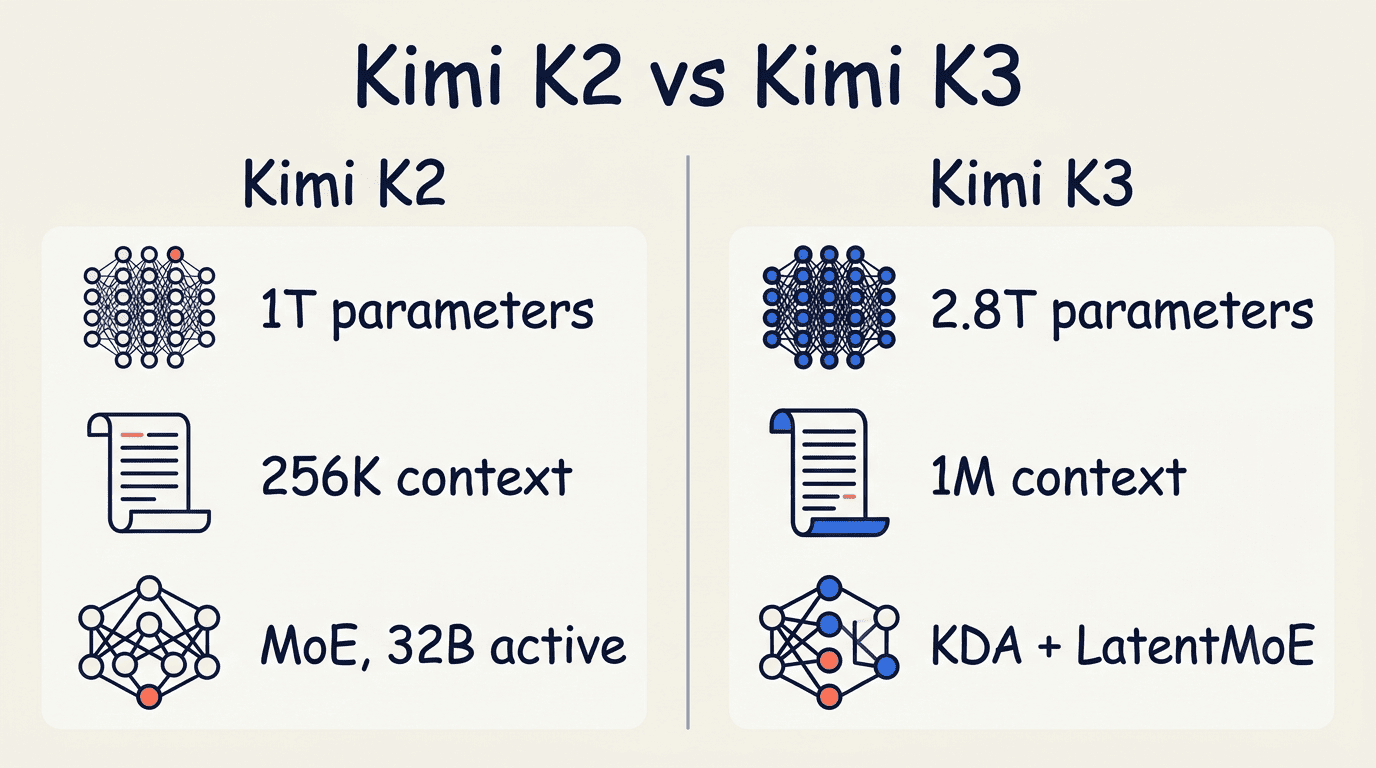
It’s a jump in both raw scale and context length, not a straight scale-up of the same architecture — which is also why Moonshot describes the efficiency gain as roughly 2.5x rather than purely a function of size.
For anyone already running K2 in production, the practical upgrade path is the model name and the context-window ceiling: existing OpenAI-SDK-compatible integrations mostly need only a model="kimi-k3" swap, though prompts built around K2’s 256K-token limit can now be redesigned around a much larger working context.