
Open Weight vs Open Source AI Models: What’s Actually the Difference?
“Open source” has become the default label for any AI model you can download, but most of them are only open-weight. A model like Moonshot’s Kimi K3 is a headline example of an open-weight release — the weights are public, the training recipe is not. The distinction decides what you can inspect, reproduce, modify, and legally ship, and the Open Source Initiative has spent years trying to pin the line down precisely.
What “Open Weight” Actually Means
An open-weight model publishes the trained parameters as downloadable files, usually in the .safetensors format. Anyone can pull them from a repository and put them to work without ever seeing how the model was built.
What You Get
Once you have the weights, a working model is genuinely yours to run. Tools like Ollama, llama.cpp, vLLM, and SGLang exist specifically to serve these downloadable-weights models without needing any of the hidden training infrastructure behind them.
In practice, an open-weight release lets you:
- Download the model and run inference locally, offline
- Fine-tune it on your own dataset
- Quantize it to fit on a laptop or a single GPU
- Deploy it on your own hardware or private cloud
- Modify its behavior through adapters, LoRA, or prompt tooling
What Stays Closed
What you cannot do is rebuild the model from scratch, because the training code, the filtering pipeline, and the dataset itself stay private. The models most commonly cited as open-weight examples follow this exact pattern:
- Llama
- Mistral
- DeepSeek
- Qwen
- Gemma
The Wikipedia entry on the Llama language model documents how Meta has published weights for each generation while keeping the training pipeline closed.
What “Open Source AI” Actually Means
Open source AI goes further than a weights file — it asks for the full recipe. The Open Source Initiative published version 1.0 of the Open Source AI Definition on October 28, 2024, requiring four freedoms: the right to use the system for any purpose, to study how it works, to modify it, and to share it with others, with or without modifications.
Meeting those freedoms means providing the “preferred form for making modifications,” not just the finished parameters. That includes data information (what shaped the training set and how), the training and inference code, the tokenizer, and the architecture details, alongside the parameters themselves. Full large language models built this way are rare, because the bar sits far above dropping a weights file on a hosting platform.
Side-by-Side: The Real Difference
The clearest way to see the gap is to line up what each category actually hands you.
| What you get | Open-weight model | Open source AI |
|---|---|---|
| Downloadable parameters | Yes | Yes |
| Model config and tokenizer | Yes | Yes |
| Inference code / examples | Usually | Yes |
| Training code | No | Yes |
| Training data information | No | Yes |
| Data filtering / processing pipeline | No | Yes |
| Full reproducibility from scratch | No | Yes |
| Unrestricted modification rights | Depends on license | Yes |
Open weights give you access: a working model you can run, tune, and ship. Open source AI gives you agency: the ability to understand why the model behaves the way it does and to reproduce or audit that process yourself. Most releases marketed as “open” stop at the first row.
Why Most “Open Source” Models Are Only Open-Weight
Training runs for a frontier model routinely cost tens of millions of dollars, and the datasets behind them mix scraped, licensed, and proprietary content that a lab cannot simply republish without legal exposure. That combination — cost plus data provenance — is why almost every model marketed as “open source,” including Llama, DeepSeek, Qwen, and Gemma, is technically only open-weight.
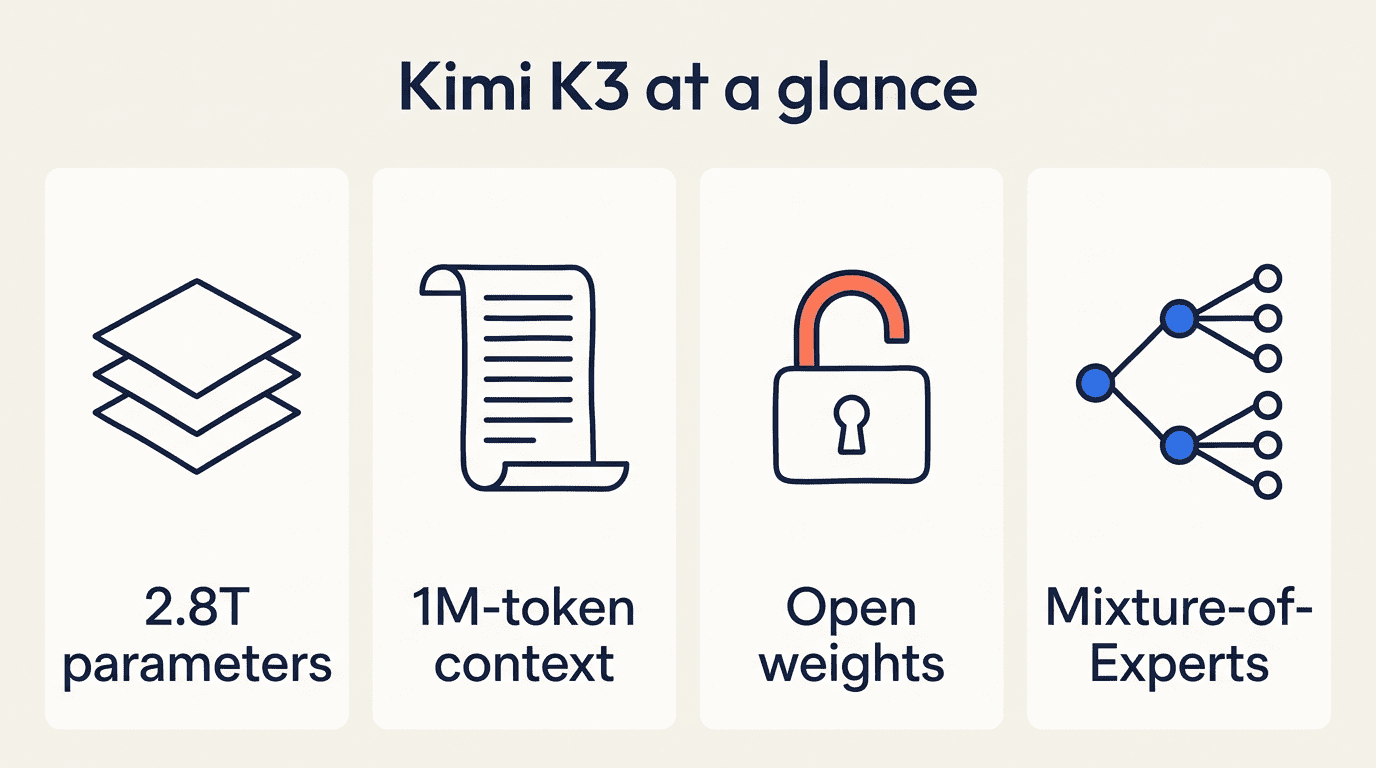
Full transparency threatens competitive position, not just legal footing. Publishing the exact data mixture and filtering pipeline hands competitors a recipe that took months of experimentation to refine, so labs release the output and keep the process. Many of these open-weight flagships also lean on a mixture-of-experts architecture to keep inference costs down at scale, a design choice worth understanding on its own before comparing model families. Moonshot AI, the lab behind Kimi K3, is one of several companies now shipping flagship-scale open-weight models rather than fully open source ones, following the same pattern as its peers.
The Open Source Initiative’s own FAQ on the definition explains why a weights file alone was never going to qualify:
The preferred form for modifying an AI system includes: the software used to create the dataset, the software used to train the system, the results of the training (i.e., the parameters), and all legally shareable data used in the training process.
Open Source Initiative
What the License Really Decides
Downloadable does not mean unrestricted. The license attached to a model’s weights determines what you can legally do with output, redistribution, and commercial deployment — and it varies far more than the “open” label suggests.
The MIT License and Apache 2.0 are permissive licenses: they place almost no restrictions on commercial use, modification, or redistribution. Many flagship releases instead ship under custom or “community” terms, and Meta’s Llama license is the clearest case — it caps free commercial use at 700 million monthly active users and blocks a handful of specific use cases outright.
Those custom terms typically fall into a few recurring categories:
- A scale threshold (a user or revenue cap above which a separate agreement is required)
- A competitor-use restriction (banning use in products that compete with the vendor)
- A ban on using the model’s output to train rival models
- A branding requirement (naming or attribution rules for derivative products)
| License type | Commercial use | Redistribution | Example |
|---|---|---|---|
| MIT / Apache 2.0 | Unrestricted | Unrestricted | Mistral (some releases) |
| Custom “community” license | Capped by scale or use case | Allowed with conditions | Llama |
| Restricted / gated weights | Requires approval or agreement | Limited or prohibited | Some research-only releases |
Those custom terms are what people mean by “restricted weights” or “source-available” models — downloadable, but gated by an acceptable-use policy rather than a standard open license.
How to Check a Model Card in 30 Seconds
Before assuming a release is open source, run through four questions on its model card.
- Can I download and run the weights on my own hardware without a paid API?
- Can I inspect how the model was trained — the code, not just a summary blog post?
- Do I know what data shaped the model, in enough detail to understand its behavior?
- Can I modify the model and share my modified version without asking permission?
A “yes” to question one alone means open-weight. A “yes” to all four is what actually qualifies as open source AI under the OSI’s definition, and few releases clear that bar today.